Key takeaways
- In the idealised model, bare flat silicon has a mean reflectance (400 to 1,100 nm) of 30.9%. Pyramids alone give 9.3%. A 75 nm film gives 7.7%. Both together give 1.2%.
- Under module glass, silicon sits behind encapsulant. Its bare reflectance is 16.0% in the model. The best film index rises from 1.87 to 2.29.
- A bare air-glass surface reflects 4.34% at normal incidence (index 1.526). A quarter-wave layer of index 1.29 leaves 0.19% at 600 nm. Averaged over 400 to 1,100 nm, it leaves 0.98%.
- Glass coatings are the weak point for lifetime. A DuraMAT page says the PV community does not know how long they last.
- Design tools handle glass coatings through the angle loss (IAM), not through a coating setting.
PVsyst and pvlib document a glass coating setting, and the three other tools we read do not state one. To compare simulation tools, see the best solar simulation software.
Anti-reflection coating at a glance
An ARC lowers reflectance. That is the share of light that bounces off. More light then reaches the cell. It works by interference. The film is one quarter of a wavelength thick.
| Item | Detail |
|---|---|
| Formula | Ideal film index n1 = √(n0 × n2). Thickness d = λ0 ÷ (4 × n1). Here n0 is the index above, n2 the index below and λ0 the design wavelength. The notation is ours. PV-Manufacturing.org and PVEducation give the same rules in words. |
| Unit and range | Reflectance in per cent. Bare silicon reflects over 30% (PVEducation). A bare glass surface reflects 4.34% in our arithmetic with index 1.526. |
| Where it matters | Cell design, module glass choice, yield models (angle loss), cleaning and ageing questions. |
| Standard or rule | None quoted here. The REC datasheet read prints the wording "anti-reflective surface treatment" and no reflectance or transmittance value. |
| In software | PVsyst and pvlib name a glass coating. Most design tools carry it only inside the module’s angle-loss data. |
Why anti-reflection coating matters for installers
Reflected light never becomes current. So coatings sit behind the efficiency and angle-loss figures you compare. You rarely choose a cell coating. You do choose modules, glass and cleaning methods.
Nameplate power is measured on the finished module (standard test conditions). Its coatings are already in the rating. The angle effect is separate. The IAM page covers it, with measured values for coated and uncoated glass. For cells, see solar cell, PERC and half-cut cells and n-type TOPCon and HJT. For laminate layers, see backsheet and EVA encapsulant. For dirt and cleaning, see soiling.
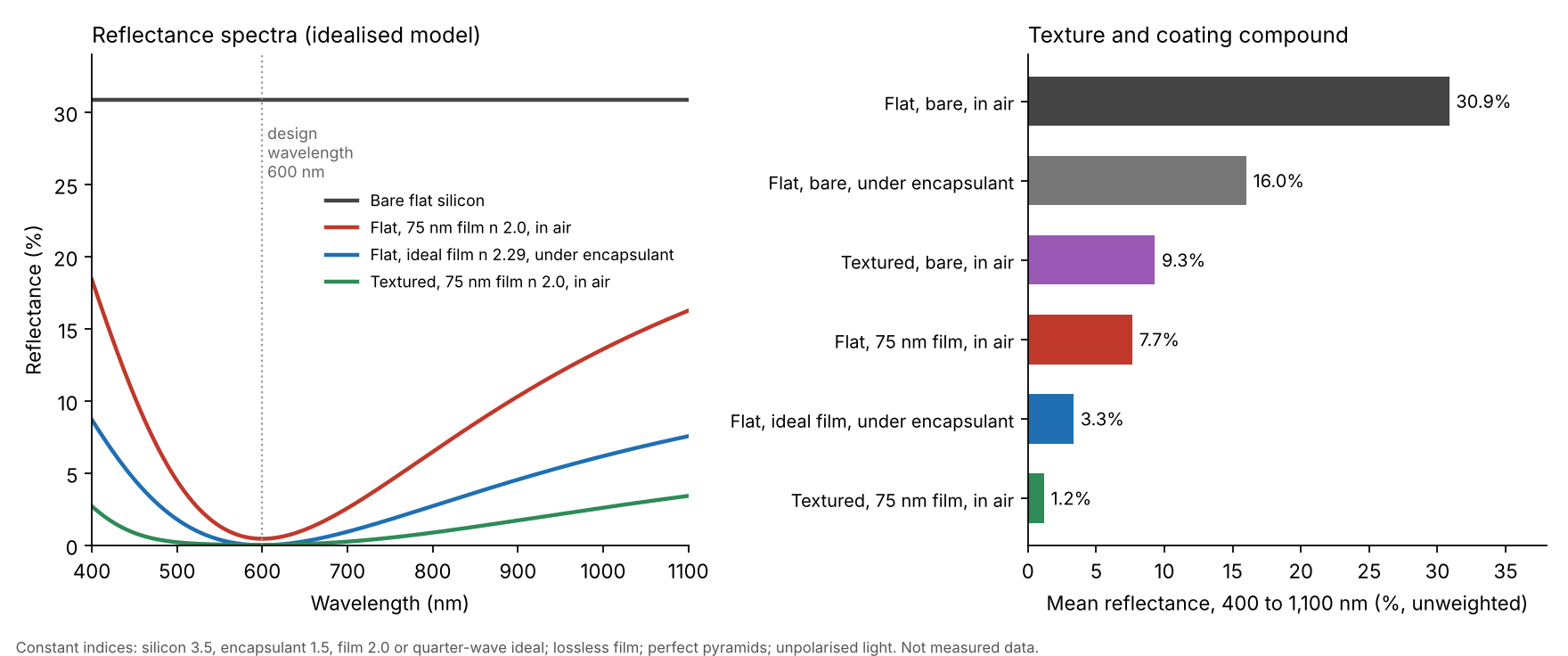
Figure 1. Texture and a coating each cut reflectance, and together they cut it furthest (idealised model, constant indices, not measured data).
How does an anti-reflection coating work?
A film one quarter-wavelength thick makes light from its top and bottom faces cancel. This works at the design wavelength. The cancelling is exact only at that wavelength. Reflectance rises on either side (Figure 1, left).
- Pick the index above the film (n0) and below it (n2). Air is 1.0 and encapsulant about 1.5. PVEducation uses 3.5 for silicon. Sandia PVPMC gives 1.526 for glass.
- Take the square root of their product. That is the ideal film index. For silicon in air, √(1.0 × 3.5) = 1.87.
- Divide the design wavelength by four times that index. At 600 nm, it is 80.2 nm. Both PVEducation and PV-Manufacturing.org use that wavelength.
- Check other wavelengths. One layer cannot be perfect everywhere.
Cells sit under glass and encapsulant. So n0 is about 1.5, not 1.0. PVEducation prints an optimum of 2.2913, which equals √(3.5 × 1.5).
Under encapsulant, our 75 nm film of index 2.0 gives a mean of 4.75%. The ideal 65.5 nm film gives 3.35%. The film tuned for air (1.87, 80.2 nm) gives a mean of 6.44% under encapsulant. The film tuned for encapsulant gives 3.35%.
PV-Manufacturing.org says the layer also cuts recombination at the interface. Its hydrogen can passivate bulk defects. So the layer does two jobs.
What does texturing add?
Texturing roughens silicon into tiny pyramids. Light that reflects once usually hits a second facet. It gets another chance to enter. It uses geometry, not interference, so it works at all wavelengths.
PVEducation says etching along crystal planes makes pyramids. This needs the wafer surface to line up with the crystal. Few grains in multicrystalline wafers line up. Other methods are needed. Texture suits single-crystal wafers best. See monocrystalline versus polycrystalline.
Baker-Finch and McIntosh say normal rays meet a facet at 54.74 degrees. They then meet an opposing facet at 15.79 degrees. In their count, 88.9% of rays bounce twice and 11.1% three times. Our 200,000-ray trace gives 89.1% and 10.9%. It finds the same two angles.
In the model, a flat silicon surface reflects 30.9%. Perfect pyramids reflect 9.3%. PV-Manufacturing.org says texturing cuts reflection to around 15%. Real surfaces sit above the ideal. Pyramids are not perfect and silicon’s index varies.
Glass can be textured too. The TU Delft PV3x course video says a standard sub-millimetre textured surface holds dust more easily. That can outweigh the gain. PVsyst treats "Textured glass" as currently identical to "AR coating".
How do glass coatings differ from cell coatings?
Glass coatings sit on the air side of the cover. The jump from air to glass reflects about 4% there. They face weather, wear and cleaning. Cell coatings sit inside the laminate.
DuraMAT says typical coatings, such as porous silica, sit on the air-glass surface. They raise transmission by about 3%. It says the PV community does not know how long they last. It shows extreme coating loss on a 13-year-old module.
Womack et al. (2019) tested one single-layer sol-gel coating. It cut the reflectance loss at the air-glass interface by 74%. Reflectance rose by 0.6 to 0.9% after 1,000 hours of damp heat. The authors think it is unlikely to last across 25 years.
A pv magazine report (April 2026) on CIEMAT porous silica gives "up to 5.2%" more transmission than bare glass. It does not say if that is relative.
PVsyst’s help says coating lifetime is not well documented. It says PVsyst does not model degradation.
Worked example: reflectance of silicon and glass
These are simple sums with fixed indices. Silicon is 3.5, encapsulant 1.5, and film 2.0 or ideal. The "mean" is an unweighted average over 400 to 1,100 nm. It is not weighted by the solar spectrum.
Table 1. Reflectance of bare silicon (per cent, idealised model, normal incidence).
| Case | At 600 nm | Mean, 400 to 1,100 nm |
|---|---|---|
| Flat, bare, in air | 30.86 | 30.86 |
| Flat, bare, under encapsulant | 16.00 | 16.00 |
| Textured, bare, in air | 9.30 | 9.30 |
Next, the same silicon with a film on top.
Table 2. Reflectance of silicon with a film (per cent, idealised model, normal incidence).
| Case | At 600 nm | Mean, 400 to 1,100 nm |
|---|---|---|
| Flat, 75 nm film (index 2.0), in air | 0.44 | 7.65 |
| Flat, ideal film (1.87, 80.2 nm), in air | 0.00 | 7.34 |
| Flat, 75 nm film (index 2.0), under encapsulant | 1.83 | 4.75 |
| Flat, ideal film (2.29, 65.5 nm), under encapsulant | 0.00 | 3.35 |
| Textured, 75 nm film (index 2.0), in air | 0.02 | 1.18 |
The last row is a floor, not a forecast. It ignores absorption in the film and uses perfect pyramids. Even so, the order holds. Texture and coating each help, and they help most together.
Table 3. One air-glass surface, index 1.526, normal incidence, glass absorption ignored (per cent).
| Surface | Reflectance at 600 nm | Light passing at 600 nm | Mean reflectance, 400 to 1,100 nm |
|---|---|---|---|
| Bare glass | 4.34 | 95.66 | 4.34 |
| Ideal layer (index 1.235, 121.4 nm) | 0.00 | 100.00 | 0.83 |
| Layer of effective index 1.29 (116.3 nm) | 0.19 | 99.81 | 0.98 |
Light passing at 600 nm rises from 95.66% to 99.81%. That is 4.15 points or 4.3% relative. The 1.29 layer cuts mean reflectance by 77.4%. That is the same order as the 74% cut Womack et al. report for their coating. Index 1.29 is the typical value pvlib uses for a coating. It is not a product figure. At 60 degrees the model gives 9.35% bare and 3.52% coated. Coatings help more at low sun.
These are lab-style single-surface gains. They are not yearly energy gains. Those depend on weather, angle, dirt and coating wear. PVsyst’s help gives 0.75% as the energy-yield gap between Fresnel AR coating and normal glass. That is for one Geneva simulation. It states no other conditions.
Calculator: ideal coating and texture estimate
Part A gives the ideal index and thickness for two indices. It also checks a film you enter. Part B estimates pyramid texture on a bare surface.
How solar software handles anti-reflection coating
Only PVsyst and pvlib document a coating setting. PV*SOL, SAM and HelioScope do not. Ratings test whether the coating is documented, not model quality.
| Software | Documents a glass coating setting? |
|---|---|
| PVsyst | Yes |
| pvlib python | Yes |
| PV*SOL premium | Not stated |
| SAM | Not stated |
| HelioScope | Not stated |
Not stated: the page we cite names no coating setting.
- PVsyst: With the default Fresnel IAM, the front surface material list includes "Normal glass" and "AR coating (glass + anti-reflective coating)". It says it does not model coating degradation. Notes: PVsyst help, "Array incidence loss (IAM)", no date shown, checked October 2026.
- pvlib python: iam.physical takes n_ar, "the effective index of refraction of the anti-reflective (AR) coating". Without it no coating is applied. Typical value 1.29. Notes: pvlib 0.16.1 docs, checked October 2026.
- PV*SOL premium: Help page "Reflection in module plane" names no coating. It says IAM at 50 degrees is in the module data and the ASHRAE model is used. Notes: PV*SOL help, no date shown, checked October 2026. An administrator forum reply (16 September 2019) says manufacturers supply the module data.
- SAM: A moderator reply (16 January 2018) says two First Solar modules, one coated and one not, have identical library parameters and so identical results. Notes: Forum thread, not SAM help. A 2012 thread says the Sandia coefficients represent the glass and coatings present. Checked October 2026.
- HelioScope: Loss Factors page has a "Reflection" row, -1% to -5%, "Based on reflection of light from shallow angles". No coating named. Notes: HelioScope help centre, no date shown, checked October 2026.
To compare simulation tools, see our ranked list of the best solar simulation software. See also pvlib.
Common mistakes with anti-reflection coating
FAQs
Why do coated solar cells look blue?
The film is tuned to cut reflection near the middle of the spectrum, so the light that still reflects skews blue. A 75 nm film in our model reflects 0.4% at 600 nm but 18.4% at 400 nm. Sinovoltaics says an uncoated cell is dark grey and the coating thickness changes the colour.
Is texturing the same as an anti-reflection coating?
No. Texture bends light into a second bounce using geometry. A coating cancels reflection by interference. A cell can use both. In the idealised model they give 9.3% and 7.7% alone, and 1.2% together.
Does the coating on module glass wear off?
It can. DuraMAT says the community does not know how long such coatings last. Womack et al. found weathering effects in a sol-gel coating. Rated power is measured on a new module. Wear would show in yield, not on the datasheet.
Do I set a coating in my design software?
Only in tools that offer it. PVsyst has a front-surface material choice and pvlib takes a coating index. PV*SOL, SAM and HelioScope document no coating setting (see the software table). They use a module angle-loss setting instead. See the IAM page.
Related terms
- IAM: how reflection grows at high angles of incidence.
- Solar cell: the junction and layers the coating sits on.
- Solar panel (module): the glass, encapsulant and cells as one product.
Next step: ask the module maker for a reflectance or transmittance test report. Then see how each tool sets glass coating and IAM in the best solar simulation software list.
Sources
All sources checked October 2026. Dates are as the page prints them.
- PVEducation, anti-reflection coatings (no date shown).
- PVEducation, surface texturing (no date shown).
- PV-Manufacturing.org, antireflection coating (published 19 January 2018, modified 14 February 2018).
- Baker-Finch and McIntosh, A freeware program for precise optical analysis of the front surface of a solar cell (PV Lighthouse copy, no date shown).
- Sandia PVPMC, physical IAM model (metadata updated 10 October 2024).
- Sinovoltaics, anti reflective coating (dated 5 October 2011).
- DuraMAT, anti-reflection coatings on module glass (no date shown).
- Womack et al., Surface and Coatings Technology 358, 2019 (sol-gel coating on cover glass).
- pv magazine, porous silica coating (15 April 2026).
- OSTI 1458821, glass coating durability study (NREL/JA-5J00-71853, no date shown).
- TU Delft PV3x, module structure transcript (file name says 2017).
- REC Alpha Pure-R datasheet (reference PM-DS-12-06-REV-/D UL EN 6.2025).
- PVsyst help, array incidence loss (no date shown).
- pvlib 0.16.1, iam.physical.
- PV*SOL help, reflection in module plane (no date shown) and PV*SOL forum, reflection losses (replies September 2019).
- SAM forum, First Solar coated and uncoated modules (replies 16 January 2018) and SAM forum, Fresnel losses (replies March 2012).
- HelioScope help centre, loss factors (no date shown).
Last updated 30 October 2026. Next scheduled review: 30 January 2027.