Key takeaways
- A BoQ gives measured quantities of work for pricing. A bill of materials lists parts to buy.
- Our assumed 655.2 kWp plant needs 10 BoQ lines: 1,092 modules give 147 piles, 9,534 m of DC string cable (single conductors) and 81 m of AC cable.
- Two cable methods agree at 9,534 m. That catches counting slips, not a wrong layout.
- In our assumed plant, pile spacing of 4.0 m instead of 5.0 m adds 42 piles (28.6%). Seven rows of three tables cut DC cable 53.7% but raise AC cable 254.3%.
- RatedPower, PVcase and HelioScope document quantity output. No published wastage standard was found.
To pull quantities from a plant layout in software, see the best utility-scale solar design software.
Bill of quantities at a glance
A BoQ turns drawings into a list that every bidder prices the same way.
| Item | Detail |
|---|---|
| Formula | Net quantity = count or measured length taken from the design. Wastage is shown apart from it in our example |
| Units | no. for items, m for cable and trench, m³ for excavation. No typical quantities are sourced |
| Where it matters | Tender pricing, cost control and checking changes |
| Standard or rule | UK building works: RICS NRM 2, October 2021. Building works only, not shown to apply to solar tenders. No solar-specific standard was found |
| In software | RatedPower, PVcase and HelioScope document quantity output. See the software table |
Why does a bill of quantities matter for installers?
It lets every bidder price the same scope. It also gives the owner a base for checking cost and variations. A missing line is a missing price.
Designing Buildings (a wiki) gives a BoQ as "measured quantities of the items of work identified by the drawings and specifications". For a firm bill, "good financial control should be possible". An approximate bill is "subject to re-measurement", with more cost uncertainty.
An early estimate from a concept layout behaves like an approximate bill (our reading). Re-run the BoQ for each design revision. Priced quantities then feed the capex line. See capex and opex.
How does a BoQ differ from a BoM?
A BoQ lists items of work and materials with measured quantities, so contractors can price it. A BoM lists the parts to buy. Our bill of materials page owns the BoM, its order quantities and its allowances.
The BoQ in our example has lines that are not parts: driven piles, trench excavation and string tests. RatedPower’s glossary page (updated 17 December 2024) also says a BoQ covers the labour a project needs. Tools blur the terms: PVcase’s Bill of Materials export carries piling, cable and grading data.
What sections does a solar BoQ have?
Grouping is the tender’s choice. Our example uses four sections: civil, mechanical, electrical and commissioning.
RatedPower says its BoQ covers main equipment, civil works, electrical systems, monitoring, security and substations. ITI Limited’s price-bid form for a 1,200 kWp plant (undated) has two sections. One has 23 supply-and-install lines. The other has 7 lines, including survey and design and five yearly "CAMC" charges. Piles can sit under civil or mechanical works. The sources do not say which is usual.
The work behind each section has its own page. Cut and fill is in earthworks and grading. Piles are in ground-mount design. Medium-voltage runs are in MV and LV design. Tests are in the commissioning report.
How are quantities measured, and who uses a BoQ?
Measurement follows the rules the tender names. No solar-specific rule set was found, so write the rules into the BoQ itself.
- UK building works: RICS NRM 2, 2nd edition, October 2021, "provides standard detailed rules for the measurement and description of building works". It is effective from 1 December 2021. It defines a BQ as "a list of items that gives detailed identifying descriptions and firm quantities of the work comprising a contract". The BQ "becomes a contract document". Where a row allows a choice of units, the method should "suit the situation". Designing Buildings (a wiki) says NRM 2 "formally replaced" SMM7 on 1 July 2013. The pages cited do not show whether NRM 2 applies to any solar tender.
- India, one form: ITI Limited’s price bid has a quantity of 1 for every line, in units of Set, No or Job. Cable lengths sit in the description, for example "900 meter approx.". It says a deviation from its format may lead to rejection. One undated form is not a rule for India.
- Who prepares it: a cost consultant, often a quantity surveyor, per Designing Buildings. Tenderers price it.
Worked example: a 655.2 kWp ground-mount BoQ
The assumed plant has 1,092 modules on 21 tables. Its BoQ has 10 lines in four sections, with no prices. The layout is a design-stage assumption, and string limits and inverter sizing are not checked. See string sizing and DC to AC ratio.
| Input (all assumed) | Value |
|---|---|
| Strings and tables | 26 modules per string, 2 strings per table, 3 rows of 7 tables: 42 strings, 1,092 modules, 655.2 kWp at 600 W each |
| Table | 30.0 m long, 0.5 m gap between tables |
| Piles | 5.0 m spacing, a pile at each end: 30.0 / 5.0 = 6 spans, so 7 piles per table |
| Inverters | One at the west end of each row, 5.0 m from the first table |
| DC cable | Each string has two leads, one at each table end, run along the row to the inverter, plus a 2.0 m tail per lead |
| AC cable | Row 1 inverter to LV board 20.0 m, row pitch 7.0 m, so runs of 20, 27 and 34 m |
| Trench | DC trench along each row. One AC trench of 34 m. Trench 0.5 m wide, 0.8 m deep |
| Wastage | 5% on cable, 2% spare piles |
| Ref | Item | Unit | Net quantity | With wastage |
|---|---|---|---|---|
| A1 Civil | Piles, driven | no. | 147 | 150 (2%) |
| A2 Civil | Cable trench length, DC and AC | m | 688 | none |
| A3 Civil | Trench excavation volume | m³ | 275.2 | none |
| B1 Mechanical | Tables assembled | no. | 21 | none |
| B2 Mechanical | Modules fitted | no. | 1,092 | none |
| C1 Electrical | DC string cable, single conductor | m | 9,534 | 10,011 (5%) |
| C2 Electrical | AC cable, inverter to LV board | m | 81 | 86 (5%) |
| C3 Electrical | String inverters | no. | 3 | none |
| D1 Commissioning | String tests | no. | 42 | none |
| D2 Commissioning | Inverter commissioning | no. | 3 | none |
We keep the BoQ net and show wastage apart, so every bidder prices the same scope. The BoQ leaves out fencing, roads, earthworks, MV, earthing, monitoring and labels. Prices are blank.
Cross-check on C1, two methods.
- Method A. Adds each string’s two leads: horizontal distance to the inverter plus a 2.0 m tail at each end. One row gives 3,178 m, so three rows give 9,534 m.
- Method B. Multiplies the conductors in each trench segment by its length. For example, 28 conductors over the first 5 m is 140 m. Table k carries 2 + 4 × (7 − k) conductors, and each 0.5 m gap after it carries 4 × (7 − k). Tails add 56 m per row. It also gives 3,178 m per row.
- Result. The two methods agreed exactly on every test layout. Both methods read the same layout, so they catch double counting and slips, not a wrong layout. HelioScope’s help says it does not count the vertical height of field segments in wire length. So the tail is an input to set yourself.
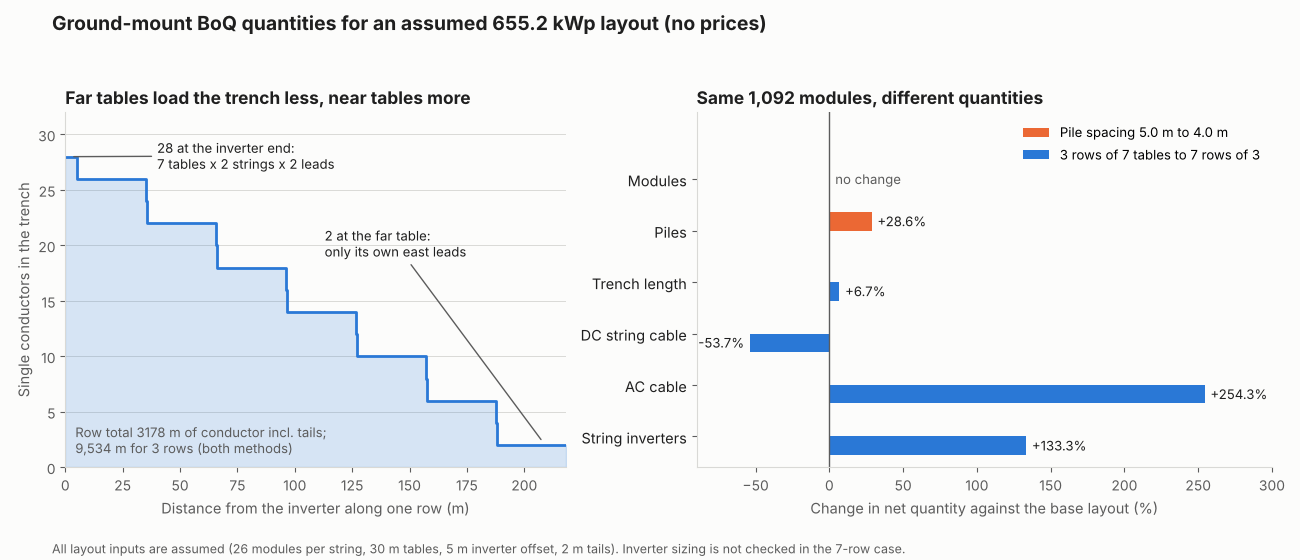
Figure 1. With modules unchanged, a 4.0 m pile spacing adds 28.6% piles and a 7-row layout cuts DC cable by 53.7% while raising AC cable by 254.3% (assumed inputs).
Effect of two layout changes (each against the base). At 4.0 m spacing, 30.0 / 4.0 = 7.5 rounds up to 8 spans. That is 9 piles per table and 189 in all, 42 more. Spacing falls 20%, yet piles rise 28.6%, because spans round up. With 2% spare that is 193 against 150.
Now take 7 rows of 3 tables, one inverter per row. DC cable falls to 4,410 m. AC cable rises to 287 m, inverters to 7 and trench length to 734 m. Piles and modules do not change. Each of the 7 inverters would serve 93.6 kWp, and inverter sizing is not checked here.
Keep DC and AC cable on separate lines, because they are different cable types. For the loss side of cable length, see wire and conductor sizing.
Solar BoQ cable and pile calculator
Use it to re-run the table above with your own layout and wastage. Its first preset reproduces the table, and two more presets reproduce the layout changes. It warns when an input is blank, negative or out of range. A lone "1,234" or "1.000" is read by the number format you choose, and the tool says how it read it. It checks no spans, voltage drop or soil, and holds no prices.
How solar software handles a bill of quantities
Only RatedPower is documented as making a document called a BoQ. Of the 5 tools we read, RatedPower and PVcase give the fullest quantity output, and HelioScope, PVsyst and Aurora Solar give part of it.
| Software | Outputs quantities? | Source and date |
|---|---|---|
| RatedPower | Yes | RatedPower glossary page, updated 17 December 2024. Methodology listed 9 November 2021. Earthworks article undated |
| PVcase Ground Mount | Yes, as a BOM | PVcase help, "Bill of Materials", updated 17 February 2025 |
| HelioScope | Partly | HelioScope help, 9 July 2025. Wire-length article, 4 March 2026 |
| PVsyst | Partly | PVsyst help, installation and operating costs, undated |
| Aurora Solar | Partly | Aurora help, updated 15 April 2026 |
Partly: the page shows some quantities but not a full BoQ. What each page says:
- RatedPower. Its algorithm produces a detailed BoQ covering equipment, civil works, electrical systems, monitoring, security and substations. Its earthworks article says cut and fill volumes go into the Design Report and the BOQ. Export format not stated. The methodology PDF is not cited.
- PVcase Ground Mount. Exports XLSX. With piling information and spot levels switched on, it includes piling (table number, number of poles, coordinates, reveal lengths) and spot levels with earth moved. It also has cable lengths between devices with cross-section, and capacity iterations. Units not stated. Examples in metres.
- HelioScope. A help article covers DC wiring lengths in the Bill of Materials. Lengths use two conductors, in metres in its example. The BOM total matches the report and single line diagram. Resistance loss uses a different total. Only the BOM wire article is cited.
- PVsyst. Component counts update from the simulation into an editable installation-cost list, priced by piece, by Wc or by m². Cabling not mentioned. The pages cited show no BoQ export.
- Aurora Solar. Design Mode downloads a Bill of Materials .csv. Racking parts appear only after a racking app design is saved. Piles and civil quantities are not mentioned on the page cited.
For wider comparisons, read the best utility-scale solar design software and best solar design software for EPCs lists. Layout drives quantities: see utility-scale layout optimisation and site plans.
Common mistakes with a BoQ
FAQs
What goes in a solar BoQ?
Each line needs a reference, description, unit and quantity, grouped by section. Our example has 10 lines in four sections. Tenderers then add rates and amounts.
Does a BoQ include prices?
Not until tenderers price it. The BoQ lists quantities. Tenderers add rates and amounts, per Designing Buildings. ITI Limited’s form leaves its price columns blank.
Can I export a BoQ from design software?
Some tools can. RatedPower documents a BoQ. PVcase and HelioScope document a BOM with piling or wire lengths. Check each export against a hand count, as in the cross-check above.
Should wastage be in the BoQ?
Show net quantities and wastage in a separate column unless the tender sets the rule, so every bidder prices the same scope. The pages cited do not say whether a tender wants wastage in the rate or the quantity. Follow the tender’s stated rules.
Related terms
- Bill of materials: the list of parts to buy, with order quantities.
- Earthworks and grading: the cut and fill that feeds civil lines.
- Capex and opex: where priced quantities end up.
Next step: To price a BoQ, see the best solar estimating software. For ground-mount layouts, see the best utility-scale solar design software.
Sources
- RICS. NRM 2: Detailed measurement for building works, 2nd edition, October 2021 (checked October 2026, extract truncated).
- Designing Buildings. Types of bill of quantities, edited 21 January 2022, and NRM2, edited 30 September 2026 (checked October 2026, a wiki).
- ITI Limited. Price bid form, Appendix-VIII, 1200 kWp solar PV plant, undated (checked October 2026).
- RatedPower. Bill of quantities, updated 17 December 2024. Methodologies list. Earthworks tool article, undated (checked October 2026).
- PVcase. Bill of Materials, updated 17 February 2025 (checked October 2026).
- HelioScope. DC Wiring Lengths in the Bill of Materials (9 July 2025). Why do my wire lengths seem inaccurate (4 March 2026). Checked October 2026.
- PVsyst. Installation and operating costs, undated (checked October 2026).
- Aurora Solar. How to use racking apps in Design Mode, updated 15 April 2026 (checked October 2026).
- Example quantities: assumed inputs. Arithmetic recomputed in code.
Last updated 30 October 2026. Next scheduled review: 30 January 2027.