Key takeaways
- kW is power and kWh is energy. A 1 kW load running for 2 hours uses 2 kWh.
- Module ratings are DC at standard test conditions (kWp or kWdc). Inverter ratings are AC (kWac or kVA). Our example array is 10.20 kWdc and 8.376 kWac, a ratio of 1.218.
- Quoting AC instead of DC raises the price per watt by the DC/AC ratio, so say which basis a price uses.
- EIA’s 2018 article says DC capacity values are typically 10% to 30% higher than AC. SEIA reports in DC.
- kVA is not kW. Real power is kVA times power factor, and microinverter datasheets are written in VA.
To see DC and AC size side by side before you quote, see the best solar design software.
Kilowatt and megawatt at a glance
A kilowatt is a rate and a kilowatt-hour is an amount. Prefixes step by 1,000 each time.
| Item | Detail |
|---|---|
| Formula | Energy (kWh) = power (kW) × time (h). 1 MW = 1,000 kW = 1,000,000 W. 1 GW = 1,000 MW. |
| Scale | Homes are usually quoted in kW and utility plants in MW. The worked example below is an invented home array, not a typical size. |
| Where it matters | Proposals, permits, interconnection, incentives, cost per watt, yield per kW. |
| Standard or rule | Module power is rated at standard test conditions (1,000 W/m², 25 °C cell, air mass 1.5). No rule says which basis a "system size" uses. |
| In software | Design tools show a DC size and an AC size. Labels differ (see the software table or the best solar design software). |
Why kilowatts and megawatts matter for installers
The same system has several valid sizes, and each buyer, utility and programme picks one. If you mix them, the price per watt, the yield per kW and sometimes the permit route change.
- Money: a quote of 2.94 USD per Wdc (on an assumed 30,000 USD) and one of 3.58 USD per Wac can describe the same job.
- Approval: some grid operators size a connection by inverter output. See the DC/AC ratio page for UK and Australian rules.
- Risk: a kWh typed where a kW belongs sends the wrong inverter or battery to site.
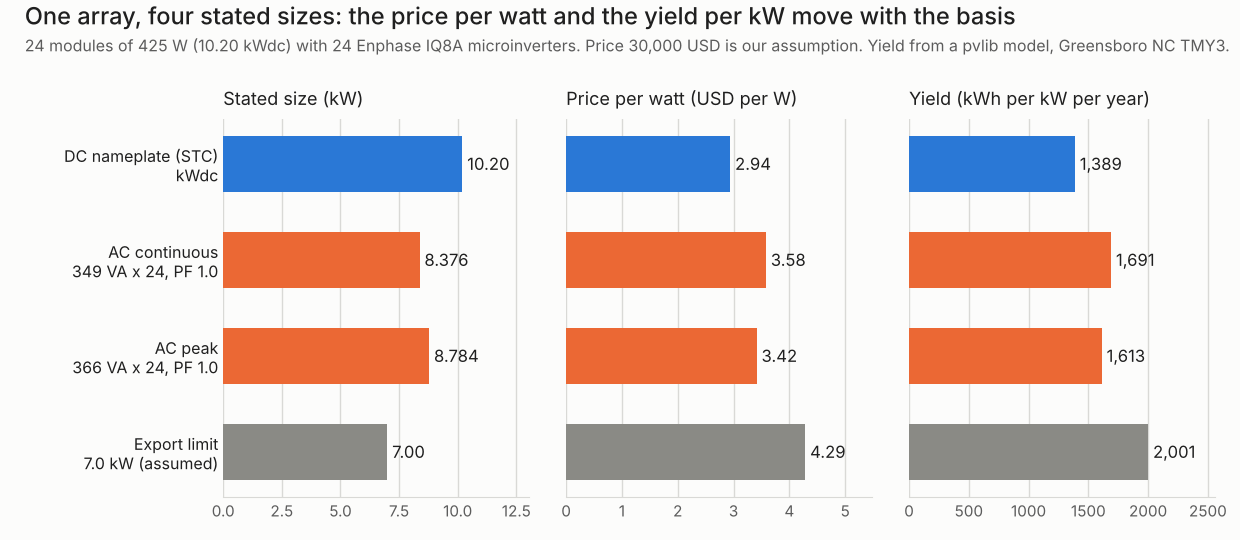
Figure 1. One array is 10.20 kW on a DC basis and 8.376 kW on an AC basis. Price per watt and yield per kW change by the ratio, 1.218.
How do kW, kWh, kWp, kWdc, kWac and kVA differ?
kW and kW-based labels measure power. kWh measures energy. The letters after kW tell you which end of the system the power is measured at.
| Label | Measures | Basis | Where you see it |
|---|---|---|---|
| kW, MW | Power | Not stated | Quotes and brochures, where the end is often not named. |
| kWh, MWh | Energy | Over a period | Bills, yield estimates, battery capacity. |
| Wp, kWp, MWp | Power | DC at standard test conditions | Module datasheets. The Qcells header reads "Wp" and its table reads "W". |
| kWdc, MWdc | Power | DC, usually the STC nameplate | Design tools, SEIA, many proposals. |
| kWac, MWac | Power | AC at the inverter output | EIA, interconnection, utility plants. |
| kVA, VA | Apparent power | AC, volts times amps | Inverter datasheets. Real power (kW) = kVA × power factor. |
"kW/h" is not a unit. People who write it usually mean kWh. For power factor see power factor and reactive power, and for energy units see kilowatt-hour and megawatt-hour.
Why do DC and AC ratings differ?
The array is rated at test conditions that rarely occur. The inverter is rated at the output it can deliver. Designers often buy less AC than DC, because modules seldom reach nameplate power.
In our pvlib run the array’s DC output peaked at 9.02 kW, or 88.4% of the 10.20 kWdc nameplate. The hourly model includes heat and a default 14.1% DC loss. The AC limit of 8.376 kW was reached in only 12 hours. Hourly weather steps understate short spikes, so real clipping is higher. For how much to oversize, see DC/AC ratio and inverter clipping.
The module datasheet also allows a +5 W and -0 W tolerance. So the 425 W class could be up to 430 W each, or 10.32 kWdc for 24 modules. A stated kWp is a label, not a measurement of your array.
Who states capacity, and on which basis?
Data bodies differ. EIA says it collects AC, SEIA counts DC, and NLR (formerly NREL) says either can be used. A national total in "GW" is meaningless until you know which.
| Source | Basis | What it says |
|---|---|---|
| EIA, Today in Energy, 16 March 2018 | AC and DC | Capacity reported in DC is typically 10% to 30% higher than AC. DC values are typically 10% to 30% higher than AC. At the end of 2016, US large-scale solar was 20.3 GW AC, 25.4 GW DC (ratio 1.25). |
| EIA, Today in Energy, 24 October 2012 | AC (EIA), DC (industry) | It says EIA collects capacity in MWAC, while IREC and SEIA reported MWDC. |
| SEIA and Wood Mackenzie, Q4 2025 summary | DC | It reports 11.7 GWdc installed in Q3 2025. It also quotes 73 GWac of projects lacking permits. |
| NLR ATB, formerly NREL ATB (2025 edition, checked November 2026) | Either | PV can be rated in MWDC or MWAC. The ratio between them is the inverter loading ratio. |
Scaled up, a 1 MWac plant built like our array has 1.218 MWdc at our ratio of 1.218. In our Greensboro TMY3 model it would make about 1,691 MWh a year. At 425 W, 1 MWdc needs 2,353 modules.
How do you calculate DC size, AC size and yield per kW?
Multiply module count by module watts for DC, then multiply inverter count by its rating for AC. Divide one by the other for the ratio.
- DC size (kWdc) = modules × module watts at STC ÷ 1,000.
- AC size (kWac) = inverters × rating. If the rating is in VA or kVA, multiply by power factor.
- If an export limit applies, the AC size for that purpose is the smaller of the inverter total and the limit.
- DC/AC ratio = kWdc ÷ kWac.
- Price per Wac = price ÷ (kWac × 1,000) = price per Wdc × ratio. Yield per kW = annual kWh ÷ kW on the same basis.
Worked example: one array, five ways to state it
The same hardware gives five different sizes, and price per watt moves with each. These are the inputs.
| Input | Value |
|---|---|
| Modules | 24 Qcells Q.TRON BLK M-G2+ 425 W modules (datasheet Rev06, March 2025, North America) |
| Inverters | One Enphase IQ8A-72-2-US per module. Datasheet DSH-00378-2.0, December 2024: 349 VA continuous, 366 VA peak, power factor setting 1.0 |
| Module and inverter limits | Voc 39.03 V and Isc 13.66 A at STC, under the IQ8A’s 60 V and 25 A input limits. This page does not cover a full compatibility check |
| Site and weather | Greensboro, North Carolina (Piedmont Triad airport, USAF 723170), TMY3 file bundled with pvlib. Typical weather, not a P50 forecast |
| Array and model | South-facing, 20 degrees tilt, albedo 0.2, PVWatts default DC losses. Model is pvlib 0.16.1 |
| Model curves | Qcells Pmax coefficient of -0.30 %/K. PVWatts inverter curve scaled to the 97% CEC efficiency |
| Our assumptions | 30,000 USD price, 7.0 kW export limit, 0.9 power factor |
The first table below gives size, ratio and price per watt.
| How the size is stated | Size (kW) | DC/AC ratio | USD per W |
|---|---|---|---|
| DC nameplate (kWdc) | 10.20 | - | 2.94 |
| AC, 349 VA × 24 at PF 1.0 | 8.376 | 1.218 | 3.58 |
| AC, 366 VA peak × 24 at PF 1.0 | 8.784 | 1.161 | 3.42 |
| AC, 349 VA × 24 at PF 0.9 | 7.538 | 1.353 | 3.98 |
| Export limit 7.0 kW | 7.00 | 1.457 | 4.29 |
The second table gives yield per kW and annual energy.
| How the size is stated | kWh per kW a year | Annual kWh |
|---|---|---|
| DC nameplate (kWdc) | 1,389 | 14,164 |
| AC, 349 VA × 24 at PF 1.0 | 1,691 | 14,164 |
| AC, 366 VA peak × 24 at PF 1.0 | 1,613 | 14,166 |
| AC, 349 VA × 24 at PF 0.9 | 1,874 | 14,126 |
| Export limit 7.0 kW | 2,001 | 14,007 |
The hardware stays the same, yet the stated size runs from 7.00 to 10.20 kW. Price per watt runs from 2.94 to 4.29 USD. Each AC price equals the DC price times its ratio. The power factor row assumes the VA rating is the limit: real power then caps at 314.1 W per unit. The 7.0 kW cap clips 1.12% of energy in this hourly model, and the PF 0.9 case clips 0.29%.
The first two rows have the same annual energy, as only 0.013% clips at 349 VA in hourly data. Only the yield per kW changes. That is why "kWh per kW" needs a basis too: see specific yield and cost per watt.
Calculator
Use the calculator to convert units and to restate your own array on a DC and AC basis. It treats the comma in 10,000 as a thousands separator and the comma in 7,6 as a decimal point. It flags unclear entries such as 1,500.
Not showing? Open the kW and MW capacity calculator on its own page.
How solar software handles DC and AC capacity
Four of six tools label DC and AC capacity separately, so you can see which basis a number uses. The HelioScope and OpenSolar pages read give ratios but no capacity labels. The table uses company pages read in October 2026 for labels only.
| Software | Labels DC and AC capacity separately? | What the page says | Page read |
|---|---|---|---|
| PVcase Ground Mount | Yes | DC is the array’s peak capacity at STC "expressed in kWp". AC is the inverter’s nominal output "expressed in kVA". | PVcase help, updated 16 September 2026 |
| PVsyst | Yes | Array Pnom is defined at STC. Inverter Pnom is defined as the output AC power. | PVsyst help, inverter and array sizing, undated |
| SAM | Yes | "Nameplate DC capacity" in kWdc and "Total AC capacity" in kWac. | SAM help, PV system design, undated |
| pvlib | Yes | The DC model’s pdc0 is module power at reference conditions in W. The inverter model’s pdc0 is the inverter’s DC input limit. | pvlib 0.16.1 documentation strings |
| HelioScope | Not stated | The two help pages read give the DC/AC ratio and loss analysis, with no capacity labels. | HelioScope help, July 2025 |
| OpenSolar | Not stated | The inverter sizing article gives ratio thresholds only, with no DC or AC size labels. | OpenSolar support, updated 24 July 2025 |
Not stated: the company page we cite does not say. SAM’s page defines its DC to AC ratio in two ways, so confirm which one is shown. To see which design tools label DC and AC capacity, read the best solar design software list.
Common mistakes with kilowatts and megawatts
FAQs
What is the difference between kW and kWh?
kW is power, the rate at a moment. kWh is energy, the amount over time. A 5 kW inverter running flat out for 2 hours delivers 10 kWh.
Is kVA the same as kW?
No. kVA is apparent power and kW is real power. They are equal only at a power factor of 1.0. At 0.9, 8.376 kVA gives 7.538 kW.
How many solar panels make 1 MW?
Divide 1,000,000 W by the module watts: 1 MWdc is 2,353 modules at 425 W. A 1 MWac plant needs more, by its DC/AC ratio.
Why does my 10 kW system never produce 10 kW?
The rating is for test conditions with a cool cell and 1,000 W/m². Our model’s 10.20 kWdc array peaked at 9.02 kW of DC power after heat and losses. Your site will differ.
Is kWp the same as kWdc?
Usually, yes. Both mean the DC nameplate power at standard test conditions. "p" stands for peak. A quote may mean the nameplate or the measured flash-test total.
Related terms
- Kilowatt-hour and megawatt-hour: units of energy, power multiplied by hours.
- Wattage, kW and kWp: the module-level view of the same units.
- Standard test conditions: the 1,000 W/m² and 25 °C basis for module ratings.
- DC/AC ratio: array kWdc divided by inverter kWac.
- Specific yield: annual kWh per kW installed.
- Watt, volt and amp: the three units that describe a circuit.
Next step: restate your own array on a DC and AC basis in the calculator above. Then compare tools in the best residential solar design software or the best utility-scale solar design software.
Sources
All pages opened and checked in October 2026 unless noted.
- Modules and inverters: Qcells Q.TRON BLK M-G2+ datasheet, Rev06, March 2025 (distributor copy). Enphase IQ8 family datasheet, DSH-00378-2.0, 10 December 2024 (distributor copy).
- Capacity bases: EIA, 16 March 2018. EIA, 24 October 2012. SEIA Q4 2025 executive summary. NLR ATB, formerly NREL ATB, PV AC and DC (2025 edition, link moved to the nlr.gov domain after the lab’s 2025 rename, re-verified November 2026).
- Definitions and mistakes: SolarQuotes, kW and kWh (last modified 27 May 2023). Aurora Solar blog, inverter sizing (modified July 2025).
- Software labels: PVcase. PVsyst. SAM. HelioScope ratio and losses. OpenSolar. pvlib 0.16.1 documentation strings (installed package).
Last updated 30 October 2026. Next scheduled review: 30 January 2027.