Key takeaways
- Power is voltage times current, so any one follows from the other two.
- NIST SP 811 (updated 18 August 2025) gives W = J/s and V = W/A. The ampere is an SI base unit.
- Wiring changes volts and amps, not watts. This example’s 14 modules make about 5,881 W as 455.56 V and 12.91 A, or as 65.08 V and 90.37 A.
- Cable loss follows current squared. On one example 0.05 ohm cable, 7 times the current gives 49 times the loss: 8.3 W against 408.3 W.
- Check array Voc and Imp against the inverter limits before you pick a wiring layout.
To turn module Vmp and Imp into array volts, amps and watts, use the calculator below. To check Voc and current against inverter limits in a design tool, see the best solar design software.
Watt, volt and amp at a glance
A watt measures power, a volt measures electrical pressure and an amp measures current. A datasheet prints one row for each, and any one follows from the other two.
| Item | Detail |
|---|---|
| Formula | P = V × I. So I = P ÷ V and V = P ÷ I. On AC, real power also carries the power factor. |
| Units | Watt (W), volt (V), ampere (A). Prefixes step by 1,000: 1 kW is 1,000 W, and 1,000 mA is 1 A. |
| Where it matters | Module and inverter datasheets, string layout, cable and fuse sizing, and any proposal that states a size. |
| Standard or rule | NIST SP 811 defines the units and prefixes. Your datasheet and local code set the limits. |
| In software | Module models and string checks work in volts. Some also show current and power. See the software table. |
Why do watts, volts and amps matter for installers?
Take the Qcells 420 W module. Fourteen of them in one string add up to 455.56 V, which the inverter must accept. The same string carries 12.91 A, and that sets the cable and fuse size.
Voltage and current limits are on Voc and Isc, Vmp and Imp and string sizing. Current sets conductor size, overcurrent protection and voltage drop. Labels such as 12 V and 48 V are on nominal voltage.
Volts vs amps vs watts: what does each measure?
The watt is power, the volt is electric potential difference and the ampere is current. A common picture is a water pipe. Voltage is like pressure, current is like flow and power is the work the flow does. It is only an analogy.
| Unit | Measures | NIST SP 811 (updated 18 August 2025) | Row on the Qcells 420 W class sheet (STC) |
|---|---|---|---|
| Watt (W) | Power, the rate of energy | J/s | Power at MPP: 420 W |
| Volt (V) | Electric potential difference, also called voltage | W/A | Voltage at MPP: 32.54 V. Open circuit voltage: 38.75 V. |
| Ampere (A) | Electric current | An SI base unit | Current at MPP: 12.91 A. Short circuit current: 13.58 A. |
NIST says the ampere’s size has been set since 20 May 2019 by fixing the elementary charge at exactly 1.602176634 × 10⁻¹⁹ coulombs. The coulomb is one ampere-second, so 1 Ah is 3,600 C. The ohm, the unit of resistance, is V/A. Energy over time is on kilowatt-hour and megawatt-hour.
How do the three connect?
Multiply voltage by current to get power. Divide power by either one to get the other. The datasheet lets you test this, as the worked example shows.
- Read power, voltage and current at the maximum power point on the datasheet.
- Check that voltage times current is close to the power row. A large gap suggests you read the wrong row.
- Solve the missing one: 420 W ÷ 32.54 V is 12.91 A.
- For an array, series modules add their voltages and parallel strings add their currents.
- Multiply the array voltage by the array current to confirm the array power.
These are STC values: see standard test conditions. This is DC arithmetic. For the AC side see AC vs DC power and power factor. The size units are on wattage, kW and kWp.
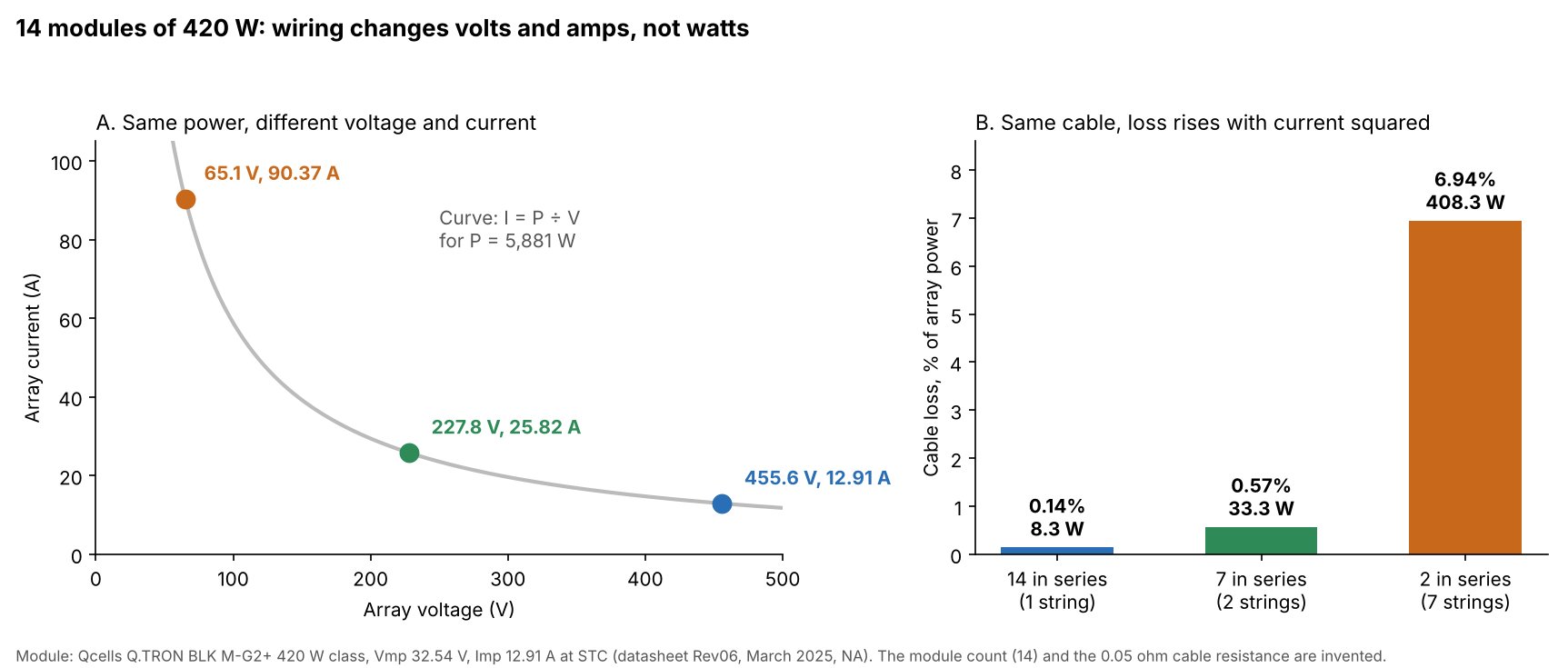
Figure 1. Three wirings of the same example 14 modules give about 5,881 W each. Cable loss rises from 0.14% to 6.94% as current rises from 12.91 A to 90.37 A.
Worked example: one array, three wirings
The module is the Qcells 420 W class: Vmp 32.54 V and Imp 12.91 A at STC. The 14 modules and the 0.05 ohm cable (one run carrying the whole array current) are example. Loss is current squared times resistance.
Table 1. Same modules, three wirings.
| Wiring | Array voltage | Array current | Array power | Cable loss |
|---|---|---|---|---|
| 14 in series, 1 string | 14 × 32.54 = 455.56 V | 1 × 12.91 = 12.91 A | 5,881.3 W | 8.3 W (0.14%) |
| 7 in series, 2 strings | 7 × 32.54 = 227.78 V | 2 × 12.91 = 25.82 A | 5,881.3 W | 33.3 W (0.57%) |
| 2 in series, 7 strings | 2 × 32.54 = 65.08 V | 7 × 12.91 = 90.37 A | 5,881.3 W | 408.3 W (6.94%) |
Power is 14 × 32.54 × 12.91 = 5,881.3 W in every row. That is 0.02% above the 5,880 W nameplate sum, because Vmp × Imp rounds to 420.09 W. Doubling the current quadruples the loss. Seven times the current gives 49 times the loss. In a real design the cable would be sized for its current, see voltage drop calculation.
These are electrical sums only. The 14-series row has a Voc of 14 × 38.75 = 542.5 V at STC, before cold-weather correction. The 7-string row is an illustration: 0.05 ohm carrying 90 A is not a design. Inverter voltage windows, start voltage and fuse ratings decide which wiring is allowed: see string sizing.
Want the design tool to check this for you? See the best solar design software.
Watt, volt and amp calculator
Part 1 solves for the missing one of power, voltage and current. Part 2 turns module Vmp and Imp into array volts, amps and watts, with an optional cable loss. The defaults reproduce the first row of Table 1.
How solar software handles watts, volts and amps
Only pvlib and the KACO string sizing tool name voltage, current and power on the pages read. The other three name some of them. Ratings follow the pages read in October 2026, for labels only.
| Software | Names voltage, current and power? |
|---|---|
| pvlib | Yes |
| KACO String Sizing Tool | Yes |
| SAM | Partly |
| OpenSolar | Partly |
| HelioScope | Partly |
A useful design tool shows string Voc, Vmp and current beside the inverter limits. Partly means the page names some of the three but not all. The notes below give the page wording and the page read. No date is printed on the KACO, SAM, OpenSolar or HelioScope pages.
- pvlib: The single-diode function returns "v_mp - voltage at maximum power point in volts". It also returns "i_mp - current at maximum power point in amperes" and "p_mp - power at maximum power point in watts". A model, not a design check. Page read: pvlib python 0.16.1 docs (stable), pvsystem.singlediode.
- KACO String Sizing Tool: Compares "max. input current of inverter" with "Generator current in MPP", and shows MPP voltage, open circuit voltage and "PV Generator power". Built for planning with KACO inverters. Page read: KACO string sizing tool page.
- SAM: Names string Vmp and Voc checks against the inverter’s MPPT range and gives nameplate power in kWdc. The page gives no DC current guidance. Page read: SAM help, PV system design.
- OpenSolar: "Voltage limit warnings (for Voc and Vmp)". The text read does not mention string current or power. Page read: OpenSolar support, inverter sizing and stringing recommendations.
- HelioScope: Stringing keeps the array inside the inverter’s MPP range, and power outside it shows as voltage clipping. Neither page names string current. Page read: HelioScope help, Stringing and How HelioScope Models Inverters.
Design tools that check string voltage and current against the inverter are ranked in our list of the best solar design software.
Common mistakes with watts, volts and amps
FAQs
How do you convert watts to amps?
Divide watts by volts. The 420 W module at 32.54 V works out to 12.91 A, the same as the Imp row on its datasheet. Use the voltage at which the power is made, not a label: see nominal voltage. On single-phase AC the power factor also counts.
What is the difference between amps and amp-hours?
An amp is a rate of charge flow. An amp-hour is an amount of charge, 3,600 C. A module carrying 12.91 A for one hour moves 12.91 Ah. Multiply amp-hours by voltage to get watt-hours, and see kilowatt-hour for energy.
Why is Vmp times Imp not exactly the rated watts?
The datasheet rounds each row. On the Qcells 420 W class, 32.54 × 12.91 is 420.09 W, 0.02% above 420 W. The sheet also lists a +5 W / −0 W power tolerance.
Is a watt the same as a volt-amp?
For DC, yes, because W = V × A. On AC, volt-amps are apparent power and watts are real power. Real power equals volt-amps times the power factor. On single-phase AC, I = P ÷ (V × PF). In an example, 5,000 W at 240 V and a power factor of 1 is 20.83 A. At a power factor of 0.9 it is 23.15 A.
Related terms
- AC vs DC power: which side of the inverter carries which current.
- Wattage, kW and kWp: module power, system size and the DC or AC basis.
- Kilowatt-hour and megawatt-hour: power held over time.
- Nominal voltage: the voltage label against the working range.
- Vmp and Imp: the working point of a module.
Next step: run your own array through the calculator above, then cross-check the string numbers in the best free solar calculators for installers.
Sources
- Units (checked October 2026): NIST SP 811, chapter 4 (updated 18 August 2025). NIST, Ampere: Introduction (updated 28 May 2026). NIST, Ampere: The Future (updated 9 February 2023).
- Datasheet: Qcells Q.TRON BLK M-G2+ series, Rev06, March 2025, NA version (distributor copy).
- Tools (all checked October 2026): pvlib singlediode. KACO string sizing tool. SAM help. OpenSolar support. HelioScope stringing and HelioScope inverter models.
Last updated 30 October 2026. Next scheduled review: 30 January 2027.