Solar forecasting software predicts how much power a running solar plant will make. It looks ahead minutes, hours or days. Forecast.Solar ranks first on this list, at 73.0/100. It is a low-cost forecast API (a way for other software to pull the forecast) for small fleets. Solargis Forecast is second at 71.0/100.
What does solar forecasting software do, and what does it not do?
This software predicts what a running plant will make in the next minutes, hours or days. Owners use it to plan sales. O&M (operations and maintenance) teams plan work around it. Traders and direct marketers use it to bid.
Battery and VPP (virtual power plant) teams buy it too. Few installers do, unless they run storage or sell into VPPs.
It is not a design study. P50/P90 yield studies (design-stage power estimates) belong on our solar simulation software page.
For what comes after the forecast, see performance analytics, battery energy storage software and VPP software. All sit in our monitoring and asset management group.
Quick picks
Rank | Product | Best for | Starting price (company page, checked October 2026) | Free plan / trial | Score /100 |
|---|---|---|---|---|---|
1 | Low-cost API for small fleets | ✓ Free. Paid from EUR 16 per year | Free public API. 14-day trial on paid plans | 73.0 | |
2 | Utility portfolios from nowcast to 14 days | Quote only | Demo only | 71.0 | |
3 | Traders wanting high-resolution weather plus power | Quote only | None found (free data sample per marketplace) | 69.2 | |
4 | US utilities and IPPs bidding into ISO markets | Quote only | Free trial (length not stated) | 68.5 | |
5 | Satellite irradiance and PV API with a free evaluation | Quote only (commercial) | Free evaluation (limited requests) | 66.0 | |
6 | Free, open-source PV forecasts for Python users | ◐ Free (MIT licence) | Free open-source code | 65.8 | |
7 | Hybrid and off-grid plants needing sky-imager nowcasts | Quote only | Unknown | 64.0 |
✓ Verified on the company’s own pricing page. ◐ Published by the company outside its pricing page (help centre, store or press release). ? We could not read the company’s pricing page, so the figure is not confirmed. Prices checked October 2026.
Quote only means the company shows no public price. You ask it for a quote.
How the 7 tools scored
- Use-case fit 35%
- User reviews 20%
- Pricing 15%
- Ease of use 10%
- Support 10%
- Momentum 10%
Tool | Score chart | Score |
|---|---|---|
73 out of 100 | 73.0 | |
71 out of 100 | 71.0 | |
69.2 out of 100 | 69.2 | |
68.5 out of 100 | 68.5 | |
66 out of 100 | 66.0 | |
65.8 out of 100 | 65.8 | |
64 out of 100 | 64.0 |
Each bar shows the weighted score out of 100.
Sub-scores at a glance (0-10)
Product | Use-case fit | User reviews | Pricing | Ease of use | Support | Momentum | Total /100 |
|---|---|---|---|---|---|---|---|
10.0 | 5.0 | 7.0 | 7.5 | 5.0 | 5.0 | 73.0 | |
10.0 | 5.0 | 4.0 | 5.0 | 7.5 | 7.5 | 71.0 | |
10.0 | 6.6 | 4.0 | 5.0 | 5.0 | 5.0 | 69.2 | |
10.0 | 5.0 | 4.0 | 5.0 | 5.0 | 7.5 | 68.5 | |
10.0 | 5.0 | 4.0 | 5.0 | 5.0 | 5.0 | 66.0 | |
6.7 | 5.0 | 10.0 | 5.0 | 2.5 | 10.0 | 65.8 | |
10.0 | 5.0 | 4.0 | 5.0 | 5.0 | 3.0 | 64.0 |
A 5.0 on reviews, ease, support or momentum is our neutral score. We use it when public evidence is thin. It is not a judgement.
How did we rank these solar forecasting tools?
How the score is weighted
- Use-case fit 35%
- User reviews 20%
- Pricing 15%
- Ease of use 10%
- Support 10%
- Momentum 10%
We looked at 11 products, scored 10 and ranked the top 7 from 22 to 24 October 2026. We used company docs, price pages, trade press and user reviews. This was desk research. We did not test any tool on plant data. We left out SolarAnywhere, a sun data service.
- Use-case fit (35%): How well it does this job. Written-up forecast features count most: horizons (how far ahead), PV output and API delivery.
- User reviews (20%): Ratings from just a few reviews count for less. Only Meteomatics gains here.
- Pricing (15%): Public prices beat quote only. Free or open-source tools score highest.
- Ease of use, support and momentum (10% each): We check docs, support terms and dated updates. With no proof, a tool gets a neutral score.
A tool loses 2 points when we could not confirm its core facts on the company’s own site. All accuracy figures here are company claims, so we did not rank on accuracy. The score rewards public prices. That is why Forecast.Solar ranks above utility-grade services. It is a light tool built on PVGIS data (the EU’s free solar data service). Read the full method: how we score software.
What are the four layers of solar forecasts, from nowcasts to week-ahead?
A horizon is how far ahead a forecast looks. A nowcast is a very short forecast that looks minutes to a few hours ahead.
- Sky-imager nowcasting (0-30 minutes): A camera on site tracks clouds as they move in. Reuniwatt (Sky InSight) offers it, as does Steadysun (also considered), and Solargis Enterprise takes sky-camera input.
- Satellite nowcasting (minutes to about 6 hours): Cloud motion seen from weather satellites. Solargis, Solcast and Reuniwatt all use it.
- Day-ahead (NWP, or numerical weather prediction): Blends of weather models for market bids. Every ranked tool offers it.
- Week-ahead and beyond: Solargis, PCI and Solcast run to 14 days. Of the tools we also considered, Steadysun runs to about two weeks. Xweather WeatherDesk runs to 15 days and enercast to 31 days.
Intraday trading and battery dispatch need the first two layers. Day-ahead bids need the last two.
1. Forecast.Solar: best for a low-cost forecast API on small fleets
Best for: Small asset owners and home energy systems that need a cheap, simple PV forecast. Score: 73.0/100.
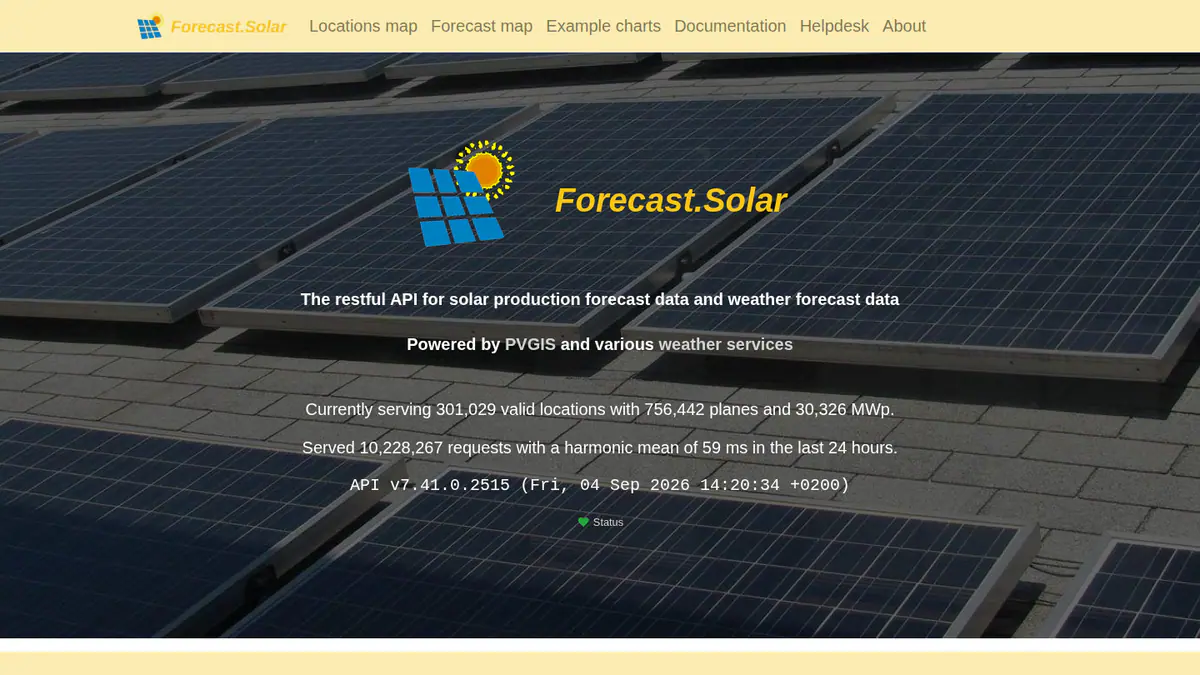
What it is: Forecast.Solar is a German PV forecast API from Knut Kohl’s consultancy, kk-c.dev. It is built on PVGIS 5.2 data and is popular with smart-home tools.
Why we picked it: It has public prices and clear docs for a PV forecast by API. Those put it top on our scores, even though it is a light tool.
Key features:
- REST API (a standard web data link), with up to 4 roof planes per call on higher plans.
- Forecast damping, historic averages and a horizon shading setting.
- Built-in Home Assistant link, plus openHAB and ioBroker add-ons.
- The free public API covers today and tomorrow in 1-hour steps. Personal runs to today plus 3 days in 30-minute steps, and Professional to today plus 6 days. Paid plans use 15-30 minute steps.
Pricing: Billed yearly through PayPal, with a 14-day trial on paid plans. Checked October 2026 on the Forecast.Solar site.
- Public: Free, with no key and 12 calls per hour per IP.
- Personal: EUR 16 per year. Personal Plus: EUR 28.
- Professional: EUR 70. Professional Plus: EUR 120. Professional Extended: EUR 200 per year.
- Enterprise: Pay-per-use on request.
Pros (from user forums and our research):
- You can start free with no key. That is why home-automation tools use it by default (ioBroker forum, April 2024).
- You know the cost up front: every plan has a public price, from EUR 16 a year.
- It works inside Home Assistant out of the box, so there is no code to write.
Cons (from user forums and our research):
- Users report large misses on cloudy days (Home Assistant forum, 2024-2025).
- Several forum users switched to Solcast for better results.
- No nowcasting and no stated update rate, so it does not suit intraday trading.
Reviews: No ratings on G2, Capterra or Trustpilot as of October 2026. User points above are from hobby forums.
Want to see Forecast.Solar working? Book a demo with the SolarSoftwares team.
Book a demoYour request goes by email to the SolarSoftwares team. A time is set only after we reply. It does not change any score or ranking.
2. Solargis Forecast: best for utility portfolios from nowcast to 14 days
Best for: IPPs (independent power producers), grid operators, traders and asset teams with large fixed-tilt and tracker fleets. Score: 71.0/100.
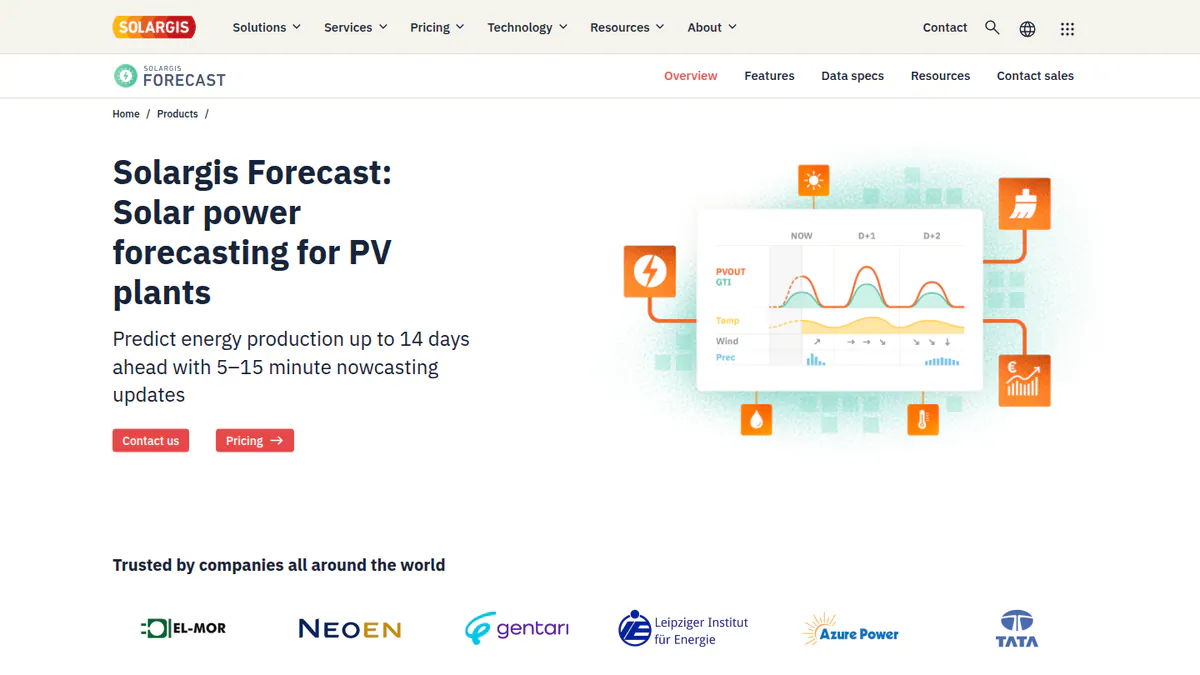
What it is: Solargis Forecast blends satellite data and weather models to forecast PV output and sunlight. It is sold in Basic, Professional and Enterprise tiers. A Solargis case study with SES reports an 8-12% gain in fiscal outcome from lower balancing costs. It is a company claim with no country or date shown.
Why we picked it: One supplier covers 5-minute satellite nowcasts through to 14-day forecasts, with uncertainty bands. It also scored above average on support and recent updates.
Key features:
- Fixed-tilt and tracker models with up to 20 system settings.
- High and low uncertainty bands.
- Combined forecasts for portfolios and VPPs.
- Basic covers today to 7 days ahead (D0 to D+7). It is hourly, updated every 6 hours, and for fixed-mount PV only.
- Professional runs to D+14 in 5, 10 or 15-minute steps. It adds satellite nowcasts updated up to every 5 minutes. It blends the IFS, GFS, ICON and HRRR weather models.
- Enterprise adds sky cameras, snow handling and forecasts for thousands of plants at once.
Pricing: Quote only: all three tiers say "Let’s talk". Add-ons cover past forecasts, wind and better accuracy from your production data. Checked October 2026 on the Solargis forecast pricing page.
Pros (from our research):
- One plan covers 5-minute nowcasts out to 14 days, so you need no second supplier.
- The archive of past forecasts lets you check accuracy before you sign.
- Uncertainty bands help traders size their bids and reserves.
Cons (from our research):
- No published prices on any tier.
- Basic is hourly with 6-hour updates, so intraday work needs Professional.
- Basic covers fixed-mount PV only, so tracker plants start on a higher tier.
Reviews: No user reviews found. G2 has a Solargis seller profile with 0 reviews and no Forecast listing, as of October 2026.
Want to see Solargis Forecast working? Book a demo with the SolarSoftwares team.
Book a demoYour request goes by email to the SolarSoftwares team. A time is set only after we reply. It does not change any score or ranking.
3. Meteomatics: best for traders wanting high-resolution weather plus power
Best for: Energy traders and utilities that want solar power forecasts and wider weather data from one API. Score: 69.2/100.
What it is: Meteomatics is a weather API firm from St. Gallen, Switzerland. It sells solar, wind and hydro power forecasts. Most details here come from Datarade and rfp.wiki.
Why we picked it: It has the only sizeable user rating base among the ranked tools. Traders also get power forecasts and wider weather data through one API.
Key features:
- One REST API that returns JSON, CSV, NetCDF and WMS/WFS (science and map data formats).
- Solar power forecasts for single sites and whole regions.
- Python connector, ArcGIS and SFTP (secure file transfer) portfolio feeds.
- Solar data at 90 m resolution in 5-minute steps, from its own 1-km EURO1k and US1k models.
- Day-ahead and intraday or nowcast power forecasts. Steps are up to 15 minutes, updated every 15 minutes.
Pricing: Quote only and usage-based, per Datarade and rfp.wiki, with a free data sample on Datarade. Checked October 2026. The company’s solar page shows no prices.
Pros (from reviews and our research):
- Reviewers praise the API docs and connectors for Python and ArcGIS (G2 review summary on rfp.wiki).
- Power and weather data come from one API, so traders need one contract, not two.
- Its own 1-km models give fine local detail in Europe and the US.
Cons (from reviews and our research):
- Reviewers call the pricing opaque and inflexible.
- The company states no forecast horizon in hours or days, so you must ask before you buy.
- You get a weather API, not a ready-made PV dashboard, so it needs setup work.
Reviews: G2 4.5/5 (36 reviews), as cited by rfp.wiki in July 2026 and checked October 2026. We did not read the G2 page itself. The reviews cover the whole weather API, not just solar.
Want to see Meteomatics working? Book a demo with the SolarSoftwares team.
Book a demoYour request goes by email to the SolarSoftwares team. A time is set only after we reply. It does not change any score or ranking.
4. PCI Energy Solutions: best for US utilities and IPPs bidding into ISO markets
Best for: US utilities, IPPs and traders who already use PCI’s trading tools. Score: 68.5/100.
What it is: PCI Energy Solutions sells trading and portfolio software. PCI Forecaster, launched in July 2025, adds solar, load, wind and price forecasts. It is built for ISO (regional grid operator) markets.
Why we picked it: It puts solar forecasts next to bidding tools for US ISO markets. They come with uncertainty bands. It also blends in your own SCADA (plant control and data system) data and other forecasts.
Key features:
- Hourly solar forecasts to 14 days from machine-learning models, with physical models for sites with no history.
- Inputs include GFS, HRRR and NAM weather, SCADA and IoT feeds, and third-party forecasts.
- Uncertainty bands at 68%, 95% and 99%.
- API delivery into market bid workflows, with links to PCI GenTrader, GSMS and outage management.
Pricing: Quote only, with a demo. A free Forecaster trial needs no long-term commitment, but its length is not stated. Checked October 2026 on the PCI Forecaster announcement.
Pros (from our research):
- It blends your SCADA data and other companies’ forecasts, so you are not tied to one source.
- Forecasts sit next to nodal price forecasts (prices at each grid point) and bidding tools.
- You can try it free before you commit.
Cons (from our research):
- Hourly only, with no sub-hour or nowcast product shown.
- Built for US ISO/RTO markets, and PCI does not say if it is sold elsewhere.
- Quote only, with no published prices.
Reviews: A G2 seller page with 0 reviews, and nothing on Capterra or Trustpilot, as of October 2026.
What we could not confirm: whether Forecaster runs as hosted SaaS (software you use online).
Want to see PCI Energy Solutions working? Book a demo with the SolarSoftwares team.
Book a demoYour request goes by email to the SolarSoftwares team. A time is set only after we reply. It does not change any score or ranking.
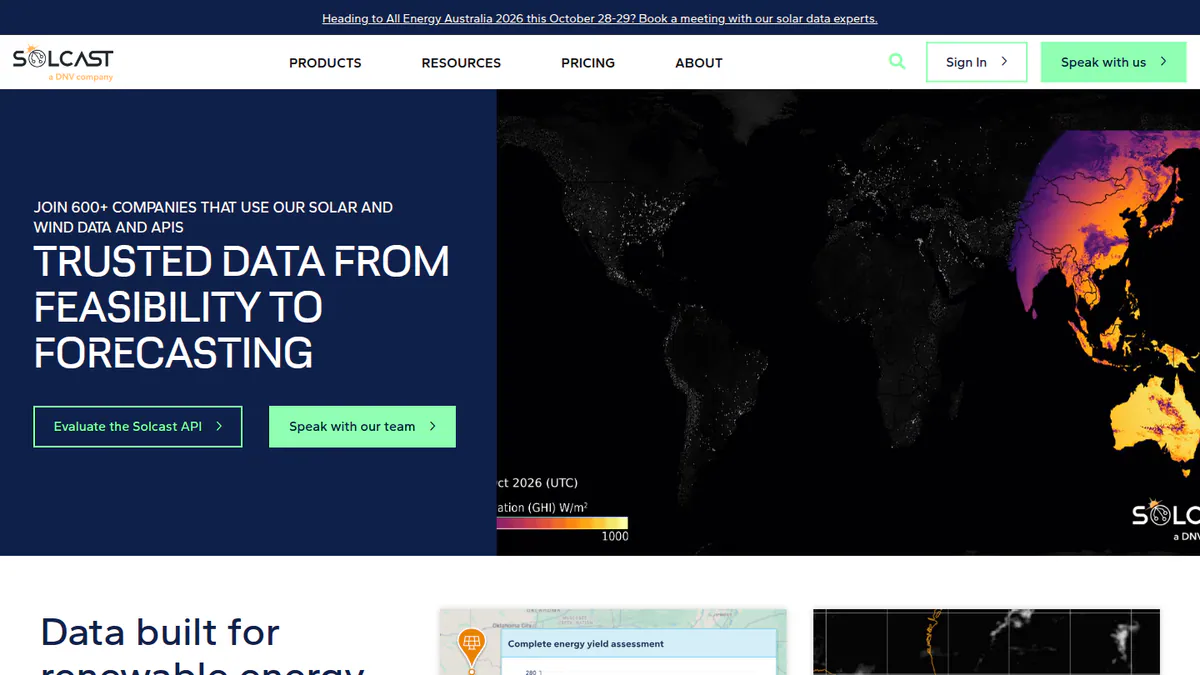
5. Solcast: best for a satellite irradiance and PV API with a free evaluation
Best for: Asset, battery and VPP teams who want live, forecast and past data from one API. Score: 66.0/100.
What it is: Solcast, based in Sydney, sells sunlight and PV power data from satellites. DNV said on 1 February 2023 that it was buying Solcast.
Why we picked it: It covers live, forecast and past data in one satellite API. Forecasts run from 5 minutes to 14 days ahead. Updates speed up from every 6 hours to every 5 minutes as you move up the tiers.
Key features:
- REST API in JSON or CSV.
- Rooftop, advanced and premium PV power models.
- Past time series and TMY (typical-year data) with P50-P95 scenarios on higher tiers.
- Forecasts from 5 minutes to 14 days ahead on all forecast tiers, in 5-60 minute steps. Live data comes in 5-15 minute steps.
- Updates every 6 hours on Starter, every 15 minutes on Pro and every 5 minutes on Max.
Pricing: Quote only: Starter, Pro, Max and Custom are all "Request a quote". Checked October 2026 on Solcast’s pricing page and the Solcast knowledge base.
- Free evaluation: Up to 10 live or forecast and 15 historic requests at your sites. Unmetered test sites are unlimited, and longer trials go through sales.
- Free Home User tier: For personal, non-commercial roof systems only.
Pros (from user forums and our research):
- Hobby users find it clearly more accurate than Forecast.Solar (Home Assistant forum, 2024-2025).
- ioBroker users see it as the more dependable source (ioBroker forum, April 2024).
- You can test it free on your own sites before you talk to sales.
Cons (from user forums and our research):
- It can still be badly wrong on some overcast days.
- The removal of some free plans from 16 April 2024 confused hobby users.
- No published commercial prices.
Reviews: A G2 listing with 0 reviews, and no Capterra listing found, as of October 2026. The forum points above come from hobby users, not pro teams.
Want to see Solcast working? Book a demo with the SolarSoftwares team.
Book a demoYour request goes by email to the SolarSoftwares team. A time is set only after we reply. It does not change any score or ranking.
6. Quartz Solar Forecast (Open Climate Fix): best for free, open-source PV forecasts for Python users
Best for: Developers, researchers and technical owners who want a free PV forecast for one site. They can run it and change it. Score: 65.8/100.
What it is: Quartz Solar Forecast is free Python code under the MIT licence. It comes from Open Climate Fix (OCF), a UK non-profit. It forecasts one PV site’s output 0-48 hours ahead from open weather data. It is not OCF’s paid Quartz service for grid operators (see Also considered).
Why we picked it: It is the only free, open-source forecast model here. New releases come out often. That gives it top marks on price and momentum.
Key features:
- Single-site PV power forecast in kW, 0-48 hours ahead, with no nowcasting.
- Needs only the site location, tilt, orientation and capacity. It does not use live PV data.
- Gradient-boosting and XGBoost models on Open-Meteo GFS and ICON weather data.
- A Python forecast function, a CSV export script, a FastAPI web endpoint and simple dashboards.
- OCF reports about 13% MAE (mean absolute error, night excluded) over 0-36 hours on UK data.
Pricing: Free, open source under the MIT licence, with no paid plan for this code. Checked October 2026 on PyPI.
Pros (from our research):
- It costs nothing, and you can read and change the model yourself.
- It is kept up to date: release 1.2.12 came out on PyPI on 6 September 2026.
- It needs only basic site details, so you can forecast a site with no monitoring link.
Cons (from our research):
- It is trained on UK data, and OCF says accuracy elsewhere is not benchmarked.
- Help comes only from the community on GitHub, with no SLA.
- You need Python skills to run it, and it has no nowcasting.
Reviews: No user reviews found on G2, Capterra or Trustpilot as of October 2026. OCF presented it at FOSDEM in 2024 and 2026.
What we could not confirm: which inverter brands its optional inverter add-on supports.
Want to see Quartz Solar Forecast (Open Climate Fix) working? Book a demo with the SolarSoftwares team.
Book a demoYour request goes by email to the SolarSoftwares team. A time is set only after we reply. It does not change any score or ranking.
7. Reuniwatt: best for hybrid and off-grid plants needing sky-imager nowcasts
Best for: Hybrid, mine-site and microgrid teams who manage PV swings with storage. Score: 64.0/100.
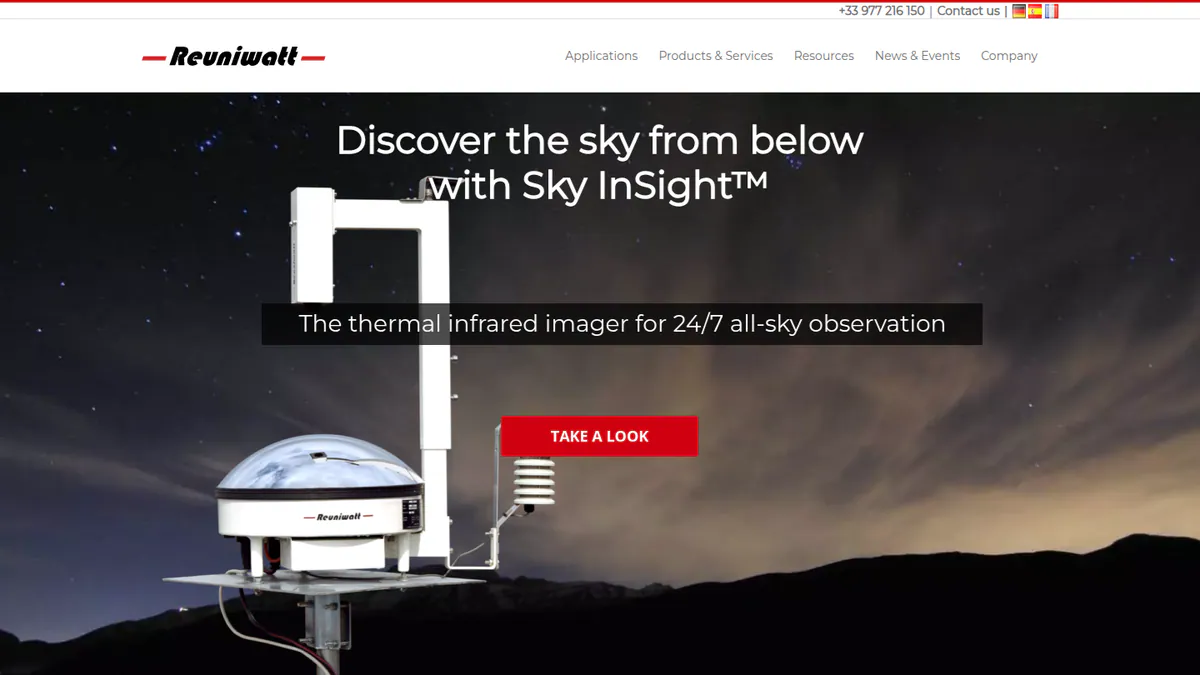
What it is: Reuniwatt, from France, pairs its own Sky InSight sky cameras with satellite and weather-model data. Note: we did not check reuniwatt.com. Details come from its Intersolar profile and trade press.
Why we picked it: Its own sky cameras give the fastest nowcasts on this page. That matters most at hybrid and off-grid sites, where a passing cloud can swing output within minutes.
Key features:
- InstaCast forecasts up to 30 minutes ahead from the Sky InSight thermal camera. The camera takes an image every 30 seconds, day and night.
- Satellite nowcasts from five geostationary satellites, refreshed every 10-15 minutes.
- HourCast runs to 6 hours and DayCast to one week.
- Solar and wind power forecasts.
- Backtests and hindcasts (past-period test runs) for plant setup and accuracy checks.
Pricing: Quote only, so contact sales. Checked October 2026 on the Intersolar exhibitor profile.
Pros (from our research):
- A sky image every 30 seconds, the fastest refresh on this page, shows cloud swings before they hit.
- It has a track record at hybrid sites. Examples are Voltalia’s Oiapoque plant in Brazil (2018) and the Fekola mine in Mali (2020), with 36 MWp (megawatts peak) of solar and 17 MW of storage.
- One supplier covers every horizon from 30-minute nowcasts to one week.
Cons (from our research):
- No published prices.
- The fastest nowcasts need its sky camera installed on site.
- No user reviews to judge support or accuracy.
Reviews: None on G2, Capterra, Trustpilot or forums, as of October 2026.
What we could not confirm: API or FTP delivery, trial terms and dated release notes.
Want to see Reuniwatt working? Book a demo with the SolarSoftwares team.
Book a demoYour request goes by email to the SolarSoftwares team. A time is set only after we reply. It does not change any score or ranking.
How do the 7 solar forecasting tools compare?
Product | Longest horizon | Nowcasting | Resolution / update frequency | Delivery | Documented markets |
|---|---|---|---|---|---|
Today + 6 days | None documented | 15-60 min resolution. Update not stated | REST API, Home Assistant, openHAB | Global (PVGIS data) | |
14 days | Satellite, every 5 min. Sky camera (Enterprise) | 5-60 min. 6-hourly to 5-min updates | REST API (XML), SFTP, CSV, email | Global, 60N-56S | |
Not stated | Intraday/nowcast listed (company page) | 5-min timesteps, 90 m. 15-min updates | REST API, SFTP, Python, ArcGIS | Global. 1-km models in EU and US | |
14 days | None documented | Hourly | API into PCI trading tools | US ISO/RTO markets | |
14 days (from 5 minutes ahead) | Satellite-based | 5-60 min. Updates every 5 min (Max) to 6 h (Starter) | REST API (JSON, CSV) | Global | |
48 hours | None | Not stated | Python package, FastAPI endpoint, CSV | Trained on UK data. Not benchmarked elsewhere | |
1 week | Sky imager (30 s) and satellite (10-15 min) | Up to 30 min ahead from imagers | Web portal (API not confirmed) | Brazil, Mali, Asia, US, France |
Also considered
- Steadysun (scored 64.0/100): A 2013 spin-off from the CEA-Liten lab. It has sky-camera nowcasts updated every minute and forecasts out to about two weeks. It ties Reuniwatt on score but comes eighth in our score order. We did not check steady-sun.com, prices are quote only, and its site count is unclear (14,000 or 1,400).
- OCF’s commercial Quartz service (not scored): A separate, paid product, not the open-source code ranked above. It has run in the control room of NESO (Great Britain’s grid operator) since November 2025, forecasting up to 36 hours ahead. OCF claims 2.8 times better within-day accuracy, with no outside test. Pricing is not public, so we did not score it.
- enercast (scored 63.5/100): A Kassel firm selling AI power forecasts for plants and regions, 15 minutes to 31 days ahead. That is the longest horizon we found. It misses the top 7: no nowcasting product, no dated release since early 2025, and quote-only pricing.
- Xweather (Vaisala) (scored 61.3/100): Vaisala’s weather API, with a free developer tier (15,000 accesses a month) and a renewables add-on. It misses the top 7. Its renewables forecasts cover only the US and Canada. The per-farm fee is not public, and it names no solar nowcasting.
- SolarAnywhere (Clean Power Research): A sun data service with past, typical-year, real-time and forecast data. We do not rank data inputs.
- Meteonorm, NSRDB and other typical-year data sets: Past sunlight data for design and bankability (proof to lenders that a project will earn enough). They do not forecast.
- PVsyst and Aurora: Design-stage yield tools, not forecasts. See solar simulation software.
- Inverter portals with yield forecasts (for example Fronius Solar.web Premium): A feature inside monitoring, not forecasting software. See solar monitoring software.
How do you choose the best solar forecasting software?
- Running a few systems on a tight budget? Pick Forecast.Solar, then test Solcast’s free evaluation against it on cloudy days.
- For intraday trading or storage dispatch in 5-minute steps, shortlist Solargis Professional and Solcast’s higher tiers. Ask each for past forecasts to backtest.
- Hybrid, mine-site or island grids with sharp PV swings suit Reuniwatt’s sky-camera nowcasts, or Steadysun (also considered).
- Already bidding into a US ISO market with PCI tools? Start with PCI Forecaster’s free trial.
- Selling wind and solar output together in Germany? Compare Meteomatics with enercast (also considered).
- Teams with Python skills who want to own the model can use the open-source Quartz Solar Forecast.
Whatever you shortlist, ask for a hindcast on your own sites and check it against your meter data.
Want more choices? Browse every tool we checked in our monitoring and asset management category.
Solar forecasting software FAQs
How accurate are solar power forecasts?
It depends on horizon, weather and region. We found no outside benchmark, so published figures are company claims. Open Climate Fix reports about 13% MAE over 0-36 hours for its open-source model on UK data (October 2026). Ask each company for a hindcast on your own sites.
What data is used for solar power forecasting?
Short-term forecasts track clouds with sky cameras and satellites. Day-ahead forecasts use weather models such as IFS, GFS, ICON and HRRR, which Solargis Professional blends. Many services also use plant output or SCADA data to correct bias.
What is the difference between intraday and day-ahead solar forecasts?
Intraday forecasts cover the next minutes to hours. They refresh often from satellite or sky cameras, up to every 5 minutes on Solargis Professional. Day-ahead forecasts look at tomorrow. They come from weather models and support market bids.
Is there a free solar forecast API?
Yes. As of October 2026, Forecast.Solar’s public API is free with no key, for today and tomorrow in 1-hour steps. Quartz Solar Forecast is free MIT-licensed code you run yourself. Solcast’s free Home User tier is for personal, non-commercial systems only. Solcast also offers a free evaluation for commercial sites.
Who needs solar forecasting: installers, asset owners or grid operators?
Mainly asset owners, traders, direct marketers, grid operators and battery or VPP teams. They need forecasts to schedule, bid and balance their plants. Few installers need one, unless they run storage or sell into VPPs.
Sources
All checked 22 to 24 October 2026.
- Forecast.Solar: pricing, account models, openHAB binding, Home Assistant forum, ioBroker forum
- Solargis Forecast: pricing, product page, subscription details, introduction to forecast, G2 seller page
- Meteomatics: Datarade listing, rfp.wiki
- PCI Energy Solutions: solar forecasting, Forecaster launch, G2 seller page
- Solcast: pricing, free home-user data, free trial plans, DNV acquisition
- Quartz Solar Forecast: PyPI, LF Energy, FOSDEM 2024
- Reuniwatt: Intersolar profile, Meteorological Technology International, pv magazine
- Steadysun: CEA profile, InnoEnergy, API docs, em-power profile
- enercast: products, EEX insightcommodity listing, SEF
- Xweather: pricing, renewables forecaster, Renewables API announcement, rfp.wiki
- SolarAnywhere: licence options
Last updated 28 October 2026. Next scheduled review: 23 January 2027.