Commercial solar design software lays out solar panels on business roofs and carports. It also models shade, estimates how much power the system will make and draws the wiring plan. These jobs are called C&I (commercial and industrial) projects. Aurora Solar ranks first at 80.0/100, and PV*SOL premium ranks second at 76.0/100.
Roof size decides the shortlist. Aurora’s lead comes mainly from review volume and published pricing, not large C&I engineering. HelioScope fits C&I design work better and has published tiers from USD 159 a month.
For a ranked list across every segment, see our best solar design software ranking.
Quick picks
Rank | Product | Best for | Starting price (company page, checked October 2026) | Pricing model | Free plan / trial | Score /100 |
|---|---|---|---|---|---|---|
1 | Small C&I sold by residential-first teams | ✓ USD 159 per user per month (USD 135 billed annually) | Per user subscription | No free plan. Trial not stated | 80.0 | |
2 | European C&I with storage, heat pumps and EV loads | ✓ EUR 845 per named user per year, plus VAT | Desktop licence, annual | 30-day trial | 76.0 | |
3 | C&I rooftop engineering in AutoCAD | Quote only | Single Professional plan | Demo only | 73.8 | |
4 | C&I rooftop and carport up to 30 MW DC | ✓ USD 159 per month (USD 1,620 per year if billed yearly) | Per licence, capped by MW DC | Free trial (length not stated) | 72.7 | |
5 | Reference yield reports for C&I financing | ✓ CHF 700 per seat per year | Annual desktop subscription | 30-day evaluation | 72.6 | |
6 | C&I installers in India and the US | ✓ USD 159 per month (international list) | Subscription | Demo only | 70.6 | |
7 | Small commercial roofs on a zero budget | ✓ Free core platform | Free. Paid API and connectors | Free plan | 66.2 |
✓ Verified on the company’s own pricing page. ◐ Published by the company outside its pricing page (help centre, store or press release). ? We could not read the company’s pricing page, so the figure is not confirmed. Prices checked October 2026.
Quote only means the company shows no public price. You ask it for a quote.
How the 7 tools scored
- Use-case fit 35%
- User reviews 20%
- Pricing 15%
- Ease of use 10%
- Support 10%
- Momentum 10%
Tool | Score chart | Score |
|---|---|---|
80 out of 100 | 80.0 | |
76 out of 100 | 76.0 | |
73.8 out of 100 | 73.8 | |
72.7 out of 100 | 72.7 | |
72.6 out of 100 | 72.6 | |
70.6 out of 100 | 70.6 | |
66.2 out of 100 | 66.2 |
Each bar shows the weighted score out of 100.
Sub-scores at a glance (0-10)
Product | Use-case fit | User reviews | Pricing | Ease of use | Support | Momentum | Total /100 |
|---|---|---|---|---|---|---|---|
8.5 | 7.9 | 8.0 | 7.5 | 7.5 | 7.5 | 80.0 | |
8.8 | 5.4 | 8.0 | 7.5 | 7.5 | 7.5 | 76.0 | |
7.9 | 6.4 | 4.0 | 10.0 | 10.0 | 7.5 | 73.8 | |
8.8 | 6.2 | 8.0 | 7.5 | 5.0 | 5.0 | 72.7 | |
7.3 | 6.3 | 8.0 | 5.0 | 7.5 | 10.0 | 72.6 | |
7.6 | 6.3 | 6.0 | 7.5 | 10.0 | 5.0 | 70.6 | |
5.8 | 5.0 | 9.0 | 7.5 | 5.0 | 10.0 | 66.2 |
A 5.0 on reviews, ease, support or momentum is our neutral score. We use it when public evidence is thin. It is not a judgement.
How did we rank the best commercial solar design software?
How the score is weighted
- Use-case fit 35%
- User reviews 20%
- Pricing 15%
- Ease of use 10%
- Support 10%
- Momentum 10%
We considered 15 products, then scored 14 from 22 to 24 October 2026 and ranked the top 7. The other 7 are listed under "Also considered" with their scores. We used company documents, pricing pages and public user reviews. This was desk research. We did not run projects in any tool.
The six criteria and weights are:
- Use-case fit (35%): How well the tool does this page’s job. Layout on commercial roofs and carports counts most. Next come 3D modelling, shading and yield (power output) simulation. After that come stringing (how panels wire into inverters) and SLD (single-line diagram, a simple drawing of how the wires connect) output. Tools built only for homes or only for utility plants score lower.
- User reviews (20%): G2 and Capterra ratings. Ratings based on only a few reviews count for less. Fewer than 8 reviews means a middle 5.0, not a penalty.
- Pricing transparency (15%): Published prices score above prices you have to ask for, or prices we could not confirm.
- Ease of use, support and momentum (10% each): Review sub-scores and dated release notes. Each gets a middle score when we found no evidence.
Scores are specific to this page’s job, so the same tool can score differently elsewhere. SurgePV is not part of this ranking. Full method: how we score software.
What counts as commercial solar design?
This page covers C&I systems on warehouse roofs, carports and small on-site ground mounts. These are usually sold in one of two ways. One is a PPA (power purchase agreement), a deal where the customer pays for power instead of buying the panels. The other is a self-consumption case, where the building uses the power itself.
The job has three parts. You lay out panels around parapets (low roof walls), setbacks (required gaps from the roof edge) and HVAC (heating and cooling) units. You produce shading and yield figures you can defend. Then you string the array and draw an SLD the electrical team can build from.
Laying out plants on open land? See our utility-scale solar design software ranking. Need construction drawings, BOMs (bills of materials) and CAD file exchange for an engineering team? See solar design software for EPCs (engineering and construction firms). For proposals and tariff modelling for commercial buyers, see commercial solar proposal software.
1. Aurora Solar: best for small C&I jobs sold by residential-first teams
Best for: Residential-first teams that also sell small commercial jobs. Score: 80.0/100.
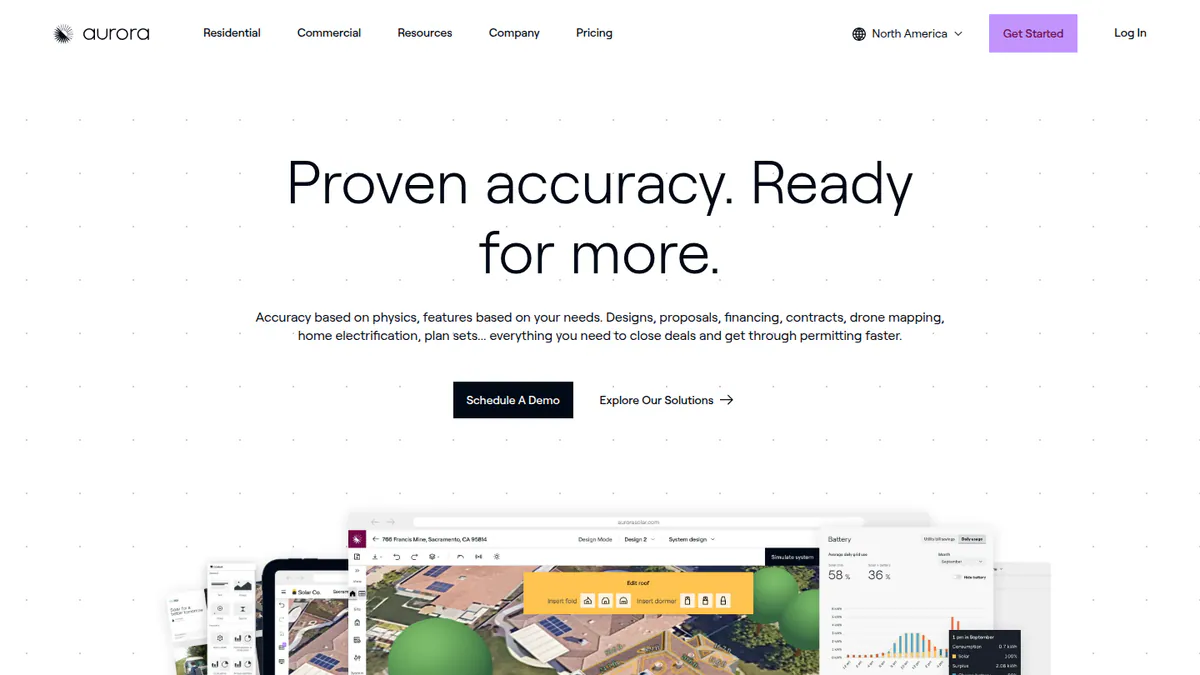
What it is: Aurora Solar is a cloud 3D design and proposal platform from Aurora Solar Inc. It is built for US residential and light commercial installers. Aurora itself routes large C&I and utility work to HelioScope (#4).
Why we picked it: Strong user reviews and published per-user prices lifted its total. It also handles small commercial roofs in the same cloud tool as homes.
Key features:
- LIDAR (laser height data) 3D modelling and bankable (lender-accepted) shade reports (Premium).
- Battery modelling for backup, self-consumption and arbitrage (storing cheap power to use when prices are high).
- Plan sets (permit drawing packages) and engineering stamps (Enterprise only).
- Design API.
Pricing: Basic is USD 159 per user per month, or USD 135 billed annually, with 50 projects a month. Premium is USD 259 (USD 220 annually). Enterprise is custom and priced per project. Checked October 2026 on the Aurora pricing page.
Pros (from user reviews):
- Accurate shade reports, with LIDAR showing obstructions (Capterra).
- Designs are accurate and customer service is strong (G2).
- Videos and a knowledge base get new staff working sooner.
Cons (from user reviews):
- It uses a lot of memory and runs slowly on weaker machines (2019 reviews).
- Proposal and finance tools feel thin for the price.
- It links to few other software tools.
Reviews: G2 4.7/5 (121 reviews) and Capterra 4.1/5 (7 reviews), checked October 2026.
What we could not confirm: stringing and SLD output in Aurora’s docs, and whether a free trial exists.
Read our full Aurora Solar review or our Aurora Solar alternatives.
Want to see Aurora Solar working? Book a demo with the SolarSoftwares team.
Book a demoYour request goes by email to the SolarSoftwares team. A time is set only after we reply. It does not change any score or ranking.
2. PV*SOL premium: best for European C&I with storage, heat pumps and EV loads
Best for: European planners modelling on-site loads in commercial buildings. Score: 76.0/100.
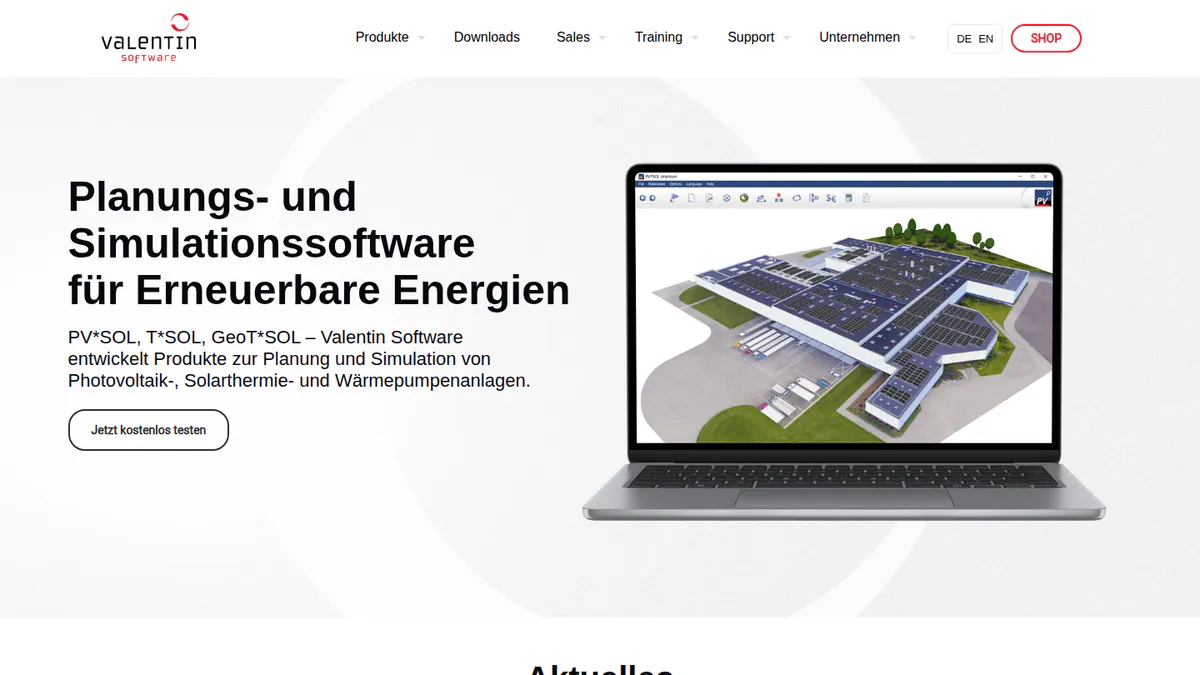
What it is: PV*SOL premium is a desktop tool for 3D design and simulation from Valentin Software. It is popular with European planners for residential and C&I systems. The 2026 version shipped on 24 November 2025.
Why we picked it: It tied for the highest fit score for C&I design. It has 3D shading, yield and on-site load modelling. Its prices are published.
Key features:
- 3D design with detailed shading analysis.
- Yield simulation on Meteonorm 9 climate data.
- AC- and DC-coupled storage, heat pumps and per-consumer EV tariffs.
- JSON export of the project and results to a CRM (customer tracking software) or ERP (business management software).
Pricing: PV*SOL premium 2026 costs EUR 845 per named user per year, or EUR 285 for 3 months, plus VAT. The 2D PV*SOL is EUR 585 per year. Checked October 2026 in the Valentin shop.
Pros (from our research):
- It models storage, heat pumps and EV charging, so on-site use is closer to real life.
- You can buy 3 months for EUR 285 to cover a busy season.
- A major release every year keeps it current.
Cons (from our research):
- It is desktop software, so a team cannot share projects in a browser.
- Sales output is a PDF or DOCX presentation, not a web proposal.
- No US permit output is documented.
Reviews: G2 4.2/5 (12 reviews), checked October 2026. G2 ease of use is 8.2/10.
What we could not confirm: SLD and detailed stringing output, and any user pros or cons (G2 shows no review text).
Read our full PV*SOL premium review or our PV*SOL premium alternatives.
Want to see PV*SOL premium working? Book a demo with the SolarSoftwares team.
Book a demoYour request goes by email to the SolarSoftwares team. A time is set only after we reply. It does not change any score or ranking.
3. PVcase Roof Mount: best for C&I rooftop engineering in AutoCAD
Best for: EPC engineering teams that work in AutoCAD. Score: 73.8/100.
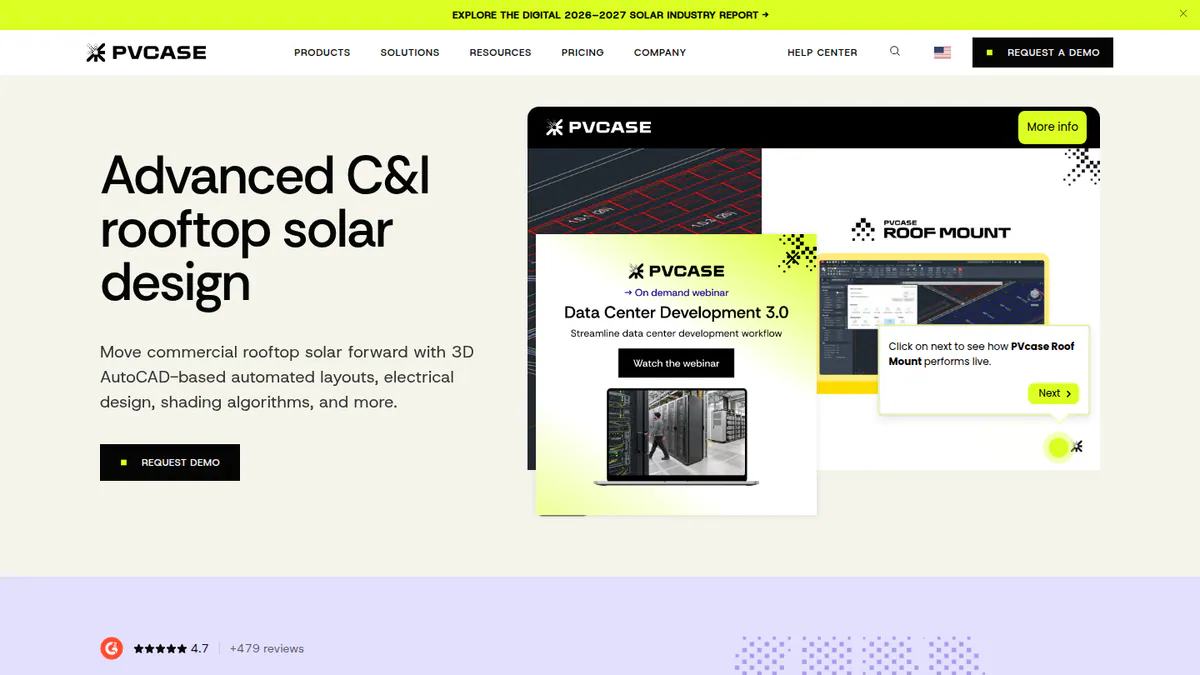
What it is: PVcase Roof Mount is an AutoCAD plug-in for commercial roofs from PVcase. It takes DWG/DXF (CAD drawing files) or drone imagery and produces layout, ballast (weights that hold panels down on flat roofs), stringing, cabling and SLD export. It is aimed at C&I EPCs and engineering firms. It is a separate product from PVcase Ground Mount.
Why we picked it: It is the only ranked tool that does commercial roof layout, stringing, cabling and SLD export inside AutoCAD. G2 users score its ease of use and support highly.
Key features:
- Multi-area layouts with setbacks, parapets and obstructions.
- PanelClaw racking with wind and ballast reports (countries that use Eurocode, the European building standards).
- MPPT (maximum power point tracking) set-up, cable trays, cable sizing and voltage drop.
- SLD, BOM and PVsyst export.
Pricing: You have to ask for a price. There is a single Professional plan. Checked October 2026 on the PVcase Roof Mount pricing page. That page does not say whether you need an AutoCAD licence.
Pros (from user reviews):
- Reviewers say it saves design time.
- It runs inside AutoCAD, so engineers keep the drawing tool they know.
- Support scores 9.8/10 on G2 from 16 reviews.
Cons (from our research):
- No published price, so you need a sales call to budget.
- Ballast reports cover Eurocode countries only, so teams outside Europe lose them.
- There is a demo but no free trial.
Reviews: G2 4.6/5 (17 reviews), checked October 2026.
What we could not confirm: user complaints (G2 shows theme tags only) and release dates.
Want to see PVcase Roof Mount working? Book a demo with the SolarSoftwares team.
Book a demoYour request goes by email to the SolarSoftwares team. A time is set only after we reply. It does not change any score or ranking.
4. HelioScope: best for C&I rooftop and carport projects up to 30 MW DC
Best for: Commercial teams sizing rooftop and carport arrays. Score: 72.7/100.
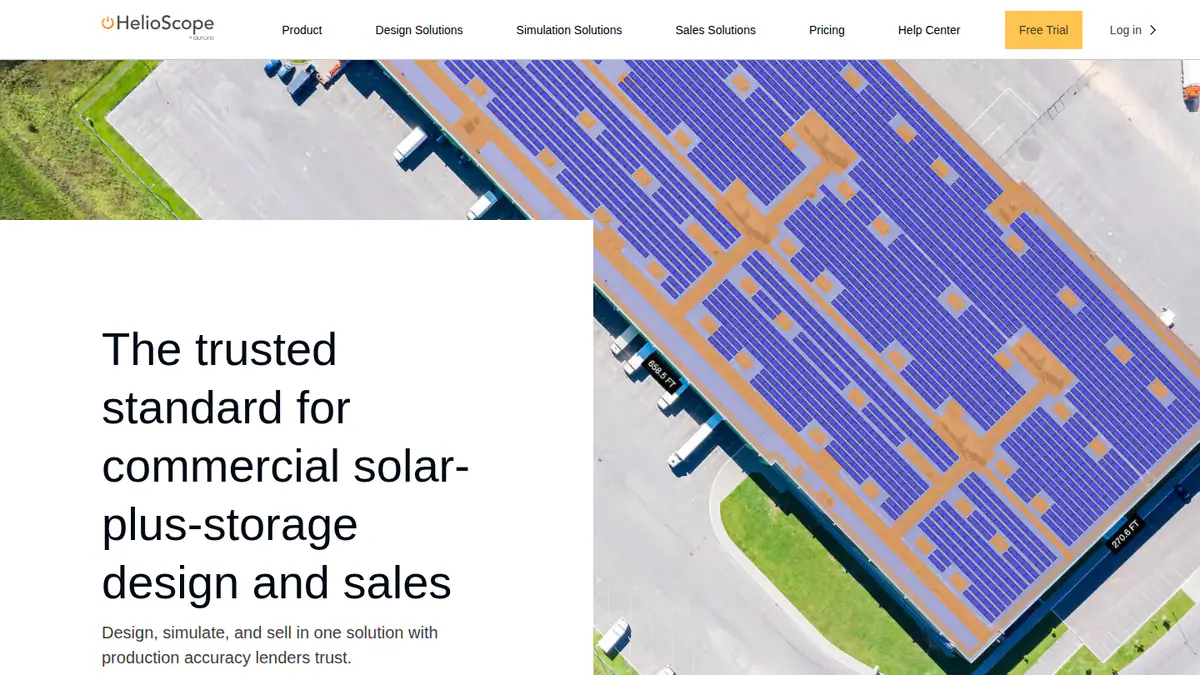
What it is: HelioScope is a web tool for commercial design and simulation. Aurora Solar owns it and sells it separately to C&I installers and EPCs. Plan caps are set in MW DC (megawatts of panel capacity), so cost is easy to map to your pipeline.
Why we picked it: It tied for the highest fit score for C&I work. It covers rooftop, carport and ground layouts with shading and wiring losses. Its prices are published.
Key features:
- Rooftop, carport and ground-mount layout.
- Shading and wiring-loss modelling. The company says production is within 1% of PVsyst.
- P90/P95/P99 values (Pro), which are confidence levels for the yield estimate.
- Single-axis trackers (mounts that follow the sun), PVsyst export and API (a link to other software) on Enterprise.
Pricing: Basic is USD 159 per month (USD 1,620 per year if billed yearly), for 1 user, 10 projects a month and up to 1.25 MW DC. Pro is USD 259 per month (USD 2,640 per year if billed yearly), up to 5 MW DC. Enterprise is custom, up to 30 MW DC. Checked October 2026 on the HelioScope pricing page.
Pros (from user reviews): (G2)
- A simple interface makes it easy to learn.
- Layouts are fast, with shading and wiring-loss figures built in.
- Reports and SLDs come out quickly.
Cons (from reviews and our research):
- The tiers are pricey if you design only now and then.
- Project limits per year get in the way on large systems.
- Trackers, PVsyst export and the API need Enterprise, at a custom price.
Reviews: G2 4.5/5 (19 reviews), checked October 2026.
What we could not confirm: the trial length, and dated release notes.
Read our full HelioScope review or our HelioScope alternatives.
Want to see HelioScope working? Book a demo with the SolarSoftwares team.
Book a demoYour request goes by email to the SolarSoftwares team. A time is set only after we reply. It does not change any score or ranking.
5. PVsyst: best for reference yield reports on C&I financing
Best for: C&I teams that must deliver lender-style yield reports. Score: 72.6/100.
What it is: PVsyst is Windows software for simulation and yield from PVsyst SA in Switzerland. It is not a layout or sales tool. C&I teams use it when a buyer, lender or adviser asks for P50/P90 (yield confidence levels) reports with a full loss diagram.
Why we picked it: It gives the detailed P50/P90 reports and loss diagrams that buyers and lenders ask for. It is still maintained, with a patch in August 2026.
Key features:
- 3D near-shading scene with electrical mismatch losses.
- Bifacial modules (panels that catch light on both sides) and trackers with backtracking (tilting to avoid shading each other).
- Weather data import from Meteonorm, PVGIS, NSRDB, Solcast and Solargis.
- Battery and self-consumption strategies.
Pricing: PVsyst 8 Professional costs CHF 700 per seat per year, with 5% to 20% off for multiple seats. Student and Classroom licences cost CHF 25. Prices are shown only in CHF. Checked October 2026 in the PVsyst shop.
Pros (from user reviews): (G2 reviewer themes)
- Detailed, accurate yield figures you can show a buyer or lender.
- A full loss breakdown explains where energy is lost.
- You can build 3D shading scenes in SketchUp.
Cons (from user reviews):
- The interface is dated and complex.
- New users face a steep learning curve.
- 3D scene work is slow (G2 ease of use 6.7/10).
Reviews: G2 4.5/5 (22 reviews), checked October 2026.
Read our full PVsyst review or our PVsyst alternatives.
Want to see PVsyst working? Book a demo with the SolarSoftwares team.
Book a demoYour request goes by email to the SolarSoftwares team. A time is set only after we reply. It does not change any score or ranking.
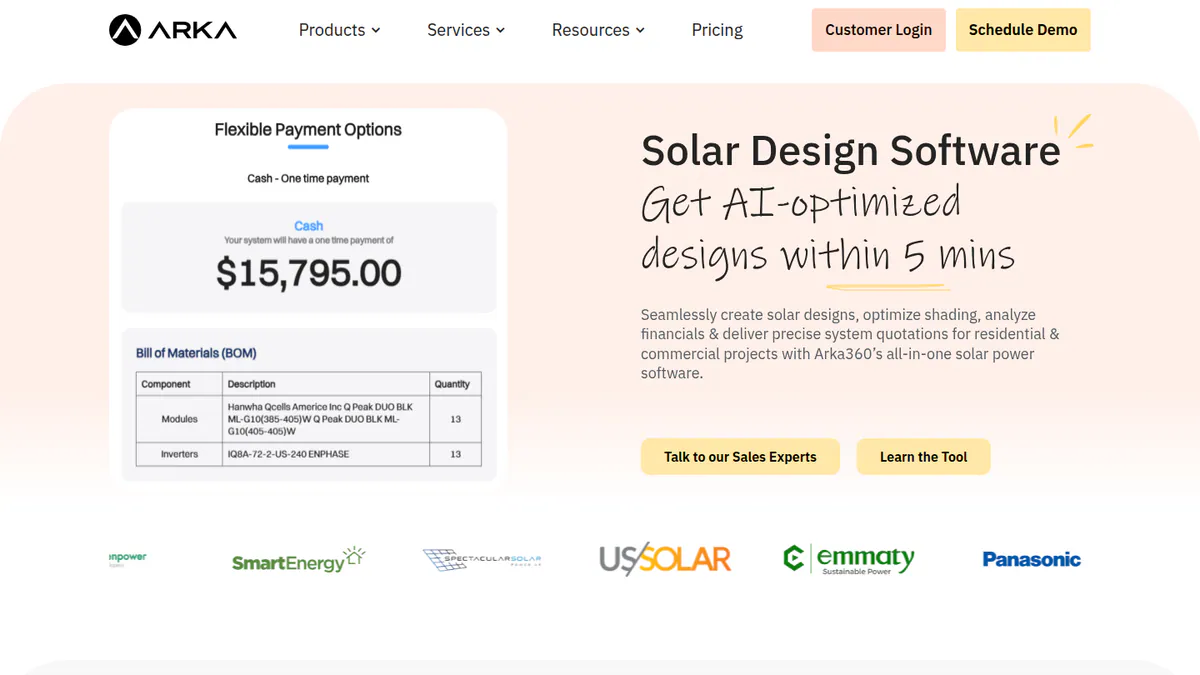
6. Arka 360: best for C&I installers in India and the US
Best for: Installers who mix commercial and residential jobs on one flat plan. Score: 70.6/100.
What it is: Arka 360, formerly The Solar Labs, is a cloud platform for design, proposals and light CRM. Its customers are residential and commercial installers in India and the US, served from Bengaluru and Texas.
Why we picked it: One flat US plan covers commercial and home projects with no project cap. It has the most G2 reviews in our top 7.
Key features:
- 3D rooftop and ground-mount design.
- Stringing with micro-inverters and optimisers.
- SLD export and 3D export to SketchUp and PVsyst (Premium).
- Unlimited residential and commercial projects on the Basic plan.
Pricing: The international-list Basic is USD 159 per month (USD 1,699 per year). Premium is USD 199 per month (USD 1,999 per year) and adds SLD export and PVsyst 3D export. Enterprise is USD 999 per month. The Indian page shows two conflicting INR price sets, so we have not quoted them. Checked October 2026 on the Arka 360 pricing page.
Pros (from user reviews): (G2)
- Easy to use day to day, with 14 G2 mentions.
- Shadow analysis and project estimates are built in.
- 3D views help you close deals with customers.
Cons (from user reviews):
- It lags on projects of 3 MWp (megawatts peak) and above.
- Picking a roof structure can confuse.
- Multi-user limits make it harder for growing teams.
Reviews: G2 4.3/5 (137 reviews), checked October 2026.
Read our full Arka 360 review or our Arka 360 alternatives.
Want to see Arka 360 working? Book a demo with the SolarSoftwares team.
Book a demoYour request goes by email to the SolarSoftwares team. A time is set only after we reply. It does not change any score or ranking.
7. OpenSolar: best for small commercial roofs on a zero budget
Best for: Small commercial installers with no software budget. Score: 66.2/100.
What it is: OpenSolar is a free design and proposal platform for residential and small commercial installers. OpenSolar Inc. earns from hardware and finance partners instead of licence fees.
Why we picked it: It is the only ranked tool here with a free core, and it covers small commercial roofs as well as homes.
Key features:
- 3D and 2D rooftop design with shading.
- AI design (OS 3.0).
- Web proposals with e-signature and payment collection.
- SolarAPP+ permit links in the US.
Pricing: The core platform is free. API access and Xero or QuickBooks connectors have been charged since 16 April 2026, at unpublished rates. Paid imagery is optional. Checked October 2026 on OpenSolar’s pricing notice.
Pros (from reviews and our research): (G2)
- Panels are easy to add, remove and move, so layout changes are quick.
- The app is friendly and gives you the facts you need in the field.
- You pay no licence fee for core design and proposals.
Cons (from user reviews):
- Layouts do not adjust themselves, so an engineer still needs to review them.
- The interface looks dated, though it works.
- API and accounting add-ons cost extra, so one reviewer calls it "not completely free".
Reviews: G2 4.8/5 (3 reviews), checked October 2026. That is too few to rely on.
What we could not confirm: the add-on fees, and how deep its shading tools go.
Read our full OpenSolar review or our OpenSolar alternatives.
Want to see OpenSolar working? Book a demo with the SolarSoftwares team.
Book a demoYour request goes by email to the SolarSoftwares team. A time is set only after we reply. It does not change any score or ranking.
SurgePV (unscored): for readers comparing roof modelling, panel layout, shading, electrical drawings and proposals. Verify the outputs and commercial fit on a representative project. The numbered scores above do not include it.
Sources checked 27 October 2026: SurgePV product information · SolarSoftwares SurgePV review
Book a demo of SurgePV with the SolarSoftwares team.
Book a demoYour request goes by email to the SolarSoftwares team. A time is set only after we reply. It does not change any score or ranking.
How do the 7 commercial solar design tools compare?
This table shows size limits, yield output, wiring diagram output, platform and starting price for each tool.
Product | Size limit or tier cap | Yield / P90 | SLD output | Platform | Starting price |
|---|---|---|---|---|---|
50 projects/month (Basic) | Production simulation | Not confirmed | Cloud | USD 159/user/mo | |
None stated | Meteonorm 9 yield | Not confirmed | Desktop | EUR 845/yr | |
None stated | Energy simulation, PVsyst export | SLD export | AutoCAD plug-in | Quote only | |
1.25 / 5 / 30 MW DC | P90/P95/P99 (Pro) | Per G2 reviewers | Cloud | USD 159/mo | |
None stated | P50/P90 reports | No | Windows desktop | CHF 700/yr | |
Lag above 3 MWp (reviews) | Yield, PVsyst export | Premium | Cloud | USD 159/mo | |
None stated | Limited | Not found | Cloud | Free |
Also considered
All 14 scored tools cleared our minimum match score. These seven ranked 8 to 14, so they fall outside our top 7:
- Archelios Pro (scored 62.9/100): Good for French design offices, with tiers from free up to 9 kWp. It has no user reviews, its data and pages are France-centric, and full SLD work needs a second product.
- Scanifly (scored 62.5/100): Builds drone-surveyed 3D models of US commercial roofs. Prices are not published, and it has only 3 G2 reviews with no visible text.
- Virto.CAD (scored 62.2/100): An AutoCAD or BricsCAD plug-in for European engineering teams. We could not reach the company site, so price and trial terms are not confirmed.
- Solarius PV (scored 51.3/100): BIM-led (building information modelling) design from ACCA Software in Italy. Our facts come from a 2021 brochure, and it has no published price or user reviews.
- Enact (Design & Proposals) (scored 49.1/100): Covers design, proposals and monitoring from one company. We found no prices or features checked on the company’s own website, and no user reviews.
- PVComplete / PVCAD (scored 49.1/100): Produces commercial plan sets in AutoCAD. Enact bought PVComplete in January 2026 and now sells PVCAD as its engineering module. Company pages could not be reached, and a G2 reviewer found it slow on larger projects.
- BlueSol Design (scored 45.3/100): A Windows tool for SLDs on a one-off licence. We could not reach the company site, and our feature list comes from a 2018 article.
We also left these off on purpose:
- Energy Toolbase: Models C&I solar-plus-storage economics on a tariff database, but it is not a layout or CAD tool. See commercial solar proposal software.
- Utility-scale layout tools (RatedPower, PVcase Ground Mount, PVFarm): built for open-land plants. They are ranked on our utility-scale list.
How do you choose commercial solar design software?
- Selling mostly homes and a few small commercial roofs? Pick Aurora Solar and move larger jobs to HelioScope.
- Need C&I rooftop and carport design up to 30 MW DC, and a price you can see today? Pick HelioScope. Size the tier to your largest project.
- If your engineers live in AutoCAD, shortlist PVcase Roof Mount. Virto.CAD and PVCAD (both also considered) are CAD-based fallbacks.
- When buyers or lenders ask for P50/P90 reports, add PVsyst alongside your layout tool rather than replacing it.
- European teams with storage, heat pumps or EV charging on site should pick PV*SOL premium. In France and Italy, Archelios Pro and Solarius PV are also considered.
- In India, Arka 360 has local offices, but confirm INR pricing in writing.
- With a zero budget, start on OpenSolar and accept limited engineering output.
For wider shortlists, see our best solar design software ranking and our residential solar design software ranking. If you need 3D models, read our 3D solar design software guide.
Want more choices? Browse every tool we checked in our design and simulation category.
Commercial solar design software FAQs
What software is used for commercial solar design?
HelioScope, PV*SOL premium and PVcase Roof Mount match C&I design work best in our October 2026 scoring. Commercial teams usually pair a layout tool with a yield tool (software that estimates power output). PVsyst is the usual yield reference for financed projects.
Is HelioScope good for commercial solar?
Yes, for rooftop and carport C&I projects. Basic costs USD 159 a month for systems up to 1.25 MW DC, and Enterprise plans go up to 30 MW DC (checked October 2026). G2 reviewers rate it 4.5/5 from 19 reviews. It does not document DWG output or permit plan sets.
Does HelioScope work for large solar plants?
No, not above 30 MW DC. That is the cap on its Enterprise plan (checked October 2026). Enterprise also adds single-axis trackers and PVsyst export. For larger open-land plants, see our utility-scale solar design software ranking, which covers tools built for that job.
Can one solar design platform handle both residential and commercial projects?
Yes, several can at small commercial sizes. Aurora Solar, Arka 360 and OpenSolar all cover homes and commercial roofs. Arka 360’s Basic plan includes unlimited projects of both types. Aurora sends large C&I jobs to HelioScope, and Arka 360 reviewers report lag above 3 MWp.
Which solar design tools produce bankable reports for C&I projects?
PVsyst is the reference most lenders’ advisers expect. It costs CHF 700 per seat per year (October 2026) and gives P50/P90 reports with full loss diagrams. HelioScope Pro outputs P90 values, and so does Archelios Pro Gold (also considered). We found no evidence of lender acceptance for either.
Do I need AutoCAD for commercial solar design?
No, not for cloud tools such as HelioScope, Aurora Solar or Arka 360. PVcase Roof Mount runs as an AutoCAD plug-in. Virto.CAD and PVCAD (both also considered) also run inside CAD programs. That suits teams that issue drawings to contractors.
Sources
All checked 22 to 24 October 2026.
- Aurora Solar: pricing, G2, Capterra
- PV*SOL premium: shop, 2026 release, G2
- PVcase Roof Mount: pricing, G2
- HelioScope: pricing, G2
- PVsyst: shop, product page, G2
- Arka 360: pricing, G2
- OpenSolar: pricing notice, features, G2
- Archelios Pro: shop, product page
- Scanifly: website, G2
- Virto.CAD: Intersolar listing, G2, Capterra
- Solarius PV: company brochure
- Enact and PVCAD: Solar Power World, January 2026, G2 reviews, G2 pricing
- BlueSol Design: G2, 2018 article
Last updated 28 October 2026. Next scheduled review: 23 January 2027.