Key takeaways
- 1 kWh is 3.6 MJ exactly (NIST SP 811) and 3,412 Btu (EIA). kWh = kW × hours. "kW/h" is not the unit.
- One proposal uses kWh in four ways. The example home makes 10,800 kWh a year (1,200 kWh/kWp), uses 9,600 kWh and has a 10.1 kWh battery.
- Peak kW times daylight hours overstates energy. On this example’s sunny day it gives 74.4 kWh against 43.5 kWh by area, 71% too high.
- One datasheet prints 10.1 kWh energy and 9.7 kWh usable with no DC or AC basis. With an example 94% discharge efficiency, 9.12 kWh reaches the load.
- Tools label energy differently. Only PVWatts V8 states its boundary (kWhac, kWhdc). HelioScope lists grid power in GWh.
To track measured kWh in software, see the best solar performance analytics software. For battery kWh, see the best battery energy storage software.
Kilowatt-hour at a glance
A kilowatt-hour is a power in kilowatts held for a number of hours. A 2 kW load running for 3 hours uses 6 kWh.
| Item | Detail |
|---|---|
| Formula | Energy (kWh) = power (kW) × time (h). Turn watts into kW first by dividing by 1,000. |
| Equivalents | 1 kWh = 1,000 Wh = 3.6 MJ = 3,412 Btu. NIST SP 811 prints 3.6 × 10⁶ J for the kW·h and marks it exact. EIA prints "One kWh is equivalent to 3,412 Btu." |
| Where it matters | Bills, annual production, battery energy and yield per kWp. |
| Standard or rule | NIST SP 811 marks the kW·h to joule factor exact. EIA defines the kilowatt as "One thousand watts." |
| In software | Simulation and monitoring tools print kWh, MWh or GWh, on an AC or DC basis. See the software table. |
Why the kilowatt-hour matters for installers
A utility bills kWh, and a proposal is judged on kWh made and kWh saved. EIA states US retail electricity prices in cents per kilowatthour. Some commercial tariffs also bill kW demand. See demand charge management. A kW typed into a kWh box can size a battery or array wrongly. See utility bill analysis, kilowatt and megawatt and kilowatt-hour and megawatt-hour.
How to turn kW into kWh, and back
Multiply kW by hours. If the power changes, multiply each period separately and add the results.
- Convert power to kW: divide watts by 1,000.
- Convert time to hours: divide minutes by 60.
- Multiply: kWh = kW × hours.
- For a changing load, do one row per period and add the rows (Table 1).
- To go back, average kW = kWh ÷ hours. A year of kWh divided by 8,760 gives average kW.
- For other units, multiply kWh by 3.6 for MJ or by 3,412 for Btu.
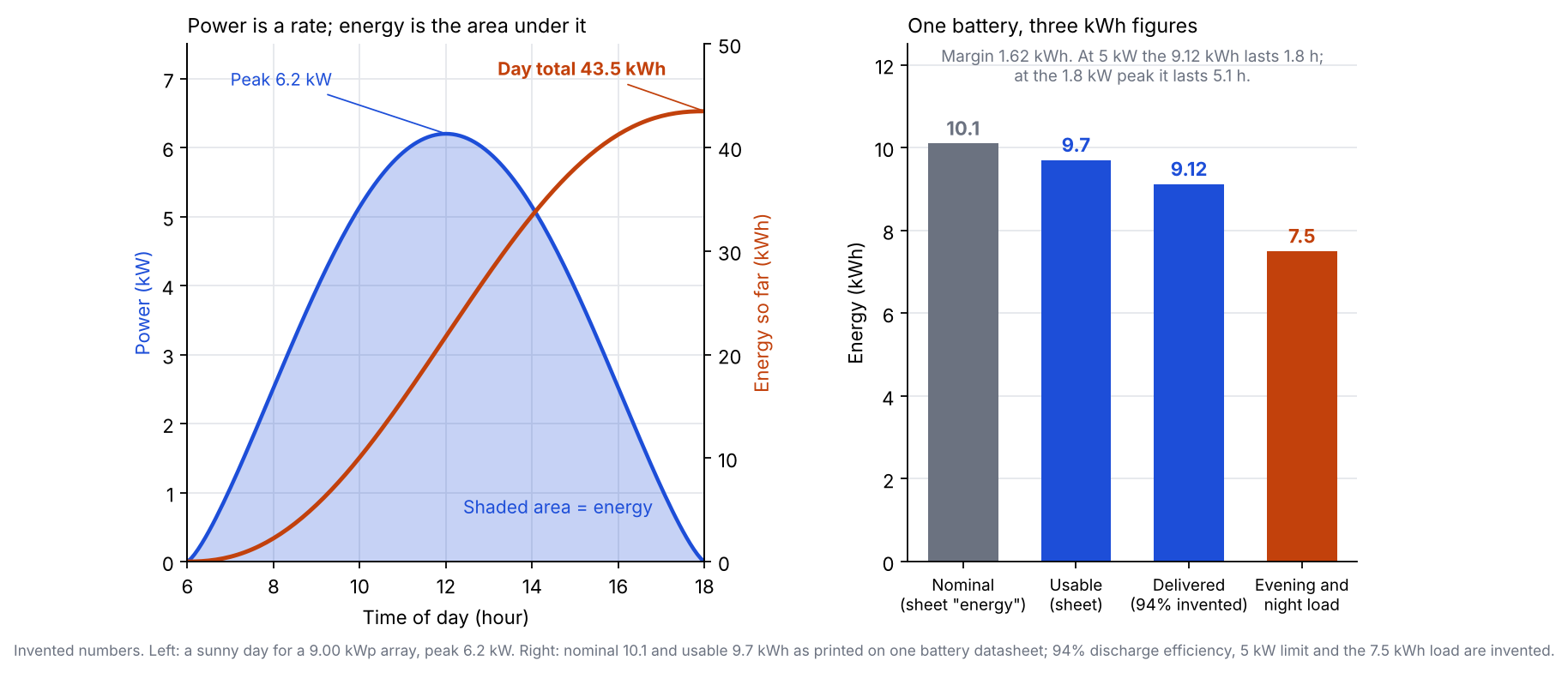
Figure 1. Energy is the area under the power curve: an example sunny day with a 6.2 kW peak gives 43.5 kWh, not 74.4. One battery gives 10.1, 9.7 and 9.12 kWh depending on which figure you read.
Where does each unit sit in a proposal?
Each line of a proposal uses a different unit. The table places them for one example home and names the usual slip.
| Proposal line | Unit | Measures | Example value | Usual slip |
|---|---|---|---|---|
| Array size | kWp or kWdc | DC power at STC | 9.00 kWp (20 × 450 W) | Writing kWh for kWp |
| Inverter | kW AC | Output power limit | 7.6 kW | Mixing DC and AC kW. See DC/AC ratio |
| Annual production | kWh a year | Energy, AC, year one | 10,800 kWh | Not stating the boundary or the year |
| Specific yield | kWh/kWp | Energy per rated kW | 1,200 | Dividing by AC kW (1,421 kWh/kW) |
| Annual use | kWh a year | Energy from bills | 9,600 kWh | Using a period other than 12 months |
| Battery energy | kWh | Stored energy, nominal or usable | 10.1 and 9.7 kWh | Quoting nominal as usable |
| Battery power | kW | Rate in or out | 5.0 kW | Reading kWh as hours of backup |
Sunlight is also measured in kWh/m², energy per area. See irradiation. Reading it as production is a common slip.
kWh/kWp is a unit of hours. 10,800 kWh from 9.00 kWp is the energy of 1,200 hours at full DC rating. PVsyst’s help page says its quantities can also be shown as hours per day at 1 kW/m². Yield maths is on the specific yield page. The share of the year in hours is on capacity factor.
What are nominal, usable and delivered battery kWh?
Nominal kWh is the sheet’s headline energy. Usable kWh is the part you may draw. Delivered kWh is what reaches the load after conversion losses. On both sheets, the usable figure is smaller than the headline figure.
| Datasheet (as printed) | Energy | Usable and depth of discharge | Volts and Ah | Check |
|---|---|---|---|---|
| AlphaESS SMILE-BAT-10.1P, V07.04112022 | "Energy Capacity" 10.1 kWh | "Usable Capacity" 9.7 kWh. Depth of discharge 96% | 48 V. Ah not listed | 9.7 ÷ 10.1 = 96.0% |
| Sunsynk G5.3, v.3 (08/04/23), copy on a Shopify CDN | "Energy" 5.32 kWh | "Usable Energy" 4.79 kWh (footnote 1: "DC Usable Energy"). "Recommend Depth of Discharge" 90% | 51.2 V. 104 Ah | 51.2 × 104 = 5,324.8 Wh. 5.32 × 0.90 = 4.79 |
Ah is not energy. Watt-hours are volts times amp-hours at the nominal voltage. AlphaESS does not say whether its kWh are DC or AC. Sunsynk’s footnote 1 labels usable energy as DC, measured at 90% DOD, 0.3C and 25 °C. Losses between the two are on round-trip efficiency, and sizing is on battery storage design. Power limits and backup modes are on solar-plus-storage.
Worked example: one example home, one example evening
All inputs here are example except the battery’s 10.1 kWh and 9.7 kWh. Table 1 adds a changing load. Table 2 carries the other figures.
Table 1. Example evening and night load, one row per period.
| Period | Power (kW) | Hours | Energy (kWh) |
|---|---|---|---|
| 18:00 to 19:00 | 1.8 | 1 | 1.8 |
| 19:00 to 21:00 | 1.2 | 2 | 2.4 |
| 21:00 to 23:00 | 0.6 | 2 | 1.2 |
| 23:00 to 06:00 | 0.3 | 7 | 2.1 |
| Total | 0.625 average, 1.8 peak | 12 | 7.5 |
Table 2. The same example home in several units. The battery discharge efficiency of 94% is an example placeholder.
| Item | Calculation | Result |
|---|---|---|
| Array size | 20 × 450 W ÷ 1,000 | 9.00 kWp |
| Specific yield | 10,800 kWh ÷ 9.00 kWp | 1,200 kWh/kWp |
| Energy per kW of AC | 10,800 kWh ÷ 7.6 kW | 1,421 kWh/kW |
| Average power | 10,800 kWh ÷ 8,760 h | 1.23 kW (13.7% of 9.00 kWp) |
| Average day | 10,800 kWh ÷ 365 | 29.6 kWh |
| Production against use | 10,800 ÷ 9,600 kWh | 112.5% in energy terms |
| Meter reading, 30 days | 45,731 − 45,210 kWh | 521 kWh, 0.72 kW average |
| Battery at the output | 9.7 kWh × 0.94 | 9.12 kWh |
| Spare after the night load | 9.12 − 7.5 kWh | 1.62 kWh |
| Hours at the 1.8 kW peak | 9.12 kWh ÷ 1.8 kW | 5.07 h |
| Hours at the example 5 kW limit | 9.12 kWh ÷ 5.0 kW | 1.82 h |
The 112.5% compares energy only. It is not the bill offset, which depends on the tariff. The battery carries the night load with 1.62 kWh to spare.
kWh calculator
Part 1 turns power and time into kWh, MJ and Btu. Part 2 shows usable and delivered battery kWh and runtime. Part 3 gives kWh per kWp. Defaults are the page’s example. Part 3 warns outside 600 to 2,200 kWh/kWp, a rough check range of ours, not a published norm.
Not showing? Open the kWh calculator on its own page.
How solar software handles kWh
Only PVWatts states AC or DC on its outputs, and HelioScope prints grid power in GWh. PVsyst and SAM give partial labels. Each row follows the page named in the last column.
| Software | States unit and boundary? | Page read, October 2026 |
|---|---|---|
| PVWatts | Yes | PVWatts V8 API documentation (undated) |
| SAM | Partly | SAM help, Energy Yield (undated) |
| HelioScope | Partly | HelioScope help, Metrics Bar (update date not seen at re-check) |
| PVsyst | Partly | PVsyst help, Normalised performance index (undated) |
Yes: the page labels both the unit and the AC or DC basis. Partly: it labels some outputs but not the basis.
- PVWatts: Version 8 API outputs ac_monthly and ac_annual in "(kWhac)", dc_monthly in "(kWhdc)", poa_monthly in "(kWh/m2)" and solrad_monthly in "(kWh/m2/day)".
- SAM: Energy yield is "Annual Energy (AC kWh) ÷ Nameplate Capacity (DC kW)" for year one. No unit-setting statement found in current SAM help (checked October 2026).
- HelioScope: The Metrics Bar lists Specific Yield in kWh/kWp. It lists Grid Power as "The total energy generated during the simulation in GWh." The page states no AC or DC basis.
- PVsyst: Normalised yields are in kWh / kWp / day and specific production in kWh/kWp per year. Yr is also shown as hours at 1 kW/m² per day or kWh/m²/day, and the page warns that irradiation kWh and electrical kWh differ. No AC or DC boundary is stated.
The same energy can appear as kWh, MWh or GWh, so check the unit, the AC or DC basis and the period before comparing. For measured kWh in operation, see the best solar performance analytics software. For battery kWh, see the best battery energy storage software.
Common mistakes with kWh
FAQs
What is the difference between kW and kWh?
A kW is power, the rate of using or making energy. A kWh is energy, the amount over a period. In the example evening, a load of 1.8 kW for 1 hour is 1.8 kWh.
How many kWh does a solar array make?
Multiply kWp by specific yield. The yield comes from a simulation for that site, so there is no fixed number. The example 9.00 kWp at 1,200 kWh/kWp gives 10,800 kWh. See energy yield simulation.
Is a bill "unit" the same as a kWh?
On a US bill, yes: EIA states US retail prices in cents per kilowatthour, so the price is per kWh. For other countries, check the bill.
How do I convert kW to kWh?
Multiply kW by hours. For a changing load, multiply each period separately and add the results. The worked example adds an example evening and night load row by row.
What is the difference between nominal and usable battery kWh?
Nominal kWh is the headline energy on the sheet, and usable kWh is the part you may draw. One datasheet prints a headline figure and a smaller usable figure. Check whether the sheet says DC or AC.
Related terms
- Kilowatt and megawatt: units of power, the rate that kWh adds up.
- Specific yield: annual kWh per kWp of modules.
- Battery capacity: stored energy in kWh and Ah.
- Capacity factor: energy as a share of running at rating all year.
Next step: check which unit and basis your own proposal prints, then compare how tools print it in the best solar proposal software list. For measured kWh in operation, use the best solar performance analytics software list.
Sources
- NIST Guide to the SI (SP 811), Appendix B.8 (page shows last updated 18 August 2025, checked October 2026).
- EIA glossary, kilowatt and kilowatthour and EIA, Units and calculators explained (no page date, checked October 2026).
- EIA, Electricity explained: prices and factors affecting prices (no date shown, checked October 2026).
- AlphaESS SMILE-BAT-10.1P datasheet (footer V07.04112022) and Sunsynk G5.3 datasheet (v.3 08/04/23, copy on a Shopify CDN). Checked October 2026.
- PVWatts V8 API documentation and SAM help, Energy Yield (both undated). Checked October 2026.
- HelioScope help, Metrics Bar (update date not seen at re-check) and PVsyst help, Normalised performance index (undated). Checked October 2026.
- Example numbers: computed from the formulas shown on this page, with a fixed random seed.
Last updated 30 October 2026. Next scheduled review: 30 January 2027.