Key takeaways
- Our invented 8 kWdc lease pays 40,820 USD over 20 years against a bill offset of 50,476 USD. The net difference is 9,656 USD, or 4,903 USD at a 7% discount rate.
- The monthly payment is fixed, but cost per kWh is not. A 2% escalator and 0.5% degradation lift it 2.5% a year, from 0.1615 to 0.2588 USD per kWh.
- If only 80% of output offsets the bill, our lease costs more than it offsets from year 1. At 80.9% the 20-year total breaks even.
- With a flat utility rate the lease costs more than the bill offset from year 10, and the 20-year total is -1,138 USD.
- The lease owner usually claims tax benefits, per a Treasury advisory and NREL (2014). US credit rules changed in 2025, so date every tax statement.
To find proposal tools that model a lease payment and escalator, see the best solar proposal software.
Solar lease at a glance
A solar lease swaps an upfront purchase for scheduled payments to the owner. The host does not own the system.
| Item | Detail |
|---|---|
| Formula | Lease paid in year t = 12 × monthly payment × (1 + escalator)^(t − 1). Cost per kWh = lease paid ÷ kWh produced |
| Unit and range | USD per month. Escalator in % a year |
| Where it matters | Proposals that offer a monthly payment, owner-side finance models, contract review |
| Standard or rule | No single standard. The contract and state rules decide. New Jersey’s 2025 lease disclosure form is one state example |
| In software | Proposal and finance tools with a lease option. Inputs differ |
A 2016 CESA and NYSERDA guide says payments in many leases and PPAs escalate between 1 and 3 percent a year. It gives typical terms of 15 to 20 years. Treat both as dated figures, not current market data.
Why does a solar lease matter for installers?
It changes what you sell and what the proposal must show. The host compares a payment with a bill, not a price with a payback.
It also moves the cost of a wrong number. A lease payment does not follow output. So a weak yield estimate hits the host directly. The U.S. Treasury’s solar scam advisory warns of this: "Under some leases, your monthly payments go up over time" (Treasury). Show the escalator and the assumptions beside every figure in your proposal. See third-party ownership for the wider structure.
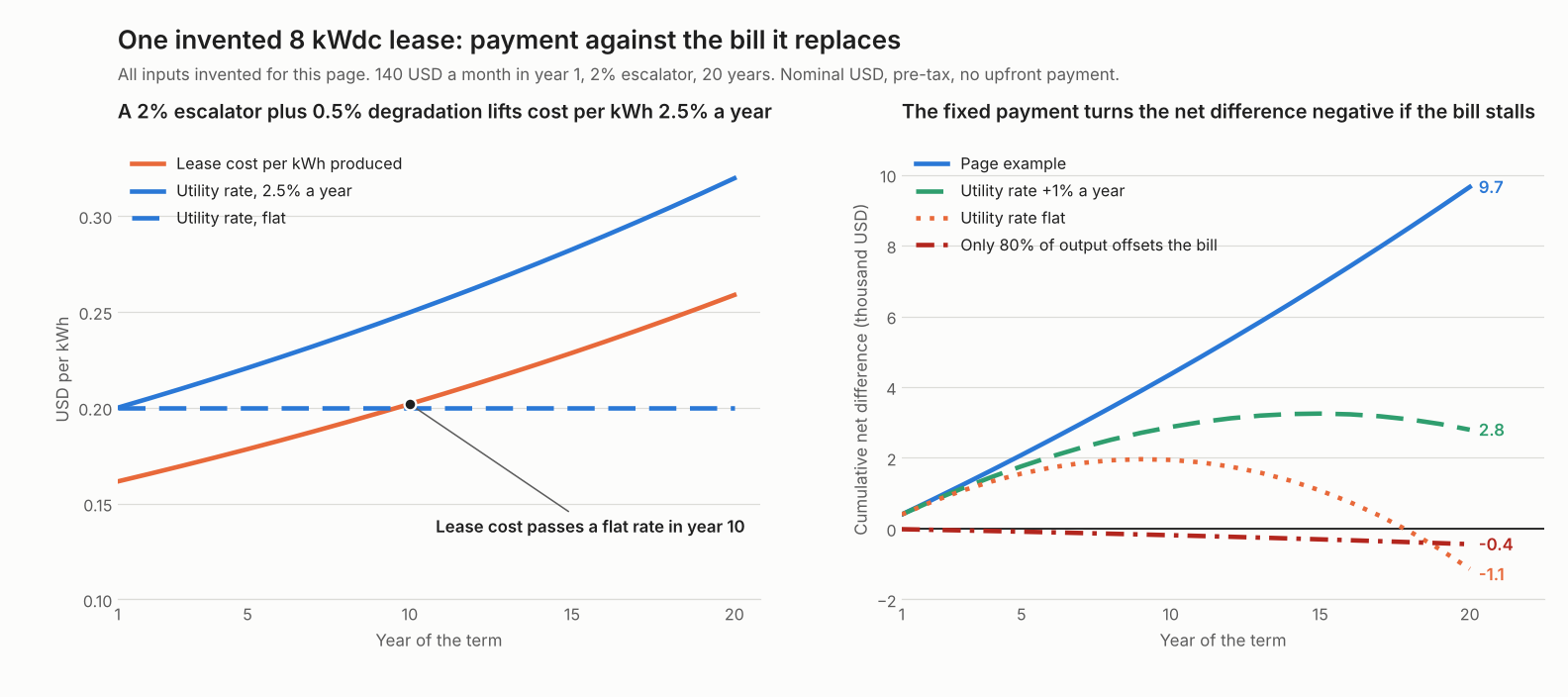
Figure 1. In this example’s lease, cost per kWh rises 2.5% a year and passes a flat utility rate in year 10.
How does a solar lease differ from a loan, a PPA and third-party ownership?
In a lease the owner keeps the system. The host pays a fixed scheduled amount. In a loan the host owns the system. In a PPA the host pays for energy produced. Lease and PPA are both third-party ownership.
| Item | Lease | Loan | PPA |
|---|---|---|---|
| Owner of the system | Third party (the lessor) | Host | Third party |
| Host pays | Scheduled payment, usually monthly | Repayments on the borrowed sum | Price for energy produced |
| Moves with output? | No, unless the contract says so | No | Yes |
| End of term | Renew, remove or buy at fair market value (NREL, 2014) | Host already owns the system | Contract sets the options |
Lease payments are "either fixed or escalate at a known rate", and under a PPA the homeowner "only pays for the energy produced by the system" (NREL, 2014). With a loan the host owns the system and claims incentives directly (CESA and NYSERDA). See power purchase agreement and solar loan for those two.
Who claims tax benefits on a leased system?
The lease owner usually does, per a Treasury advisory and a 2014 NREL guide. NREL’s guide predates the 2025 rule changes and the Treasury advisory is undated, so read each statement with its date. This is not tax advice.
- The Treasury’s solar scam advisory (undated) says "The tax credits and incentives go to the system’s owner".
- NREL’s guide (July 2014) says the lessor receives the tax benefits and incentives. It predates the 2025 changes.
- IRS FAQ FS-2025-05 (21 August 2025) covers the residential clean energy credit. It says the credit "will not be allowed for any expenditures made after December 31, 2025". It does not mention leased systems.
- IRS Notice 2025-42 prints no issue date. It covers sections 45Y and 48E for wind and solar facilities, not the residential clean energy credit. A tax adviser can say which rules reach a given lease.
See third-party ownership, investment tax credit and solar incentives and rebates for more.
What must a lease model include?
Model the payment, the escalator, the term and what happens at the end. Then test the output and bill assumptions. The payment will not move with them.
- Payment fields: monthly payment in year 1, annual escalator and term. New Jersey’s lease disclosure form (2025) has fields for the term and the number of payments. It also asks for the first-year monthly payment and the escalator.
- Upfront payment: NREL (2014) says a prepaid lease is one payment up front with no monthly obligations. Aurora’s help calls its upfront field a collateral amount. Confirm which one the contract means.
- Output: use degraded kWh. NREL’s guide says typical degradation rates "are assumed to be 0.5% annually". See degradation rate.
- Bill offset: the host’s tariff and escalation, and export rules under net metering. See tariff rate databases and utility rate escalation.
- Guarantee and upkeep: the CESA and NYSERDA guide says providers commonly give minimum production guarantees. It says most leases cover maintenance but may not cover inverter replacement. Our example leaves guarantees out.
- Contract risks: the New Jersey form also asks about the production guarantee and transfer on sale. It asks whether the lessor will "File a fixture filing or a UCC-1 on the system". These are contract terms, not cash flows.
The owner’s side is different. The payments are revenue against the owner’s capex and opex, in a project finance model. Decide whether site-specific adders sit in the monthly payment or an upfront payment.
Worked example: an 8 kWdc lease over 20 years
This example’s lease pays 40,820 USD against 50,476 USD of bill offset. The net difference is 9,656 USD. The cost per kWh climbs every year.
| Input (example) | Value |
|---|---|
| System and energy | 8 kWdc. 1,300 kWh per kWdc in year 1 (10,400 kWh). 0.5% degradation a year. 20 years |
| Lease | 140 USD per month in year 1 (1,680 USD a year). 2% escalator. No upfront payment. Owner pays upkeep |
| Bill offset | 0.200 USD per kWh in year 1, rising 2.5% a year. 100% of output offsets the bill |
| Discount rate | 7% nominal. Year-end flows |
| Left out | Tax, production guarantee, buyout, removal, fees, transfer |
The lease costs less than the bill it offsets in every year of this example, and the gap is small. Net difference is bill offset minus lease paid. Both the lease cost per kWh and the utility rate rise 2.5% a year from year 2.
| Year | kWh | Lease paid (USD) | Lease per kWh (USD) | Utility rate (USD per kWh) |
|---|---|---|---|---|
| 1 | 10,400 | 1,680 | 0.1615 | 0.2000 |
| 5 | 10,194 | 1,818 | 0.1784 | 0.2208 |
| 10 | 9,941 | 2,008 | 0.2020 | 0.2498 |
| 15 | 9,695 | 2,217 | 0.2286 | 0.2826 |
| 20 | 9,455 | 2,447 | 0.2588 | 0.3197 |
| 20-year total | 198,410 | 40,820 |
The same years, as bill offset and net difference:
| Year | Bill offset (USD) | Net difference (USD) |
|---|---|---|
| 1 | 2,080 | 400 |
| 5 | 2,250 | 432 |
| 10 | 2,483 | 475 |
| 15 | 2,740 | 523 |
| 20 | 3,023 | 576 |
| 20-year total | 50,476 | 9,656 |
Cost per kWh grows (1.02 ÷ 0.995) − 1 = 2.5% a year. The utility rate also grows 2.5% a year. So lease cost per kWh stays at 80.8% to 81.0% of it in every year. The next table changes one input at a time and leaves the rest as above.
| Case (example) | 20-year net difference (USD) | NPV at 7% (USD) | First year lease costs more |
|---|---|---|---|
| Page example | 9,656 | 4,903 | none |
| Lease escalator 0% | 16,876 | 7,803 | none |
| Bill offset 80% of plan output | -439 | -217 | year 1 |
| Utility rate escalation 0% (flat) | -1,138 | 552 | year 10 |
| Utility flat and lease escalator 3% | -5,460 | -1,147 | year 8 |
With the utility rate flat, the total is -1,138 USD, yet the NPV is still 552 USD because early years carry more weight. The 20-year total breaks even when 80.9% of output offsets the bill. The NPV breaks even at 80.8%.
Calculator: test a lease payment
Enter your own inputs. It reproduces the tables above. It warns on blank, negative, out-of-range or ambiguous values. Open the solar lease calculator on its own page if the frame does not load.
How solar software handles a solar lease
Aurora and Solargraf list a monthly payment and an escalation rate on their help pages, while Scanifly lists no monthly payment field. Ratings follow each company’s own help page, checked October 2026. Partly means the page lists some lease inputs but not all. Not stated means the company page we cite does not say.
| Software | Models a lease? | What the page lists | Source and date |
|---|---|---|---|
| Aurora Solar | Yes | Admins create custom leases for Sales Mode. Inputs: monthly payment or pricing matrix, escalation rate, upfront payment. Term and buyout are not mentioned | Aurora help, Custom Leases and PPAs, updated 17 April 2026 |
| Solargraf | Yes | Fields: monthly payment, escalator, term, optional buyout amount, lender and rate type. How savings are shown is not described | Solargraf help, How to Add a Lease, published 21 July 2023 |
| Scanifly | Partly | A lease uses an initial rate, escalator, term in years and degradation percent. A monthly payment is not listed as a lease input | Scanifly help, select a financing option, undated |
| ARKA 360 | Partly | Setup names upfront and monthly payment. The Financing tab shows price, escalation rate, upfront payment and a cash flow graph. Term is not listed | ARKA 360 help, 16 December 2024 |
| HelioScope | Not stated | The glossary lists cash, loan and PPA financing. The text checked does not mention a lease | HelioScope Financial Modeling Glossary, undated |
The best solar proposal software list covers more tools.
Common mistakes with a solar lease
FAQs
Is a solar lease the same as a loan?
No. In a lease the owner keeps the system. The host pays for its use. In a loan the host owns the system and repays the money borrowed. The CESA and NYSERDA guide (2016) says the same.
Does the host own the system at the end of a lease?
Not automatically. The Treasury’s advisory says "At the end of your lease you will not automatically own the system". NREL (2014) lists renewal, removal or purchase at fair market value as the options. The contract decides the price.
Who claims the tax credit on a leased system?
Usually the owner, per two federal documents: the undated Treasury advisory and NREL (2014). Rules changed in 2025, and the tax section dates each IRS text. A tax adviser can say which rules reach a given lease.
Solar lease vs PPA: what is the difference?
A lease payment is a scheduled amount that usually does not move with output. A PPA charges for the energy the system produces. In both, a third party owns the system.
Is a solar lease worth it?
Only if the system offsets enough of the bill. In our example the 20-year total breaks even at 80.9% of output offsetting the bill. Below that the lease costs more than it saves. Test your own inputs in the calculator above.
Related terms
- Third-party ownership: the wider structure where someone else owns the system.
- Power purchase agreement: the host pays for energy produced, not a fixed amount.
- Solar loan: the host owns the system and repays the borrowed sum.
- Financing side: see the best solar financing platforms for installers.
Next step: before you quote a lease, confirm your tool holds the payment, escalator, term and end-of-term fields from the model list. Compare tools in the best solar proposal software. For the owner’s finance side, see the best solar financial modeling software.
Sources
- NREL: Homeowners Guide to Leasing a Solar Electric System, July 2014 (checked October 2026).
- CESA and NYSERDA: Homeowner’s Guide to Solar Financing, Leases, Loans and PPAs, 2016 cover date (checked October 2026).
- U.S. Department of the Treasury: Consumer Advisory: Solar Energy Scams are Against the Law (scam advisory), undated (checked October 2026).
- IRS: FAQs on One, Big, Beautiful Bill changes to home energy credits, FS-2025-05, 21 August 2025 (checked October 2026).
- IRS Notice 2025-42, no issue date printed on the PDF. It covers sections 45Y and 48E. Also reported by Jones Day (checked October 2026).
- NJ Clean Energy: ADI Program Solar Lease Disclosure Form, footer 2025 (checked October 2026).
- Company help pages: Aurora, Solargraf, Scanifly, ARKA 360 and HelioScope (checked October 2026).
- Calculation: SolarSoftwares model. Every input is our assumption.
Last updated 30 October 2026. Next scheduled review: 30 January 2027.