A CRM for solar EPCs is customer relationship software (an app that tracks leads, deals and customers) that also follows each job after the contract is signed. Coperniq ranks first on this list, at 63.5/100.
We scored 10 products: 6 ranked, 3 general and 1 also considered. Salesforce (63.0) and Zoho CRM (61.4) score close to the top, mainly because they have thousands of user reviews. They are general CRMs with no solar-specific features, so we list them separately.
This page is for EPCs: firms that sell, engineer, procure and build. Many work across residential and commercial jobs, with their own crews or subcontractors. If you mainly sell residential systems, our best solar CRM guide covers the wider market. For setter and closer floors, see CRM for solar sales teams.
Quick picks
Rank | Product | Best for | Starting price (company page, checked October 2026) | Pricing model | Free plan / trial | Score /100 |
|---|---|---|---|---|---|---|
1 | Small-to-mid EPCs running sales, crews and O&M together | ✓ USD 90 per user per month (Field). USD 200 (Office) | Per seat | Demo only | 63.5 | |
2 | Existing users of a US sales-to-workflow suite (status unconfirmed) | ✓ From USD 90 per licence (3 minimum. Period not stated) | Per licence | Demo only | 56.3 | |
3 | Mid-to-large EPCs and asset owners on NetSuite | Quote only, plus NetSuite licence | Custom | Demo only | 54.3 | |
4 | Residential EPCs wanting CRM, projects and inventory in one suite | ✓ From USD 59 per user per month | Per user, custom modules | None. Trial not confirmed | 53.7 | |
5 | Rooftop EPCs in India | Quote only | Not published | Unknown | 52.3 | |
6 | EPCs whose bottleneck is field and service operations | Quote only | By modules and volume. Unlimited users | Demo only | 47.5 |
✓ Verified on the company’s own pricing page. ◐ Published by the company outside its pricing page (help centre, store or press release). ? We could not read the company’s pricing page, so the figure is not confirmed. Prices checked October 2026.
Quote only means the company shows no public price. You ask it for a quote.
How did the 9 tools score?
- Use-case fit 35%
- User reviews 20%
- Pricing 15%
- Ease of use 10%
- Support 10%
- Momentum 10%
Tool | Score chart | Score |
|---|---|---|
63.5 out of 100 | 63.5 | |
56.3 out of 100 | 56.3 | |
54.3 out of 100 | 54.3 | |
53.7 out of 100 | 53.7 | |
52.3 out of 100 | 52.3 | |
47.5 out of 100 | 47.5 | |
Salesforce Sales Cloud (general) | 63 out of 100 | 63.0 |
Zoho CRM (general) | 61.4 out of 100 | 61.4 |
50.1 out of 100 | 50.1 |
Each bar shows the weighted score out of 100. Tools marked (general) are general tools that are not solar-specific.
Sub-scores at a glance (0-10)
Product | Use-case fit | User reviews | Pricing | Ease of use | Support | Momentum | Total /100 |
|---|---|---|---|---|---|---|---|
8.0 | 5.0 | 7.0 | 5.0 | 5.0 | 5.0 | 63.5 | |
6.7 | 5.0 | 7.0 | 5.0 | 5.0 | 2.5 | 56.3 | |
6.7 | 5.0 | 4.0 | 5.0 | 5.0 | 5.0 | 54.3 | |
5.2 | 5.0 | 7.0 | 5.0 | 5.0 | 5.0 | 53.7 | |
6.7 | 5.0 | 4.0 | 5.0 | 5.0 | 3.0 | 52.3 | |
4.0 | 5.0 | 4.0 | 5.0 | 5.0 | 7.5 | 47.5 | |
Salesforce Sales Cloud (general) | 6.0 | 7.0 | 7.0 | 5.0 | 7.5 | 5.0 | 63.0 |
Zoho CRM (general) | 6.0 | 6.2 | 7.0 | 7.5 | 5.0 | 5.0 | 61.4 |
5.3 | 6.0 | 3.0 | 5.0 | 5.0 | 5.0 | 50.1 |
A 5.0 on reviews, ease, support or momentum is our neutral score. We use it when public evidence is thin. It is not a judgement.
General CRMs scored on the same rubric: Salesforce Sales Cloud 63.0, Zoho CRM 61.4, Odoo 50.1. See general tools installers also use.
Should a solar EPC choose a CRM, an operations platform or an ERP?
A residential installer can live in a sales CRM. An EPC cannot, because the costly mistakes happen after the contract is signed.
A permit gets stuck with the AHJ (local permitting authority). Modules get ordered against the wrong BOM (bill of materials). A crew turns up at a site that is not ready, or an invoice goes out before the milestone.
So the EPC question is less "which CRM" and more "where does the CRM stop". There are three answers:
- Sales CRM: Leads, deals and proposals. Fine for the front end, but blind after signature.
- Operations platform: CRM plus project phases, scheduling, field apps and service. Coperniq, SolarNexus, Sunbase, Solar Ladder and Scoop Solar sit here.
- Solar ERP (enterprise resource planning): CRM and projects tied to accounting, procurement and inventory. SolarSuccess is the only solar-specific product here that does this, on NetSuite. Odoo does it as a general suite.
Few solar CRMs are built for C&I (commercial and industrial) pipelines. Most are residential sales tools. Among the ranked products, only SolarSuccess and Scoop Solar document utility-scale work (very large solar farms).
Tools that document no commercial work score lower on this page. That is why Sunbase drops here. For deeper project tools, see our solar EPC project management and solar ERP guides.
How did we rank these CRMs for solar EPCs?
How the score is weighted
- Use-case fit 35%
- User reviews 20%
- Pricing 15%
- Ease of use 10%
- Support 10%
- Momentum 10%
We scored 10 products from 22 to 25 October 2026. We used company documents, pricing pages and public user reviews.
Each product is scored on six criteria:
- Use-case fit (35%): How well the tool does this page’s job. CRM depth counts most, then project management. Tools with no documented C&I work score lower.
- User reviews (20%): Ratings from G2 and Capterra, two software review sites. Ratings based on only a few reviews count for less. None of the six ranked products has 8 or more reviews, so all get a middle score.
- Pricing (15%): Published prices score higher than prices you must ask for, or figures from third parties.
- Ease of use, support and momentum (10% each): Taken from review sub-scores and dated release notes. Without evidence, a tool gets a middle score here.
Products below our minimum match score (4 out of 10) go to "Also considered". General tools use the same rubric but stay out of the solar ranking.
SurgePV is not part of this ranking. Read the full method: how we score software.
1. Coperniq: best for small-to-mid EPCs running sales, crews and O&M together
Best for: US and Canadian EPCs doing residential and commercial work with their own crews and a service book. Score: 63.5/100.
What it is: Coperniq is an operations platform for solar, storage and other trades, made by US company Coperniq Inc. Its CRM keeps the project pipeline inside the customer record. Small-to-mid installers and service firms use it to carry each job from survey to PTO (permission to operate), then into maintenance.
Why we picked it: It carries a job from sale to crew to service in one system, which is what an EPC needs from a CRM. It also publishes seat prices, which half the tools here do not.
Key features:
- Phase workflows from site survey to PTO.
- Scheduling, dispatch and route optimisation with live technician tracking.
- Offline iOS and Android field app with forms and GPS-stamped photos.
- O&M tools: maintenance memberships, work orders and spare-parts inventory.
- Homeowner portal with production data and service tracking.
- AI voice agent for inbound calls.
Pricing: Field is USD 90 per user per month for the crew mobile app. Office is USD 200 per user per month for CRM, scheduling and dispatch, work orders, invoicing, project financials, workflows and reporting. AI features and add-ons cost extra, with no figures shown. Checked October 2026 on the Coperniq pricing page. Third-party listings show a different starting price, so confirm seat prices in the demo.
Pros (from our research):
- Published seat prices, with a cheaper Field seat for crews than for office staff.
- Covers the post-sale phases (permit, inspection, PTO) that sales CRMs skip.
- Service and O&M are built in, so your install base stays in one system.
Cons (from our research):
- No user reviews: G2 shows no score and Capterra has 0 reviews.
- No named connections to other apps on the pages we read, so check accounting and design links.
- No procurement or project accounting beyond invoicing and project financials.
Reviews: None on G2 or Capterra as of October 2026.
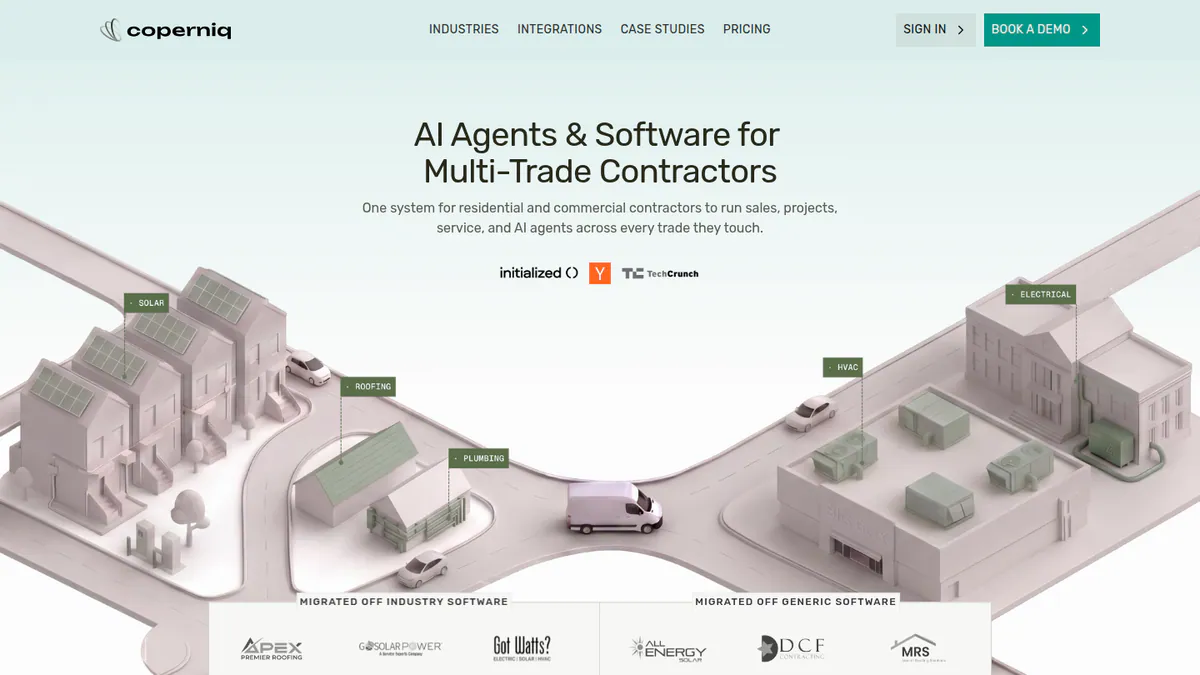
Want to see Coperniq working? Book a demo with the SolarSoftwares team.
Book a demoYour request goes by email to the SolarSoftwares team. A time is set only after we reply. It does not change any score or ranking.
2. SolarNexus: best for existing users of a US sales-to-workflow suite
Best for: US residential and small commercial installers already on SolarNexus (status unconfirmed: it may not be sold to new customers). Score: 56.3/100.
What it is: Built for US residential and small commercial installers, SolarNexus is solar business software. It combines lead capture, array design with hourly energy modelling, proposals and custom project workflows. Solo bought it in September 2023, and its help pages now sit on Solo’s site. Note: we could not confirm that SolarNexus is still sold to new customers.
Why we picked it: It joins the sales pipeline, design and custom project workflows, so office staff can track each job in one place. A published price per licence also helps, though its status for new buyers is unclear.
Key features:
- Lead capture and sales pipeline.
- Array design on aerial imagery with a module database.
- Cash flow, financing, incentive and tax estimates.
- Custom workflows, automatic task assignment and workload balancing.
- Mobile app and automated customer progress emails.
Pricing: From USD 90 per licence, with a 3-licence minimum and volume discounts. The billing period is not stated. Checked October 2026 on the SolarNexus solutions page.
Pros (from our research):
- Workload balancing spreads tasks across project staff.
- Design and energy modelling sit in the same system as the pipeline.
- A low published price per licence lets you budget before a demo.
Cons (from our research):
- The latest release notes we found are from February 2024.
- You must buy at least 3 licences.
- No user reviews to judge it by.
Reviews: None found as of October 2026.
Read our full SolarNexus review.
Want to see SolarNexus working? Book a demo with the SolarSoftwares team.
Book a demoYour request goes by email to the SolarSoftwares team. A time is set only after we reply. It does not change any score or ranking.
3. SolarSuccess: best for mid-to-large EPCs and asset owners on NetSuite
Best for: US EPCs doing 20 or more residential installs a month, multi-entity C&I or utility developers, and asset owners. Score: 54.3/100.
What it is: SolarSuccess is a solar business suite built on Oracle NetSuite by Blu Banyan, a NetSuite solution provider. It covers CRM, project management, accounting, service and asset management. The company names BayWa r.e., Titan Solar Power and All Energy Solar as clients.
Why we picked it: It is the one solar-specific tool here that links the CRM to purchasing, stock and the general ledger. It also covers residential, C&I and utility work.
Key features:
- Solar CRM with lead routing, a deal pipeline and a two-way link to proposal tools.
- Commission calculation, including adders (extra charges), redlines (price floors) and milestones.
- Milestone-triggered invoicing with WIP (work in progress) and deferred-revenue journals.
- Asset management for PPA (power purchase agreement) and community-solar production billing.
- Service ticketing and warranty management.
- Optional ERP & Inventory module: distributor purchasing, real-time stock, project BOMs synced to sales orders, and multi-subsidiary or multi-SPV (project company) books. It can install into an existing NetSuite account. See our solar inventory management guide.
Pricing: Quote only, after a discovery call. You also need an Oracle NetSuite licence. Twice-yearly updates are included, and premium support packages cost extra. Checked October 2026 on the Blu Banyan solar solutions page.
Pros (from our research):
- The only solar-specific product here that ties CRM, procurement and the general ledger together.
- Covers residential, C&I and utility work, including multi-entity structures.
- The company states a templated go-live in 3-4 months, so you can plan the switch.
Cons (from our research):
- NetSuite licence and implementation costs are not published.
- No user reviews on G2 or Capterra.
- Several new modules are marked "coming soon" with no dates.
Reviews: None found as of October 2026.
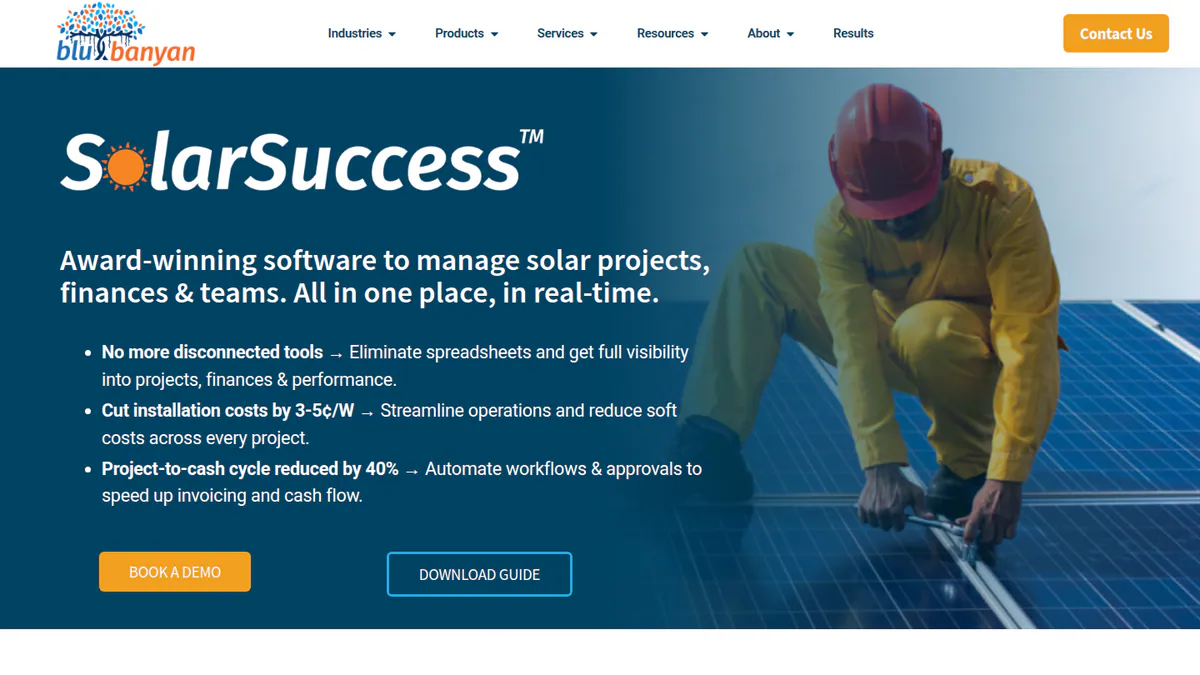
Want to see SolarSuccess working? Book a demo with the SolarSoftwares team.
Book a demoYour request goes by email to the SolarSoftwares team. A time is set only after we reply. It does not change any score or ranking.
4. Sunbase: best for residential EPCs wanting CRM, projects and inventory in one suite
Best for: US residential EPCs that sell and install their own jobs. Score: 53.7/100.
What it is: Sunbase is a modular suite from Sunbase Data. It covers CRM, proposals, project management, inventory and finance, and it is sold to residential solar installers and to roofing and construction contractors. We found no documented commercial or utility work, so it scores lower on this page.
Why we picked it: It puts CRM, projects and inventory in one suite at a published entry price. That suits an EPC that buys and stores its own kit.
Key features:
- Lead and sales pipeline.
- Proposals, estimates and e-sign contracts.
- Built-in solar design with shading and production estimates.
- Project management and workflow automation.
- Inventory and asset management.
Pricing: From USD 59 per user per month. The final price is custom-quoted by users, modules, workflows and onboarding. Checked October 2026 on the Sunbase pricing page.
Pros (from one Capterra review and our research):
- Inventory and projects sit alongside the CRM at a published entry price.
- Automated emails and tasks save time.
- No long-term contract, so you can leave if it does not fit.
Cons (from that review and our research):
- Residential only, with no C&I pipeline features documented.
- Setup is hard for non-technical admins.
- Company pages name no connections to other apps.
Reviews: Capterra 4.0/5 (1 review), checked October 2026.
What we could not confirm: whether Sunbase offers a free trial.
Read our full Sunbase review or our Sunbase alternatives.
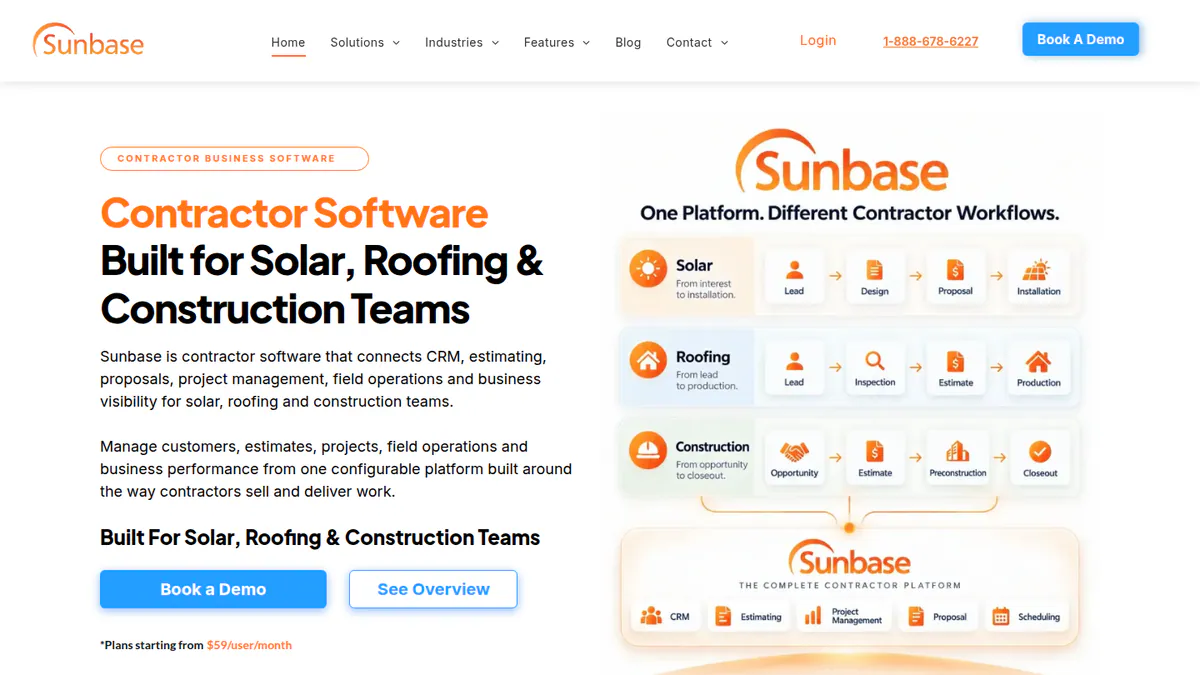
Want to see Sunbase working? Book a demo with the SolarSoftwares team.
Book a demoYour request goes by email to the SolarSoftwares team. A time is set only after we reply. It does not change any score or ranking.
5. Solar Ladder: best for rooftop EPCs in India
Best for: Small and mid-sized Indian EPCs doing residential and C&I rooftop work. Score: 52.3/100.
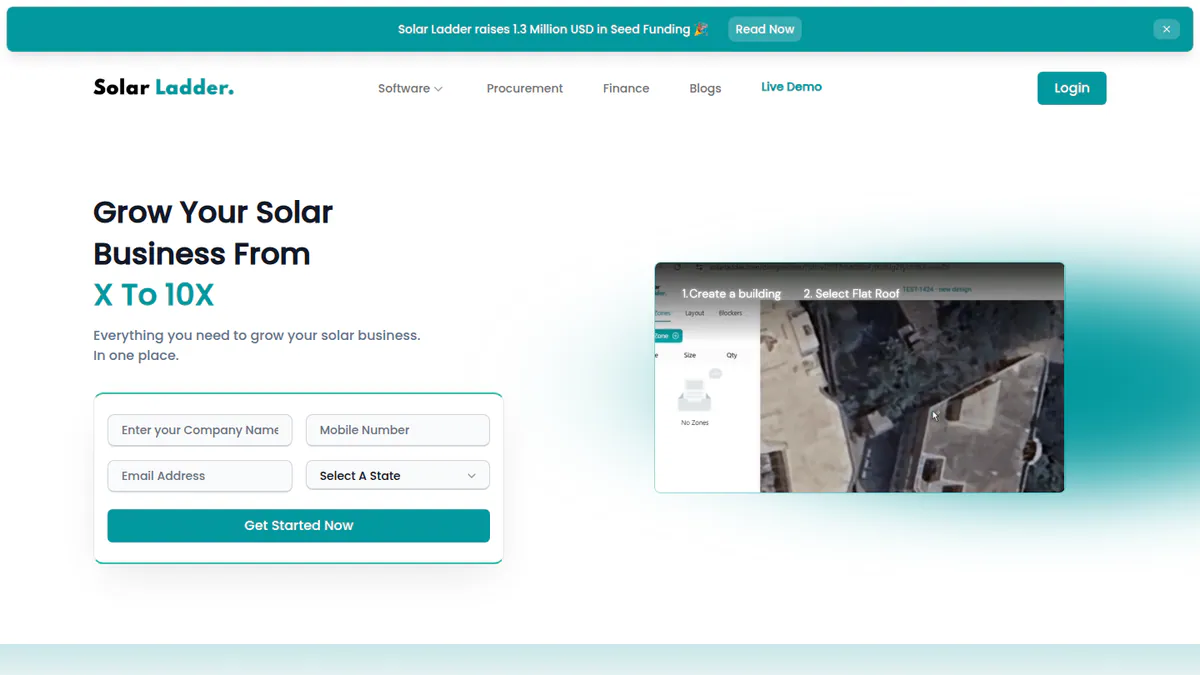
What it is: Solar Ladder is an operations platform for rooftop EPCs from Abhimanhan Energy in Mumbai. It adds component procurement and financing to CRM and project management. Note: we could not open Solar Ladder’s website, so its features and prices are unconfirmed. The features below come from its own G2 and App Store text.
Why we picked it: It adds parts buying and BOM costing to the CRM, which matters to rooftop EPCs on tight margins. It is also the only tool here built for Indian installers.
Key features:
- Solar CRM and sales pipeline.
- Branded proposals and basic 3D design with shading.
- Project management, tasks, site surveys and forms.
- BOM-based cost tracking.
- Component procurement marketplace and working-capital finance.
Pricing: Quote only, as G2 says the company lists no prices. A 2023 press report said the sales module was free, with paid modules as EPCs scale. We could not confirm this is still true. Checked October 2026 via G2.
Pros (from our research):
- Procurement and BOM costing sit next to the CRM, which suits margin-sensitive rooftop EPCs.
- Built for Indian rooftop EPCs and their supply chain.
- O&M alerts and a customer dashboard keep clients informed after handover.
Cons (from our research):
- No user reviews: G2 and the App Store show 0.
- No published prices.
- Not suited to markets outside India.
Reviews: None on G2 or the App Store as of October 2026.
Read our full Solar Ladder review.
Want to see Solar Ladder working? Book a demo with the SolarSoftwares team.
Book a demoYour request goes by email to the SolarSoftwares team. A time is set only after we reply. It does not change any score or ranking.
6. Scoop Solar: best for EPCs whose bottleneck is field and service operations
Best for: EPCs and O&M contractors with many crews, subcontractors and service calls, from residential to utility. Score: 47.5/100.
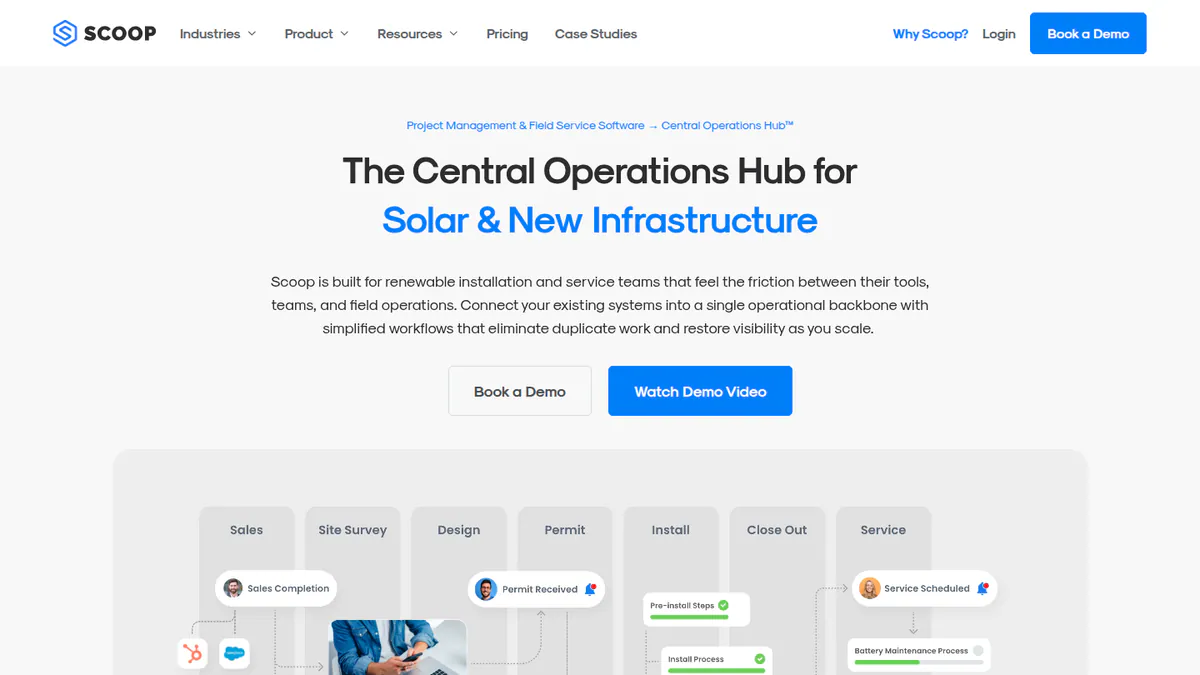
What it is: Scoop Solar is a field service and project operations hub from Vancouver for solar, storage, EV charging and wind O&M firms. It calls itself an operations hub, not a CRM, so it usually sits beside one and only just meets our minimum match score here.
Why we picked it: It is built around crews, subcontractors and service calls, where many EPCs lose time and money. It also covers work up to utility scale.
Key features:
- Project workflows with conditional rules and required forms.
- Offline field app with geotagged photos.
- Crew scheduling, dispatch and service calls.
- Subcontractor portal with scoped permissions.
- Preventive maintenance, asset history and SLA (service level agreement) records.
- Inventory, price book and quoting module.
Pricing: Quote only, based on modules, workflows and install or service volume. Every plan includes unlimited users, storage and devices. Checked October 2026 on the Scoop pricing page.
Pros (from our research):
- Unlimited users suit EPCs with large or seasonal crews.
- A subcontractor portal gives outside crews limited access, set by you.
- Its TrustRadius listing names connections to Aurora Solar, OpenSolar, NetSuite, QuickBooks Online and HubSpot.
Cons (from our research):
- Not a CRM, so lead and deal management need another tool.
- No reviews on G2 or Capterra, and one review on TrustRadius.
- Onboarding needs executive commitment, according to the company FAQ.
Reviews: None on G2 or Capterra as of October 2026.
Read our full Scoop Solar review.
Want to see Scoop Solar working? Book a demo with the SolarSoftwares team.
Book a demoYour request goes by email to the SolarSoftwares team. A time is set only after we reply. It does not change any score or ranking.
Which general CRMs do installers also use?
These three tools are not solar-specific. We scored them on the same rubric as the solar products and list them in score order.
Large review bases lift their scores. But you or a partner must build the solar stages, permits, BOMs and PTO steps.
Salesforce Sales Cloud (general CRM): 63.0/100
Salesforce Sales Cloud is a highly customisable CRM. Once an administrator builds the objects and flows, it covers residential, commercial and utility pipelines. Its forecasting and reporting suit long commercial sales cycles.
OpenSolar partners and the Aurora API (a way for other apps to connect) give you routes to link it to solar tools. We found no packaged solar template.
Pricing: Free Suite costs nothing. Starter Suite is AUD 35 and Pro Suite AUD 140 per user per month. Core is USD 195, Advanced USD 395 and Max USD 550 per user per month, billed annually, as listed on Salesforce’s Australian page. Checked October 2026 on the Salesforce pricing page.
Reviews: Capterra 4.4/5 (18,816 reviews), checked October 2026. Reviewers praise reporting and customisation. They warn of a steep learning curve and reliance on an admin.
Zoho CRM (general CRM): 61.4/100
Zoho CRM is a low-cost, customisable CRM. Blueprints map your process steps, and it links into Zoho Books, Desk and Sign. Aurora publishes an API tutorial for creating projects from Zoho, and partners build solar customisations.
Pricing: Free for up to 3 users. Standard is INR 800, Professional INR 1,400, Enterprise INR 2,400 and Ultimate INR 2,600 per user per month, billed annually (monthly billing costs more). We could not confirm USD prices. Checked October 2026 on Zoho’s edition comparison.
Reviews: Capterra 4.3/5 (7,005 reviews) and G2 4.1/5 (2,947), checked October 2026. Reviewers praise value for money and customisation, but setup often needs outside help.
Odoo (general CRM and ERP): 50.1/100
Odoo is a modular business suite. Its CRM, sales, inventory, accounting and project apps share one database.
A third-party solar installation module from Probuse costs USD 484.92 on the Odoo Apps Store. It adds estimates, projects, job costing and site visits, and it is not made by Odoo S.A.
Pricing: We could not load Odoo’s pricing page. Capterra lists Standard at USD 31.10 and Custom at USD 61 per user per month, plus a free version. We could not check these figures on the company’s own site. Checked October 2026 via Capterra.
Reviews: Capterra 4.2/5 (1,335 reviews), checked October 2026. Reviewers like how the apps connect. They say heavy customisation makes upgrades expensive.
How do the 6 solar CRMs compare for EPCs?
Product | Solar-specific | Segments documented | Project phases | Crew / field app | Procurement and inventory | Accounting | Starting price |
|---|---|---|---|---|---|---|---|
Yes (also other trades) | Residential, C&I | Survey to PTO | Yes, offline | Spare parts (O&M) | Invoicing, project financials | USD 90/user/mo | |
Yes | Residential, C&I | Custom workflows | Mobile app | Not documented | Not documented | USD 90/licence | |
Yes | Residential, C&I, utility | Milestone-based | Not documented | Yes (ERP & Inventory) | Full ledger (NetSuite) | Quote + NetSuite | |
Yes (also roofing) | Residential | Yes | Not documented | Inventory | Financial tools | USD 59/user/mo | |
Yes | Residential, C&I (India) | Yes | Mobile app (iOS) | Procurement marketplace | BOM cost tracking | Quote only | |
Yes (plus storage, EV, wind) | Residential, C&I, utility | Configurable | Yes, offline | Inventory module | Via integrations | Quote only | |
Salesforce Sales Cloud | No | Any (custom build) | Custom build | Not documented | Not documented | Not documented | AUD 35/user/mo |
Zoho CRM | No | Any (custom build) | Blueprints | Not documented | Via Zoho apps | Via Zoho Books | Free. INR 800/user/mo |
No | Any (custom build) | Project app | Not documented | Inventory app | Accounting app | Not checked with the company |
Also considered
- Enact (Design & Proposals) (below the minimum score): a design, proposal and fleet-monitoring platform. It bought PVComplete (PVCAD) in January 2026. It helps with EPC engineering but has little CRM. We could not check its features or pricing on the company site. See solar design software for EPCs.
How do you choose a CRM for a solar EPC?
- Small-to-mid EPC with your own crews and a service book? Pick Coperniq. Price Office seats for the back office and Field seats for crews.
- Running 20 or more installs a month, several legal entities or SPVs, or billing PPA production? Shortlist SolarSuccess and budget for NetSuite.
- When sales are fine but crews, subcontractors and service calls are slipping, add Scoop Solar beside your CRM.
- For a US residential EPC that wants inventory next to the CRM at a published entry price, look at Sunbase.
- Rooftop EPCs in India have one solar-specific option here, Solar Ladder. Ask for references, because it has no public reviews.
- Already have a Salesforce or Zoho admin? Keep that CRM and connect a solar operations tool. That beats rebuilding PTO and permit stages yourself.
- Need commercial proposals rather than a CRM? See our commercial solar proposal software guide.
Want the wider field? Browse every tool we checked in our CRM and lead management category.
Solar EPC CRM FAQs
What software do solar EPC companies use?
Most EPCs combine a CRM, a design tool, a project or field-service platform and accounting software. In our October 2026 scoring, Coperniq (63.5/100) led the solar CRMs for EPC work, and Salesforce (63.0) was the strongest general CRM. Our EPC project management guide covers the build side.
Does a solar EPC need a CRM or an ERP?
A CRM is enough while procurement and accounting stay simple. Once you manage stock, several entities or milestone billing at volume, look at an ERP route such as SolarSuccess on NetSuite. Its maker targets installers doing 20 or more installs a month (checked October 2026).
Which solar CRM suits an EPC with a sales team and site crews?
Coperniq suits an EPC with both a sales team and site crews. It documents both sides at published prices (checked October 2026). Office seats cost USD 200 per user per month for CRM and dispatch. Field seats cost USD 90 for the crew app. Scoop Solar covers crews with unlimited users but needs a separate CRM.
Can a solar CRM handle commercial project pipelines and procurement?
Few can. SolarSuccess documents C&I and utility work, with distributor purchasing and BOMs synced to sales orders. Solar Ladder lists a procurement marketplace for Indian rooftop EPCs. Most residential solar CRMs, including Sunbase, document no commercial pipeline as of October 2026.
How should an EPC connect CRM, design and project management tools?
Pick one system of record for the customer and the job, then connect design and accounting to it. Scoop’s TrustRadius listing names connections to Aurora Solar, OpenSolar, NetSuite and HubSpot. SolarSuccess connects to OpenSolar and DocuSign (checked October 2026). Ask each company to demo the hand-off working, not a logo slide.
Sources
All checked 22 October 2026. Coperniq, SolarNexus, Sunbase and Scoop Solar re-checked 25 October 2026.
- Coperniq: pricing, product site
- SolarNexus: solutions and pricing, 2024 release notes
- SolarSuccess: solar solutions, solar ERP FAQ, Solar Power World, August 2021
- Sunbase: pricing, Capterra
- Solar Ladder: G2 pricing, G2 listing, App Store
- Scoop Solar: pricing, FAQ, TrustRadius
- Salesforce Sales Cloud: pricing, Capterra
- Zoho CRM: edition comparison, Capterra, G2
- Odoo: Capterra, Odoo Apps Store solar module
- Enact: Solar Power World, January 2026
Last updated 28 October 2026. Next scheduled review: 23 January 2027.