Reonic alternatives are solar design, proposal and sales tools you can use instead of Reonic, a German all-in-one platform for installers. Aurora Solar ranks first at 85.3/100, but it is built for the US. In Germany, Austria and Switzerland, PV*SOL premium is the closest regional fit.
This guide compares 10 tools by region, price and scope. Reonic is demo-only and built around Germany.
Why do installers look for a Reonic alternative?
Reonic is a German all-in-one platform for installers, so the best Reonic alternatives have a lot to match. It covers 3D design, shading, proposals, CRM (software that tracks customers and sales) and project management. It handles solar, storage, wallboxes (home EV chargers) and heat pumps in one place.
Its home market is Germany, Austria and Switzerland (DACH). It is also in the UK and Brazil, and a 2024 report put it in France and Italy. Some of its services, such as grid registration and KfW support, work in Germany only. So installers elsewhere may find parts of the tool do not apply to them.
Price is the other common reason. Reonic publishes no prices and sells through a demo. Small installers who want to see a cost first often look elsewhere. Its reviews are also thin outside Trustpilot, and we found no dated release notes.
Reonic at a glance
Item | Reonic (checked October 2026) |
|---|---|
What it is | All-in-one installer platform from Reonic GmbH (Augsburg and Berlin): design, shading, proposals, CRM, project management. Solar, storage, wallboxes and heat pumps |
Pricing | Not published. "Book a demo" only |
Ratings | Trustpilot 4.5/5 (33 reviews). Capterra 0 reviews. No G2 listing found |
Regions | Core: Germany, Austria, Switzerland. Also UK and Brazil. France and Italy per a 2024 report |
Who it still suits | DACH installers who sell PV with heat pumps and wallboxes and want German grid registration and KfW help in one tool |
Source: Reonic product page and Trustpilot, checked October 2026.
Quick picks
Rank | Product | Best for | Starting price (company page, checked October 2026) | Main region | Score /100 |
|---|---|---|---|---|---|
1 | US home design and sales | ✓ USD 159/user/month | US | 85.3 | |
2 | UK installers who want a public price | ✓ GBP 4 per project | UK, IE, AU | 80.0 | |
3 | No licence fee | ✓ Free core platform | Global | 75.8 | |
4 | DACH design with heat pumps | ✓ EUR 845/year + VAT | Germany, Europe | 72.5 | |
5 | India | ✓ USD 159/month (international list) | India, US | 70.1 | |
6 | US permit packs | ? USD 2,799/year (2 users) | US, Canada | 68.0 | |
7 | C&I projects | ✓ USD 159/month | US | 66.6 | |
8 | Battery and off-grid jobs | ✓ USD 135/month (annual) | AU, NZ | 65.3 | |
9 | Australian rebate quotes | ✓ 4 per project (AUD implied) | Australia | 64.1 | |
10 | US teams with many reps | Quote only | US | 62.9 |
✓ Verified on the company’s own pricing page. ◐ Published by the company outside its pricing page (help centre, store or press release). ? We could not read the company’s pricing page, so the figure is not confirmed. Prices checked October 2026.
Quote only means the company shows no public price. You ask it for a quote.
How did the 10 tools score?
- Use-case fit 35%
- User reviews 20%
- Pricing 15%
- Ease of use 10%
- Support 10%
- Momentum 10%
Tool | Score chart | Score |
|---|---|---|
85.3 out of 100 | 85.3 | |
80 out of 100 | 80.0 | |
75.8 out of 100 | 75.8 | |
72.5 out of 100 | 72.5 | |
70.1 out of 100 | 70.1 | |
68 out of 100 | 68.0 | |
66.6 out of 100 | 66.6 | |
65.3 out of 100 | 65.3 | |
64.1 out of 100 | 64.1 | |
62.9 out of 100 | 62.9 |
Each bar shows the weighted score out of 100.
Sub-scores at a glance (0-10)
Product | Use-case fit | User reviews | Pricing | Ease of use | Support | Momentum | Total /100 |
|---|---|---|---|---|---|---|---|
10.0 | 7.9 | 8.0 | 7.5 | 7.5 | 7.5 | 85.3 | |
7.8 | 6.7 | 8.0 | 7.5 | 10.0 | 10.0 | 80.0 | |
8.5 | 5.0 | 9.0 | 7.5 | 5.0 | 10.0 | 75.8 | |
7.8 | 5.4 | 8.0 | 7.5 | 7.5 | 7.5 | 72.5 | |
7.4 | 6.3 | 6.0 | 7.5 | 10.0 | 5.0 | 70.1 | |
9.3 | 3.3 | 6.0 | 5.0 | 5.0 | 10.0 | 68.0 | |
7.0 | 6.2 | 8.0 | 7.5 | 5.0 | 5.0 | 66.6 | |
8.5 | 5.0 | 7.0 | 5.0 | 5.0 | 5.0 | 65.3 | |
7.0 | 5.0 | 8.0 | 5.0 | 5.0 | 7.5 | 64.1 | |
7.0 | 6.1 | 4.0 | 5.0 | 5.0 | 10.0 | 62.9 |
A 5.0 on reviews, ease, support or momentum is our neutral score. We use it when public evidence is thin. It is not a judgement.
How did we choose and score these Reonic alternatives?
How the score is weighted
- Use-case fit 35%
- User reviews 20%
- Pricing 15%
- Ease of use 10%
- Support 10%
- Momentum 10%
We scored 13 rivals from 22 to 25 October 2026. The 10 highest are ranked, and the last three sit under Also considered. We worked from company websites, price lists, release notes and user reviews. We did not run the tools ourselves. Reonic is left out of its own ranking. On this page, fit means the heart of Reonic’s job: 3D design, shading and sales proposals.
- Use-case fit (35%): Design, shading and proposals for home and small commercial jobs.
- User reviews (20%): Star ratings on G2, Capterra and Trustpilot. Fewer than eight reviews earns a neutral 5 out of 10.
- Pricing (15%): A price you can see, or a free way in, beats a demo-only sale.
- Ease of use, support and momentum (10% each): Based on review sub-scores and dated updates. A tool with no evidence gets a midpoint.
Region is not a score criterion, so we show it for every tool. Most tools here are solar-only, while Reonic also covers heat pumps. Read the full method.
1. Aurora Solar: best for US home design and sales
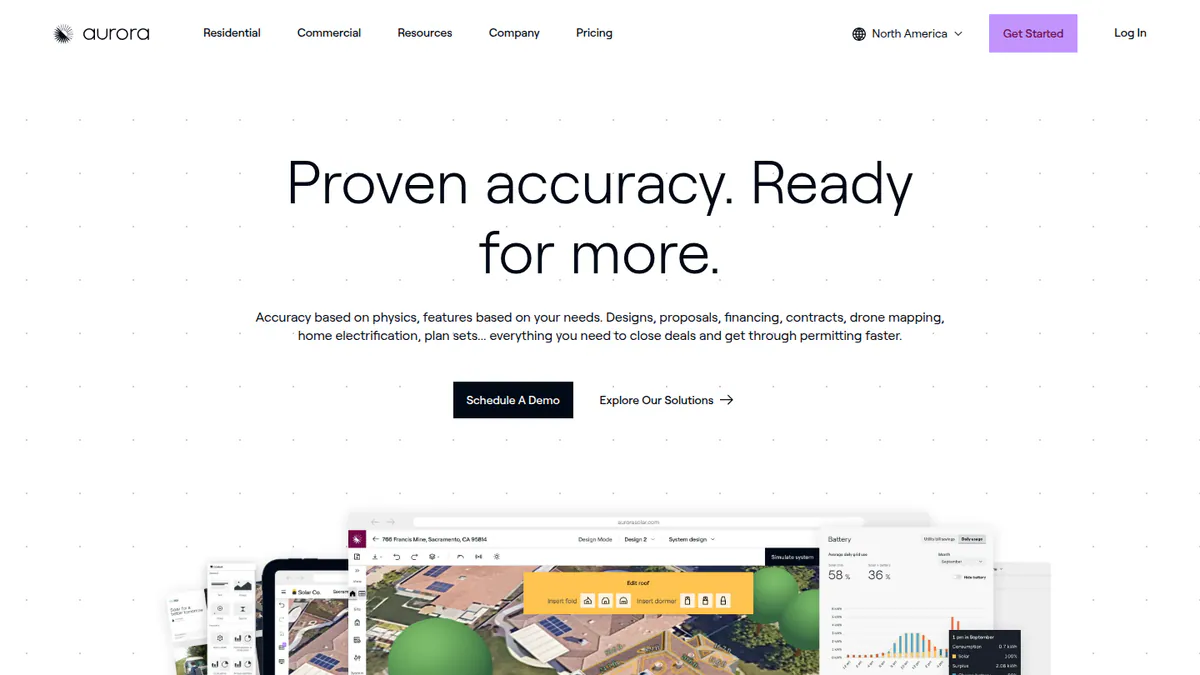
Best for: US home and light-commercial installers who want detailed 3D design and a published price. Score: 85.3/100.
vs Reonic: Aurora publishes seat prices where Reonic is demo-only. It has no CRM, project tools or heat pump planning in our sources, and it is built for the US.
What it is: Aurora Solar Inc. runs this cloud platform for design, shading, simulation and proposals. It prices in US dollars for North American buyers.
Why we picked it: It scored top marks for design fit and has one of the largest review bases here. Its prices are public, unlike Reonic’s.
Key features:
- 3D design, with LIDAR (laser height data) assisted modelling on Premium.
- Shade analysis and bankable (lender-accepted) shade reports (Premium).
- Battery modelling for backup, self-use and arbitrage (storing cheap power to use or sell when prices are high).
- Proposals with US financing, including tax-credit estimates (US credit rules change, check current law) and TPO (a deal where the customer pays for power instead of buying the panels).
Pricing: Basic costs USD 159 per user per month, or USD 135 billed annually. Basic allows one user and 50 projects a month. Premium costs USD 259 (USD 220 billed annually). Enterprise is custom, per project. Checked October 2026 on the Aurora Solar pricing page.
Pros (from user reviews):
- LIDAR shows obstructions, and shade reports are accurate (Capterra).
- Design is accurate and customer service is strong (G2).
- Videos and a knowledge base help new users learn (Capterra).
Cons (from user reviews):
- Proposal and financial tools feel limited for the price (Capterra).
- It connects poorly with other software (G2).
- Some 2019 reviews say it runs slowly on weak computers (Capterra).
Reviews: G2 4.7/5 (121 reviews) and Capterra 4.1/5 (7 reviews), checked October 2026.
Read our full Aurora Solar review or our Aurora Solar alternatives.
Want to see Aurora Solar working? Book a demo with the SolarSoftwares team.
Book a demoYour request goes by email to the SolarSoftwares team. A time is set only after we reply. It does not change any score or ranking.
2. Pylon: best for UK installers who want a public price
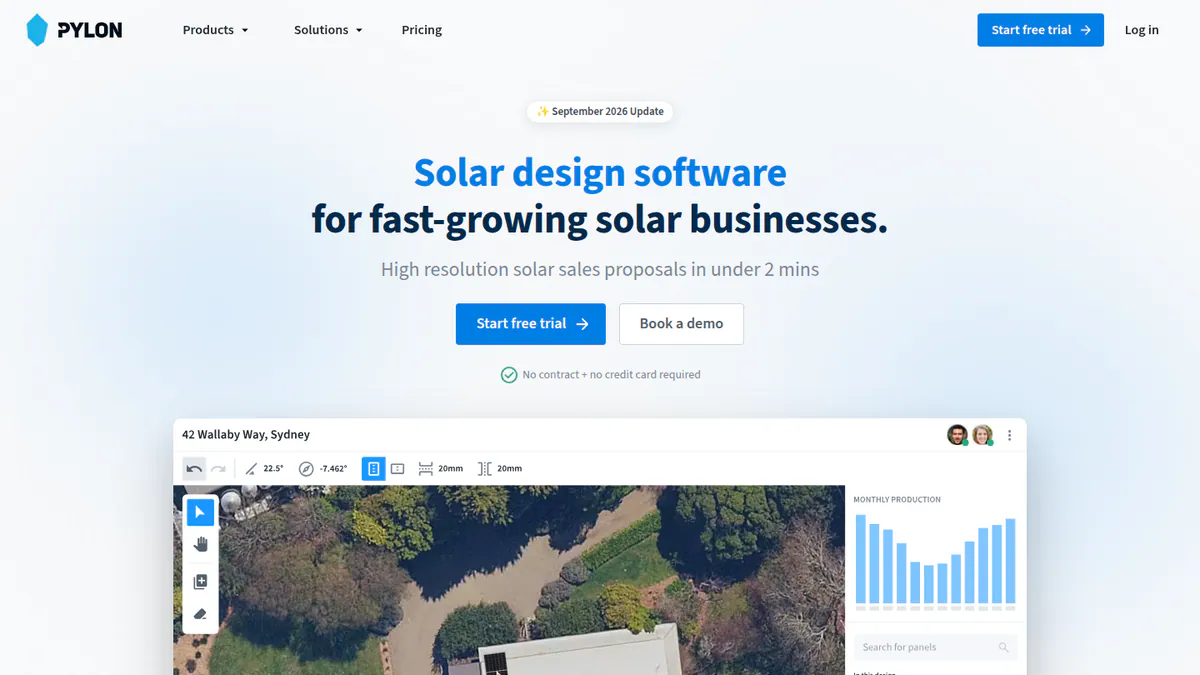
Best for: Small and mid-sized installers in the UK, Ireland and Australia. Score: 80.0/100.
vs Reonic: Pylon shows a per-project price and gives five free credits, where Reonic needs a demo. It makes reports for MCS (the UK certification scheme), but our sources show no heat pump design.
What it is: Pylon is a design and proposal tool built in Sydney. A solar CRM is optional, and per-project pricing means no user cap and no monthly minimum.
Why we picked it: It scored top marks for support and recent updates, and its price is public. It also makes UK MCS reports, which matter to UK firms leaving Reonic.
Key features:
- PV and battery layouts on aerial images.
- MCS reports for the UK and STC/PDRS (Australian incentive schemes) support.
- Single-line diagrams (SLDs, simple drawings of how the wires connect) you can edit, since July 2026.
- Optional CRM with automations, plus an API with webhooks.
Pricing: Standard costs GBP 4 per project, up to 30 kW DC. Pro costs GBP 10 per project. Enterprise is quote only. The CRM add-on starts from GBP 49 per user per month. Checked October 2026 on the Pylon UK pricing page.
Pros (from user reviews):
- Paying per job keeps costs low for small firms (Capterra).
- The interface and manual suit beginners (Capterra).
- Quotes and proposals are thorough (G2).
Cons (from reviews and our research):
- Image quality depends on the area, and Nearmap links are patchy (Capterra).
- Usage modelling is awkward (Capterra).
- We found prices only in GBP, on the UK page.
Reviews: Capterra 4.6/5 (25 reviews) and G2 4.3/5 (2 reviews), checked October 2026.
Read our full Pylon review or our Pylon alternatives.
Want to see Pylon working? Book a demo with the SolarSoftwares team.
Book a demoYour request goes by email to the SolarSoftwares team. A time is set only after we reply. It does not change any score or ranking.
3. OpenSolar: best free Reonic alternative
Best for: Installers in any country who want design and proposals with no licence fee. Score: 75.8/100.
vs Reonic: The core is free and the company cites 160+ countries. It has far less CRM and project management than Reonic.
What it is: OpenSolar is a design, proposal and sales platform with a free core. Partners, paid imagery and a supplier shop fund it, and in 2026 it pushed into the UK and India.
Why we picked it: It costs nothing for the core tools and works in any country. It also scored well for design and proposal fit.
Key features:
- 3D and 2D roof design with shading, free.
- AI design in OS 3.0 (September 2025).
- Online proposals with e-sign and payments.
- Xero and QuickBooks connectors.
Pricing: Free core. The company promises it "will always be free for you to use". API access and accounting connectors have been paid since 16 April 2026, at rates it does not publish. Checked October 2026 on the OpenSolar pricing notice.
Pros (from reviews and our research):
- Panels are very easy to add, remove and change (G2).
- The interactive app gives information in the field (G2).
- The company says the free core has unlimited users.
Cons (from user reviews):
- Layouts need an engineer’s check, as auto tweaks are missing (G2).
- The interface feels dated (G2).
- It is "not completely free", one reviewer says (G2).
Reviews: G2 4.8/5 (3 reviews), checked October 2026. That is too few to judge.
Read our full OpenSolar review or our OpenSolar alternatives.
Want to see OpenSolar working? Book a demo with the SolarSoftwares team.
Book a demoYour request goes by email to the SolarSoftwares team. A time is set only after we reply. It does not change any score or ranking.
4. PV*SOL premium: best for DACH installers who model heat pumps
Best for: Installers in Germany, Austria, Switzerland and wider Europe who design PV with batteries, heat pumps and EV charging. Score: 72.5/100.
vs Reonic: Like Reonic, it comes from a German company and models heat pumps. But it is a desktop design tool only, with no CRM or project management.
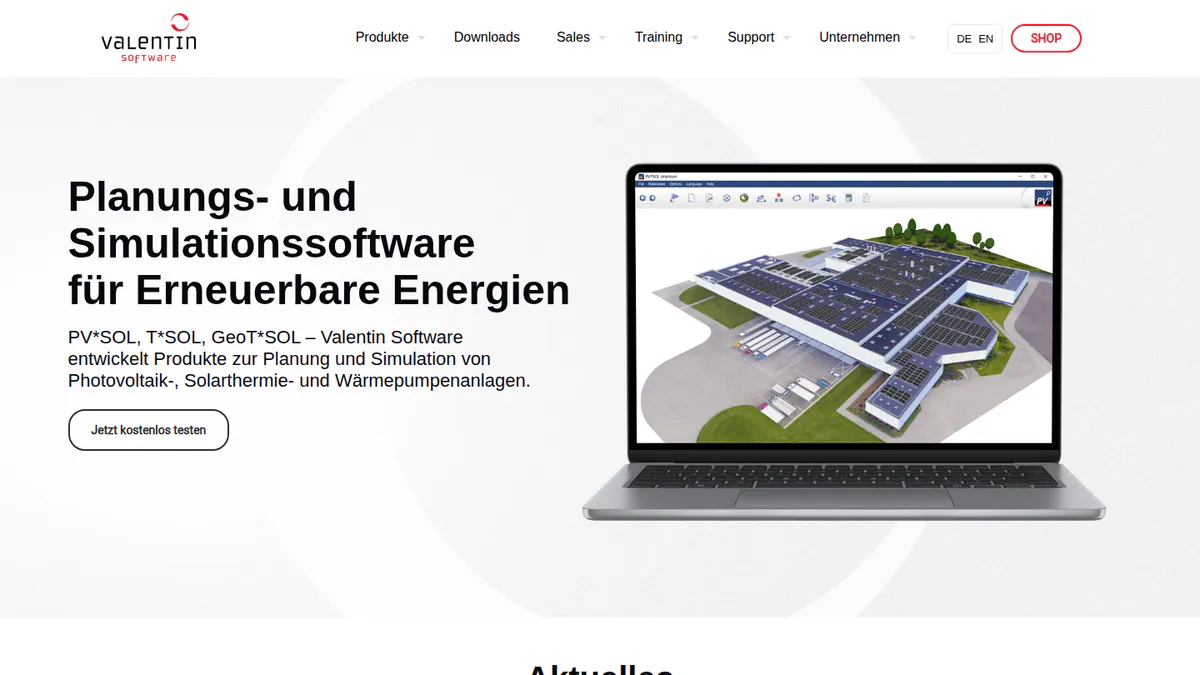
What it is: Valentin Software GmbH, a German firm, makes PV*SOL premium for 3D design and simulation on the desktop. It is priced in euros and used mostly by European installers and planners.
Why we picked it: It is the closest match here for Reonic’s heat pump planning, from a German company. Its fixed yearly price in euros is public.
Key features:
- 3D design with detailed shading.
- Yield forecasts (how much power the system will make) run on Meteonorm 9 weather data.
- AC- and DC-coupled battery storage.
- Heat pump, immersion heater and EV loads with per-consumer tariffs.
- Customer presentation export (PDF or DOCX) and JSON export for a CRM.
Pricing: EUR 845 per year per named user plus VAT, or EUR 285 for three months. The 2D version costs EUR 585 a year. There is a 30-day trial. Checked October 2026 in the Valentin shop.
Pros (from reviews and our research):
- You can buy three months to cover a busy season.
- Users rate it easy to use (G2 ease of use 8.2/10).
- It is kept current, with the 2026 version out on 24 November 2025.
Cons (from our research):
- Reps cannot open it in a browser on a customer’s roof. It is desktop only.
- You need a separate CRM, since it has none.
- Customer output is a presentation, not an e-signed proposal.
Reviews: G2 4.2/5 (12 reviews), checked October 2026. Too little review text exists to pull out themes.
What we could not confirm: Stringing (how panels wire into inverters) and SLD depth.
Read our full PV*SOL premium review or our PV*SOL alternatives.
Want to see PV*SOL premium working? Book a demo with the SolarSoftwares team.
Book a demoYour request goes by email to the SolarSoftwares team. A time is set only after we reply. It does not change any score or ranking.
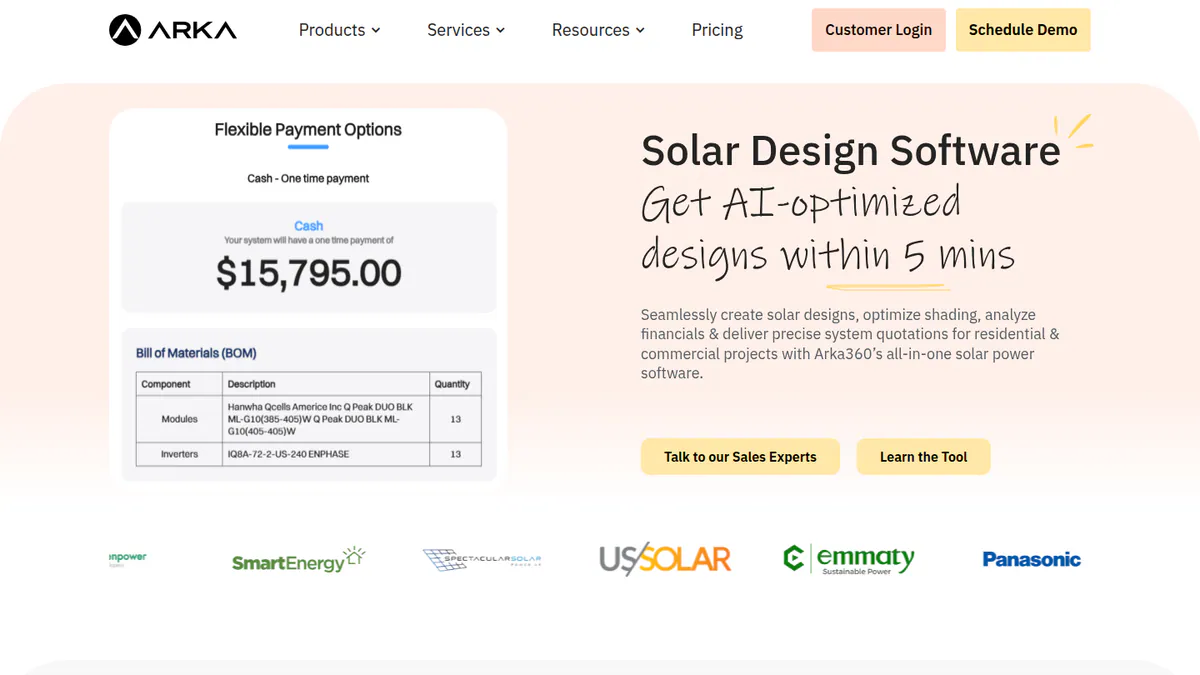
5. Arka 360: best for installers in India
Best for: Indian installers, and US installers who want unlimited projects on one plan. Score: 70.1/100.
vs Reonic: Arka publishes prices and has 137 G2 reviews. It sells in India and the US, not in Reonic’s European markets.
What it is: Arka 360 is a cloud platform for design and proposals, with a light CRM. It was sold as The Solar Labs before its rebrand, and its offices are in Bengaluru and Allen, Texas.
Why we picked it: It has the most G2 reviews of any pick here, and reviewers rate its support highly. US plans include unlimited projects.
Key features:
- 3D design for roofs and ground mounts, with shading.
- Stringing with micro-inverters and optimisers.
- SLD export and API on Premium.
- A lead management CRM add-on.
Pricing: The international-list Basic costs USD 159 a month or USD 1,699 a year. US Premium costs USD 199 a month, and Enterprise USD 999 a month. India plans are in INR plus 18% GST. The page shows two conflicting INR price sets, so confirm in writing. Checked October 2026 on the Arka 360 pricing page. Demo only.
Pros (from user reviews):
- It is very easy to use, say 14 G2 reviewers.
- Shadow analysis and estimates are useful for quotes.
- 3D views help win customers, and support is caring.
Cons (from user reviews):
- It hangs on projects of 3 MWp and above.
- Some features and options are missing or confusing.
- Multi-user limits hold back bigger teams.
Reviews: G2 4.3/5 (137 reviews), with support 9.2/10, checked October 2026.
Read our full Arka 360 review or our Arka 360 alternatives.
Want to see Arka 360 working? Book a demo with the SolarSoftwares team.
Book a demoYour request goes by email to the SolarSoftwares team. A time is set only after we reply. It does not change any score or ranking.
6. Solargraf: best for US permit packs
Best for: US and Canadian home installers who want design, finance and permits in one plan. Score: 68.0/100.
vs Reonic: Solargraf publishes yearly bundle prices. A February 2024 release lists Germany and Austria among its markets, but its permit tools follow US rules.
What it is: Solargraf has belonged to Enphase since the 2021 Sofdesk purchase. It combines design, proposals, finance and permits, and most of its users are in the US and Canada.
Why we picked it: It scored very high for fit, with permit packs in every plan. Weak Capterra reviews, mainly on support, pull it down.
Key features:
- Shade analysis the company calls NREL and NYSERDA validated.
- Permit-ready SLDs and plan sets (permit drawing packages) to NEC 2026 (the US electrical code).
- Data on 14,000+ AHJs (local permit offices).
- CRM and a sales dashboard.
Pricing: Yearly bundles: Starter USD 2,799 (240 projects, 2 users), Small Business USD 4,799, Teams USD 6,399 and Enterprise USD 12,999 (unlimited users). Checked October 2026 on the Solargraf pricing page.
Pros (from user reviews):
- Shading and 3D tools are good once you learn them.
- It runs the whole job, from proposal to permit.
- Clients find the proposals and contracts clear.
Cons (from user reviews):
- Crashes and wrong property data disrupt 3D work.
- It costs more than other options, reviewers say.
- Support now takes longer to reply.
Reviews: Capterra 3.2/5 (15 reviews), checked October 2026.
Read our full Solargraf review or our Solargraf alternatives.
Want to see Solargraf working? Book a demo with the SolarSoftwares team.
Book a demoYour request goes by email to the SolarSoftwares team. A time is set only after we reply. It does not change any score or ranking.
7. HelioScope: best for commercial and industrial projects
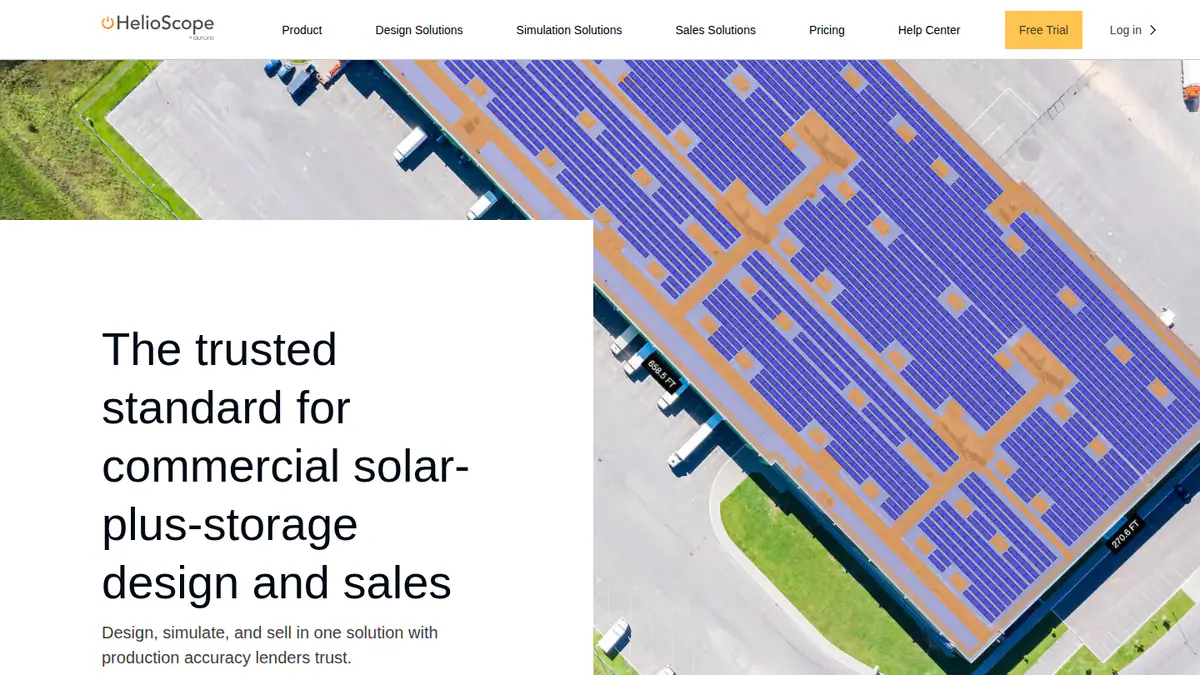
Best for: Commercial and industrial (C&I) designers and EPCs (firms that design and build solar projects) who build systems up to 30 MW DC. Score: 66.6/100.
vs Reonic: HelioScope goes deeper on commercial engineering, with P90/P95/P99 values on Pro (figures that show the risk of making less power than forecast). It has no CRM, home sales tools or heat pump planning.
What it is: HelioScope is a browser tool for commercial design and simulation, owned by Aurora Solar Inc. Prices are in US dollars.
Why we picked it: It handles larger commercial engineering that Reonic’s home focus does not. Reviewers rate it easy to use, and its price is public.
Key features:
- Rooftop, carport and ground-mount layout.
- Shading and wiring-loss modelling.
- Output the company says is within 1% of PVsyst.
- Single-axis trackers (mounts that follow the sun) and PVsyst export on Enterprise.
Pricing: Basic costs USD 159 a month, or USD 1,620 a year if billed yearly per licence, up to 1.25 MW DC. Pro costs USD 259 a month or USD 2,640 a year, up to 5 MW DC. Enterprise is custom. A free trial is offered. Checked October 2026 on the HelioScope pricing page.
Pros (from user reviews):
- It is simple to learn (G2).
- Layouts and loss sums are fast and accurate (G2).
- Reports and SLDs come out quickly (G2).
Cons (from user reviews):
- The subscription is expensive for occasional users (G2).
- Large systems run into the yearly project cap (G2).
- Users in India and Mexico find units and prices set to US defaults (G2).
Reviews: G2 4.5/5 (19 reviews), checked October 2026.
Read our full HelioScope review or our HelioScope alternatives.
Want to see HelioScope working? Book a demo with the SolarSoftwares team.
Book a demoYour request goes by email to the SolarSoftwares team. A time is set only after we reply. It does not change any score or ranking.
8. SolarPlus: best for battery and off-grid jobs in Australia and New Zealand
Best for: Australian and New Zealand installers who design storage, off-grid and C&I systems. Score: 65.3/100.
vs Reonic: SolarPlus publishes team plans and goes deep on off-grid design. It is built for Australia and New Zealand, not Europe.
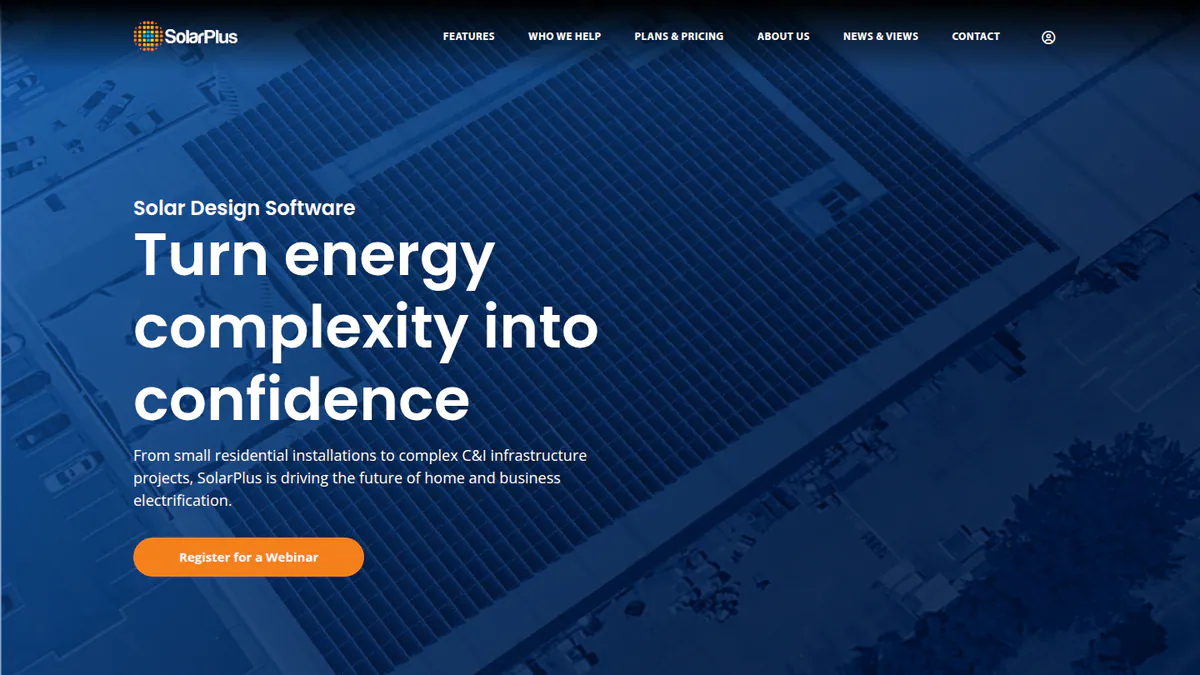
What it is: SolarPlus was founded in 2011 in Healesville, Victoria. It sells design, quoting and sales software with a light CRM and install job packs.
Why we picked it: It scored highly for proposal and design fit, with deep battery and off-grid tools. Only one review keeps it lower here.
Key features:
- 3D shading viewer with tree modelling.
- Battery, peak-shaving (cutting your highest power use) and tariff models.
- Off-grid loads with generator sizing.
- Install job packs and handover manuals.
Pricing: Starter costs USD 135 a month paid yearly, or USD 150 monthly, for 5 designers. Pro costs USD 260 or USD 300. Complete costs USD 450 or USD 520, with unlimited users. Plans cap the kW you can quote. Onboarding packs add AUD 500 or AUD 1,000. Checked October 2026 on the SolarPlus pricing page.
Pros (from our research):
- A single plan covers a team of designers.
- Off-grid and generator design handle remote sites.
- Job packs and checklists help the install crew.
Cons (from our research):
- Quote volume is capped on each plan.
- Onboarding can add up to AUD 1,000.
- One G2 review gives little user feedback.
Reviews: G2 4.5/5 (1 review), checked October 2026.
Want to see SolarPlus working? Book a demo with the SolarSoftwares team.
Book a demoYour request goes by email to the SolarSoftwares team. A time is set only after we reply. It does not change any score or ranking.
9. Solar Proof: best for Australian rebate quotes
Best for: Small Australian installers who quote with STC, battery and VEEC rebates (Australian incentive schemes). Score: 64.1/100.
vs Reonic: Solar Proof shows a pay-as-you-go price and handles Australian rebates. It has no heat pump or project tools in our sources.
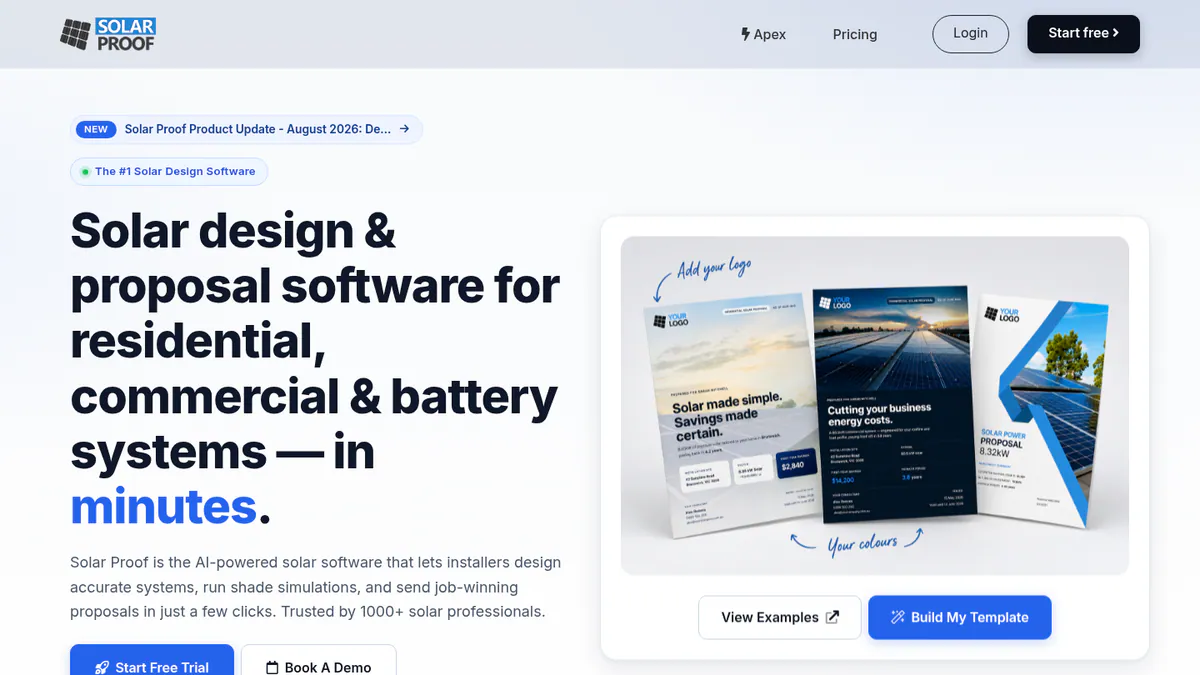
What it is: Solar Proof Solutions, based in Kingscliff, New South Wales, sells design, proposal and rebate-quoting software. It follows Australian rules only.
Why we picked it: It shows a pay-as-you-go price, so you can start without a demo or contract. It handles Australian rebates in the quote.
Key features:
- Design on aerial images with multiple inverters and batteries.
- A browser SLD editor that fills itself from the quote.
- Automatic STC, Cheaper Home Batteries and VEEC sums.
- Interval data analysis with IRR and NPV (ways to measure a project’s return).
Pricing: Pay As You Go costs 4 per project in credits that never expire, with five free projects. Pro starts from 99 a month. The page shows only a dollar symbol, so AUD is implied. Checked October 2026 on the Solar Proof pricing page.
Pros (from our research):
- Unused credits never expire.
- Rebate sums are automatic.
- Five free projects let you test it on real jobs.
Cons (from our research):
- It only works for Australian rules.
- Pro prices by team size are not listed.
- We found no user reviews to judge it by.
Reviews: No user reviews found as of October 2026.
Want to see Solar Proof working? Book a demo with the SolarSoftwares team.
Book a demoYour request goes by email to the SolarSoftwares team. A time is set only after we reply. It does not change any score or ranking.
10. Solo: best for US teams with many reps
Best for: US home solar dealers with large sales teams. Score: 62.9/100.
vs Reonic: Like Reonic, Solo is quote-only. It is built for US lenders and utilities, with no European features in our sources.
What it is: Solo, from Lehi, Utah, is an AI-assisted platform for design, proposals and finance. It also sells roofing, HVAC and generator "Studios".
Why we picked it: Its updates are recent and its G2 reviews are solid. It suits large rep teams that need finance built into the sale.
Key features:
- AI auto-design with setbacks.
- Finance marketplace with US lenders.
- Validation against lender, utility and permit-office rules.
- Links to Salesforce, HubSpot, Pipedrive and Zoho.
Pricing: No public price. Solo says cost is "based on usage, support level, and scale". Unlimited users are included. Checked October 2026 on the Solo pricing page.
Pros (from reviews and our research):
- New reps learn it quickly (Capterra review, December 2025).
- Monthly release notes run through April 2026.
- No per-seat fee as the team grows.
Cons (from reviews and our research):
- Reps can change too many settings (same review).
- It covers US lenders and utilities only.
- No published price.
Reviews: G2 4.6/5 (12 reviews), checked October 2026.
Read our full Solo review or our Solo alternatives.
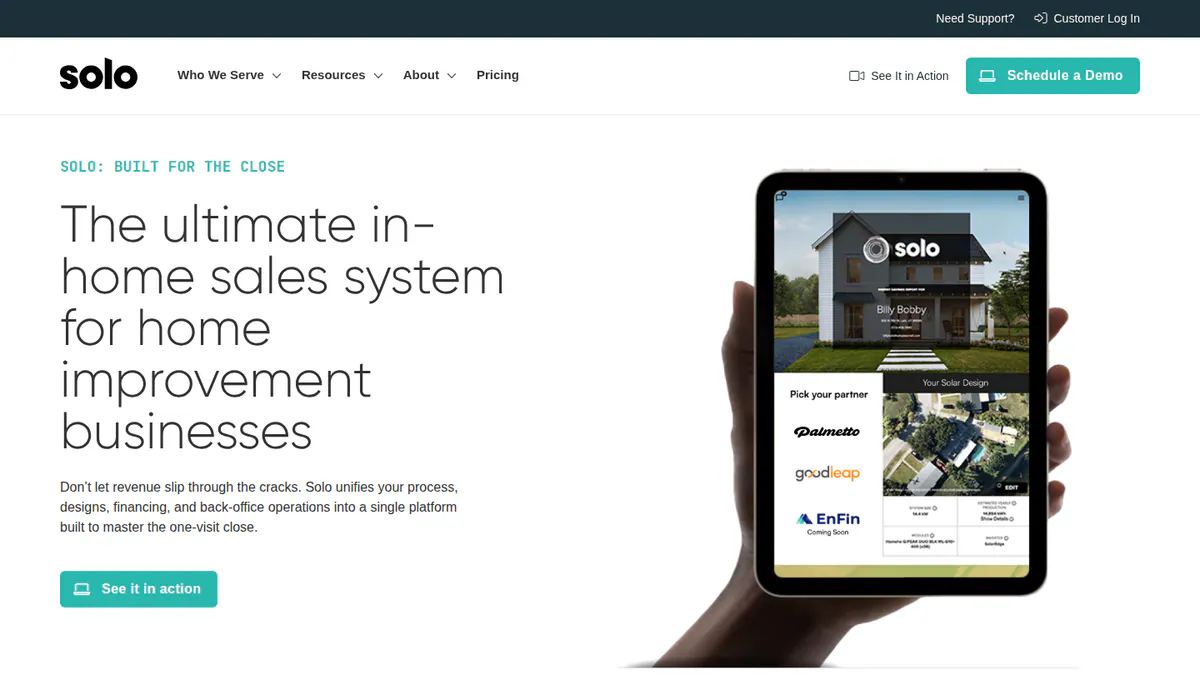
Want to see Solo working? Book a demo with the SolarSoftwares team.
Book a demoYour request goes by email to the SolarSoftwares team. A time is set only after we reply. It does not change any score or ranking.
How do the 10 Reonic alternatives compare by region, price and scope?
Product | Entry price (checked October 2026) | Price published | Heat pump modelling | CRM or project tools | Main regions |
|---|---|---|---|---|---|
Reonic (reference) | Quote only | No | Yes | CRM, projects, portal | Germany, Austria, Switzerland. Also UK, Brazil |
USD 159/user/month | Yes | Not documented | No | US | |
GBP 4/project | Yes (UK) | Not documented | CRM add-on | UK, Ireland, Australia | |
Free | Core only | Not documented | Light lead tools | Global | |
EUR 845/year + VAT | Yes | Yes | No (JSON export) | Germany, Europe | |
USD 159/month | Yes | Not documented | Lead CRM add-on | India, US | |
USD 2,799/year | Yes | Not documented | CRM, sales dashboard | US, Canada (Germany, Austria listed 2024) | |
USD 159/month | Yes | Not documented | No | US | |
USD 135/month | Yes | Not documented | Light CRM | Australia, NZ | |
4/project (AUD implied) | Partly | Not documented | Installer portal | Australia | |
Quote only | No | Not documented | CRM links | US |
Also considered
- solarVis Sales Engine: Scored 61.5/100. This Turkish tool lists heat pump and EV charger modelling and claims 45+ countries. We could not reach its website, so its price and features are unconfirmed.
- Scanifly: Scored 59.3/100. It builds drone-based 3D site models for US installers, but it is quote only and has three G2 reviews. See our Scanifly alternatives.
- SolarEdge Designer: Scored 55.3/100. It was free for SolarEdge kit per a 2018 press release, but we could not confirm its current status. See our SolarEdge Designer alternatives.
How do you choose a Reonic alternative?
- If you work in Germany, Austria or Switzerland and design heat pumps, pick PV*SOL premium. Pair it with a CRM.
- If you left Reonic because you want a public price and you work in the UK or Ireland, pick Pylon.
- If you want no licence fee and work anywhere, pick OpenSolar.
- If you are in the US, pick Aurora Solar for home design, or Solargraf if you also need permit packs.
- If your work has moved into C&I, pick HelioScope.
- If you are in India, pick Arka 360.
- If you are in Australia or New Zealand, pick SolarPlus for off-grid and batteries, or Solar Proof for pay-as-you-go quotes.
If you need CRM, project tracking and heat pumps in one tool in DACH, no ranked tool matches Reonic’s full scope.
For wider lists, see all-in-one solar software. UK readers can also see solar software for the UK and the proposals and sales hub. For a ranked list across every segment, see our best solar design software ranking.
Want more choices? Browse every tool we checked in our design and simulation category.
How do you switch from Reonic?
- Export your records. Save customer, project and document data before your contract ends.
- Keep signed paperwork. Download signed proposals and customer portal files you must keep.
- Rebuild your templates. Recreate your proposal layout, prices and terms in the new tool.
- Run one live job in both. Compare layout, expected power output and savings before you switch fully.
- Plan for heat pumps. If the new tool is solar-only, decide where heat pump and wallbox jobs will live.
Reonic alternatives FAQs
What is the best alternative to Reonic?
Aurora Solar is the best Reonic alternative in our October 2026 ranking, at 85.3/100, but it is a US product. In Germany, Austria and Switzerland, PV*SOL premium (72.5/100) is the closest fit. In the UK, Pylon (80.0/100) is the best start.
How much does Reonic cost?
Reonic does not publish a price as of October 2026. Its site offers a free demo only, so you need a sales call to get a quote. Small firms that want a public price can look at Pylon or OpenSolar.
Is Reonic available in the UK and outside Germany?
Yes. Reonic has a UK site and UK reviews from March 2026, plus a presence in Brazil. Its core market is still Germany, Austria and Switzerland, and some services work in Germany only. A 2024 report also put it in France and Italy.
Is Reonic suitable for small installers?
It can be, but you cannot see a price without a demo. Small firms that want a public price can look at Pylon (GBP 4 per project) or OpenSolar (free core), both checked October 2026. Reonic’s own reviews are thin outside Trustpilot.
Does Reonic handle grid registration outside Germany?
No. Its grid registration and KfW services are German-only, per our October 2026 research. Elsewhere, look at local tools. Pylon makes MCS reports for the UK (MCS is the UK certification scheme), and Solargraf builds US permit packs.
Which Reonic alternative also covers heat pumps?
PV*SOL premium models heat pumps, immersion heaters and EV loads, as of its 2026 version. solarVis also lists heat pump modelling, but we could not confirm it on its own site. Reonic itself also covers heat pumps, so PV*SOL premium is the one ranked tool that matches that part.
Sources
All read 22 to 23 October 2026. We checked the page plan on 25 October 2026.
- Reonic: product, integrations, Trustpilot, Capterra, TechCrunch (2024)
- Aurora Solar: pricing, G2, Capterra
- Pylon: UK pricing, Capterra, G2, July 2026 update
- OpenSolar: pricing notice, news, G2
- PV*SOL premium: shop, 2026 release, G2
- Arka 360: pricing, G2
- Solargraf: pricing, Capterra, Enphase release
- HelioScope: pricing, G2
- SolarPlus: pricing, features, G2
- Solar Proof: pricing, product
- Solo: pricing, integrations, G2, Capterra review
- solarVis: G2
- Scanifly: G2
- SolarEdge Designer: press release (2018)
Last updated 28 October 2026. Next scheduled review: 23 January 2027.