SolarEdge Designer alternatives are design tools you can use instead of SolarEdge Designer, a free web tool from the inverter maker SolarEdge. Pylon ranks first at 83.9/100. Aurora Solar ranks second at 81.4/100.
An inverter is the box that turns panel power into power a building can use. This guide covers two kinds of swap. One is a neutral platform. The other is another inverter brand’s own designer.
For a ranked list across every segment, see our best solar design software ranking.
Why do installers look for SolarEdge Designer alternatives?
SolarEdge Designer is a free web tool for design, simulation and proposals. It comes from inverter maker SolarEdge, which launched it in 2018. It added commercial features in January 2020. Free is hard to beat, so installers tend to leave for one of these reasons:
- One hardware brand. Designs and one-click stringing are built around SolarEdge inverters and optimisers (small devices on each panel). If you also fit SMA, Fronius or Enphase, plan on a second tool.
- Old public facts. We could not reach SolarEdge’s product page in October 2026. Our sources are a 2018 press release and a 2020 trade article, with no release notes, so we cannot say what it does today.
- No user reviews. We found no G2 or Capterra listing, so there is no outside view of accuracy, stability or support.
- Sales and paperwork gaps. The 2018-2020 sources do not mention a CRM (customer records and sales pipeline), e-signature, finance or permit plan sets. Pylon, Aurora and Solargraf each cover some of these.
What you would give up: Free stringing to SolarEdge’s own rules, and a link to SolarEdge monitoring.
SolarEdge Designer at a glance
Item | What the sources say (2018-2020. Current terms not confirmed in October 2026) |
|---|---|
Price | Free, per SolarEdge’s 2018 press release |
Hardware | Designs built around SolarEdge inverters and optimisers |
Segments | Residential and commercial. Commercial features added January 2020 (Solar Power World) |
Design | Web-based layout on satellite imagery. 3D site modelling. One-click stringing |
Simulation | Energy simulation with shading and loss modelling. Irradiance analysis. Commercial load profiles (factory, retail, office) |
Outputs | Bill of materials report. Homeowner proposals. Link to SolarEdge monitoring. Multi-user cloud access |
Ratings | No G2 or Capterra listing found (October 2026) |
It runs in the browser, so there is no "SolarEdge Designer download" to install (per the 2018 release).
Quick picks
Rank | Product | Best for | Starting price (company page, checked October 2026) | Pricing model | Free plan / trial | Score /100 |
|---|---|---|---|---|---|---|
1 | Pay-per-project design and proposals | ✓ GBP 4 per project (UK page) | Per project | 5 free project credits | 83.9 | |
2 | US residential design and sales teams | ✓ USD 159 per user per month | Per user | None stated | 81.4 | |
3 | Staying free without one inverter brand | ✓ Free core platform | Free. Paid API and connectors | Free core platform | 69.3 | |
4 | Commercial rooftop and carport projects | ✓ USD 159 per month | Per licence | Free trial (length not stated) | 69.2 | |
5 | Detailed 3D shading and self-consumption in Europe | ✓ EUR 845 per year plus VAT | Per named user | 30-day trial | 68.6 | |
6 | Only if moving to Enphase hardware: US permit plan sets | ? USD 2,799 per year | Annual bundle | Not stated by the company | 66.7 | |
7 | Huawei FusionSolar installers | ✓ Not published | Huawei installer channel | Not stated | 54.8 |
✓ Verified on the company’s own pricing page. ◐ Published by the company outside its pricing page (help centre, store or press release). ? We could not read the company’s pricing page, so the figure is not confirmed. Prices checked October 2026.
How the 7 tools scored
- Use-case fit 35%
- User reviews 20%
- Pricing 15%
- Ease of use 10%
- Support 10%
- Momentum 10%
Tool | Score chart | Score |
|---|---|---|
83.9 out of 100 | 83.9 | |
81.4 out of 100 | 81.4 | |
69.3 out of 100 | 69.3 | |
69.2 out of 100 | 69.2 | |
68.6 out of 100 | 68.6 | |
66.7 out of 100 | 66.7 | |
54.8 out of 100 | 54.8 |
Each bar shows the weighted score out of 100.
Sub-scores at a glance (0-10)
Product | Use-case fit | User reviews | Pricing | Ease of use | Support | Momentum | Total /100 |
|---|---|---|---|---|---|---|---|
8.9 | 6.7 | 8.0 | 7.5 | 10.0 | 10.0 | 83.9 | |
8.9 | 7.9 | 8.0 | 7.5 | 7.5 | 7.5 | 81.4 | |
6.7 | 5.0 | 9.0 | 7.5 | 5.0 | 10.0 | 69.3 | |
7.8 | 6.2 | 8.0 | 7.5 | 5.0 | 5.0 | 69.2 | |
6.7 | 5.4 | 8.0 | 7.5 | 7.5 | 7.5 | 68.6 | |
8.9 | 3.3 | 6.0 | 5.0 | 5.0 | 10.0 | 66.7 | |
6.7 | 5.0 | 6.0 | 5.0 | 5.0 | 2.5 | 54.8 |
A 5.0 on reviews, ease, support or momentum is our neutral value where public evidence is thin, not a judgement.
What kinds of SolarEdge Designer alternative are there?
- Another inverter-brand designer: If you are switching or adding an inverter brand, its maker’s tool is the like-for-like swap. It is just as tied to one brand. Huawei SmartDesign 2.0 makes our top 7. The free Sungrow, SMA, GoodWe and Fronius tools sit under Also considered. Enphase owns Solargraf, but it is a paid, full sales platform.
- A neutral platform: Fit several brands, or need proposals, a CRM or permit paperwork? Pick a neutral tool: Pylon, Aurora Solar, OpenSolar, HelioScope (owned by Aurora) and PV*SOL premium.
For more free options, see our free solar design software ranking and the free solar software directory. All design tools sit in the design and simulation hub.
How did we choose and score these SolarEdge Designer alternatives?
How the score is weighted
- Use-case fit 35%
- User reviews 20%
- Pricing 15%
- Ease of use 10%
- Support 10%
- Momentum 10%
We scored 12 alternatives from 22 to 25 October 2026, using desk research, not hands-on tests. Eleven reached our minimum match score (4 out of 10). We rank the top 7, and the rest sit under Also considered. SolarEdge Designer itself is not ranked.
- Use-case fit (35%): How well it does this page’s job, which is SolarEdge Designer’s job. That means layout, 3D, stringing, shading and yield, storage and a customer proposal.
- User reviews (20%): G2 and Capterra ratings. Ratings based on only a few reviews count for less.
- Pricing (15%): Free and published prices score higher than quote-only or hidden prices.
- Ease of use, support and momentum (10% each): Review sub-scores, support channels and dated releases.
A criterion with fewer than eight reviews or no evidence gets a neutral 5.0. Tools whose core facts we could not confirm on the company’s site lose two points. Scores are page-specific. SurgePV is not part of this ranking. Read the full method and how we verify pricing.
1. Pylon: best for pay-per-project design and proposals
Best for: Installers who want neutral design and proposals and prefer to pay per job. Score: 83.9/100.
vs SolarEdge Designer: Pylon costs GBP 4 a project instead of nothing. In return, no inverter maker owns it, and it adds eSignature, an optional CRM and local paperwork.
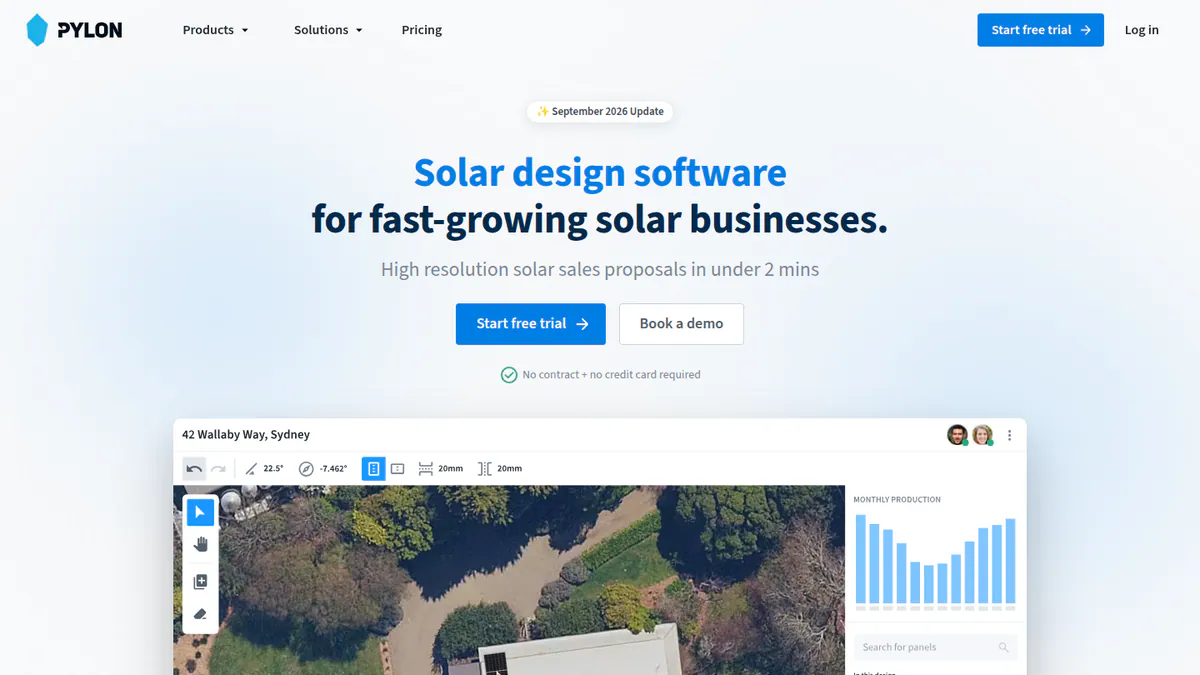
What it is: Pylon is a design and proposal tool from Pylon, a firm based in Sydney, Australia. It is aimed at small and mid-sized home and business installers in Australia, the UK, Ireland and the US. Pylon has shipped regular dated updates in 2026.
Why we picked it: It scored highest of the 12 tools we checked. A 4.6/5 Capterra rating from 25 reviews and a low published price helped. It covers the design and proposal work Designer does, with any inverter brand.
Key features:
- Solar and battery design on aerial imagery.
- Web and PDF proposals with eSignature.
- Editable SLDs (single-line diagrams), added in July 2026.
- MCS (UK certification scheme) reports and STC/PDRS incentive paperwork (Australia).
- API with webhooks (automatic alerts to other apps), plus Xero and ServiceM8 links.
Pricing: Standard is GBP 4 per project (up to 30 kW DC). Pro is GBP 10 per project and adds custom load profiles and commercial sizes. Enterprise is quote only. The CRM add-on starts at GBP 49 per user per month, and the payment gateway fee is 2.5%. You get unlimited users and no monthly minimum. Sign-up gives five free Standard projects, with no card needed. Checked October 2026 on the Pylon UK pricing page.
Pros (from user reviews): From Capterra and G2 reviews.
- Small firms only pay when they design, so each job stays cheap.
- Most reviewers find the layout friendly and the manual clear, though one says the interface takes time to learn.
- Proposals are detailed enough to send straight to customers.
Cons (from reviews and our research): The first two come from Capterra reviews.
- Imagery quality varies by place, and the Nearmap link is patchy.
- Modelling a customer’s usage is awkward.
- It does not make NEC (US electrical code) permit plan sets.
Reviews: Capterra 4.6/5 from 25 reviews, with customer service 4.9/5. G2 4.3/5 from 2 reviews. Both checked October 2026.
What we could not confirm: USD or AUD prices, and whether its design tools support SolarEdge kit.
Read our full Pylon review or our Pylon alternatives.
Want to see Pylon working? Book a demo with the SolarSoftwares team.
Book a demoYour request goes by email to the SolarSoftwares team. A time is set only after we reply. It does not change any score or ranking.
2. Aurora Solar: best for US residential design and sales teams
Best for: US home installers with in-house sales teams. Score: 81.4/100.
vs SolarEdge Designer: Aurora costs USD 135 to 159 per user per month instead of nothing. You get LIDAR-assisted (laser-scan) modelling, bankable (lender-accepted) shade reports and finance proposals.
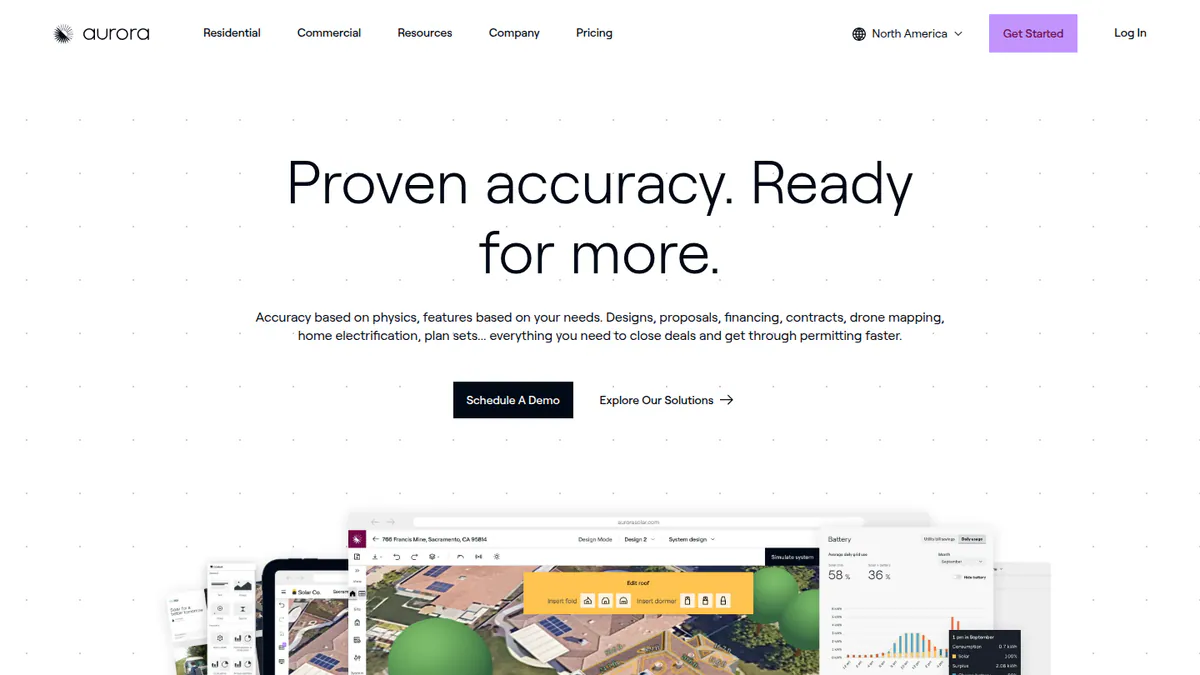
What it is: Aurora Solar is a cloud platform for 3D design, simulation and proposals, made by Aurora Solar Inc. It is aimed at US residential and light commercial installers. Aurora sends large C&I (commercial and industrial) work to its separate HelioScope product, ranked 4th.
Why we picked it: It has 121 G2 reviews averaging 4.7/5, the biggest review base on this page. Its shade reports and battery modelling go well past what Designer’s public sources describe.
Key features:
- 3D design with LIDAR-assisted modelling.
- Shade analysis and bankable shade reports.
- Battery modelling for backup, self-consumption and arbitrage.
- Sales proposals with finance, including tax-credit estimates (US credit rules change, check current law) and TPO (third-party ownership, where the customer pays for power instead of buying panels).
- Plan sets and engineering stamps (Enterprise).
Pricing: Basic is USD 159 per user per month, or USD 135 billed annually, with 50 projects a month. Premium is USD 259 (USD 220 annually). It adds LIDAR modelling, bankable shade reports and battery modelling. Enterprise is custom and priced per project, with plan sets and engineering stamps. On-demand site models start at USD 9.99. Checked October 2026 on Aurora pricing.
Pros (from user reviews):
- Accurate shade reports and output estimates (Capterra).
- Accurate design and strong customer service (G2).
- Videos and a knowledge base make it easy to learn (Capterra).
Cons (from user reviews):
- Heavy memory use on weaker machines (2019 reviews, Capterra).
- Proposal and finance features are thin for the cost (Capterra).
- Few links to other software (G2).
Reviews: G2 4.7/5 from 121 reviews. Capterra 4.1/5 from 7 reviews. Both checked October 2026.
Read our full Aurora Solar review or our Aurora Solar alternatives.
Want to see Aurora Solar working? Book a demo with the SolarSoftwares team.
Book a demoYour request goes by email to the SolarSoftwares team. A time is set only after we reply. It does not change any score or ranking.
3. OpenSolar: best for staying free without one inverter brand
Best for: Installers who want a free tool that is not tied to one inverter brand. Score: 69.3/100.
vs SolarEdge Designer: Like Designer, it has a free core, but partners fund it, not one inverter maker. It adds e-signature, payments and permit links.
What it is: OpenSolar Inc. gives away OpenSolar, a design, proposal and sales platform for home and small business installers. The company cites users in 160+ countries. It launched OS 3.0 in September 2025.
Why we picked it: It is the only ranked tool with a free core. That matters when you are leaving a free tool. Dated updates since OS 3.0 show it is still being built.
Key features:
- Free 3D and 2D rooftop design with shading.
- AI design (OS 3.0).
- Web proposals you can click through, with e-signature and payment collection.
- Permit integrations such as SolarAPP+.
Pricing: The core design and proposal platform is free, with unlimited users per the company. Since 16 April 2026, API access and Xero or QuickBooks connectors are paid. OpenSolar does not publish these rates. API access comes with a 30-day free trial. Premium imagery is optional and paid. Checked October 2026 on the OpenSolar pricing notice.
Pros (from reviews and our research): The first two come from G2 reviews.
- Adding, removing and changing panels is very easy.
- The app gives you useful information in the field.
- Regular updates, from OS 3.0 in September 2025 to new sales tools in August 2026, keep it moving.
Cons (from reviews and our research): From G2 reviews and the company’s pricing notice.
- Panel design lacks automatic tweaks, so an engineer still has to review it.
- The interface looks dated, though reviewers say it works.
- It is not fully free, because the API and connectors now cost extra.
Reviews: G2 4.8/5 from 3 reviews (checked October 2026).
Read our full OpenSolar review or our OpenSolar alternatives.
Want to see OpenSolar working? Book a demo with the SolarSoftwares team.
Book a demoYour request goes by email to the SolarSoftwares team. A time is set only after we reply. It does not change any score or ranking.
4. HelioScope: best for commercial rooftop and carport projects
Best for: C&I installers who design commercial rooftop, carport and small ground-mount projects. Score: 69.2/100.
vs SolarEdge Designer: HelioScope swaps Designer’s 2020 commercial features for a dedicated C&I simulation tool.
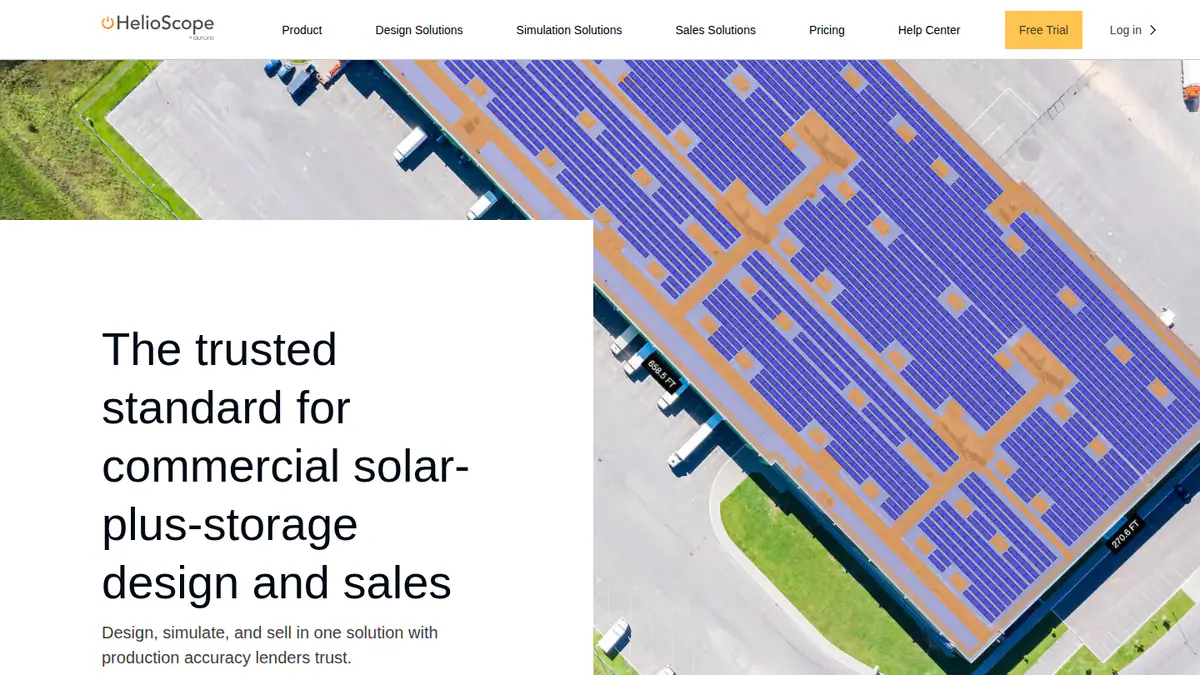
What it is: Aurora Solar bought Folsom Labs, the maker of HelioScope, in 2019. It runs HelioScope as a separate commercial design and simulation product. Its buyers are C&I installers and EPCs (engineering and construction firms). HelioScope states that its output estimates fall within 1% of PVsyst.
Why we picked it: Designer’s commercial features date from 2020, and HelioScope is built for that work today. Its prices are published, and 19 G2 reviews average 4.5/5.
Key features:
- Rooftop, carport and ground-mount layout.
- Shading and wiring-loss modelling.
- AI obstruction detection (Pro).
- P90/P95/P99 (yield confidence levels) values on Pro.
- Storage design.
Pricing: Basic is USD 159 per month or USD 1,620 a year. It covers 1 user, 10 projects a month, systems up to 1.25 MW DC and storage design. Pro is USD 259 per month or USD 2,640 a year, up to 5 MW DC, and adds LIDAR, financial modelling and proposals. Enterprise is custom, up to 30 MW DC, with single-axis trackers, PVsyst export and an API. Checked October 2026 on HelioScope pricing.
Pros (from user reviews): From G2 reviews.
- New designers learn it fast, thanks to a simple interface.
- Layouts and shading and wiring-loss sums are fast and accurate.
- You get reports and SLDs out quickly.
Cons (from reviews and our research): The first two come from G2 reviews.
- It is expensive, and the tiers do not suit occasional users.
- Yearly project limits bite on large systems.
- Trackers and PVsyst export are only on Enterprise.
Reviews: G2 4.5/5 from 19 reviews, with ease of use 8.8/10 (checked October 2026).
Read our full HelioScope review or our HelioScope alternatives.
Want to see HelioScope working? Book a demo with the SolarSoftwares team.
Book a demoYour request goes by email to the SolarSoftwares team. A time is set only after we reply. It does not change any score or ranking.
5. PV*SOL premium: best for detailed 3D shading and self-consumption in Europe
Best for: European installers who model shading, storage and self-consumption in detail. Score: 68.6/100.
vs SolarEdge Designer: You pay for a desktop licence instead of using a free web tool. In return, you get deeper 3D shading and load modelling.
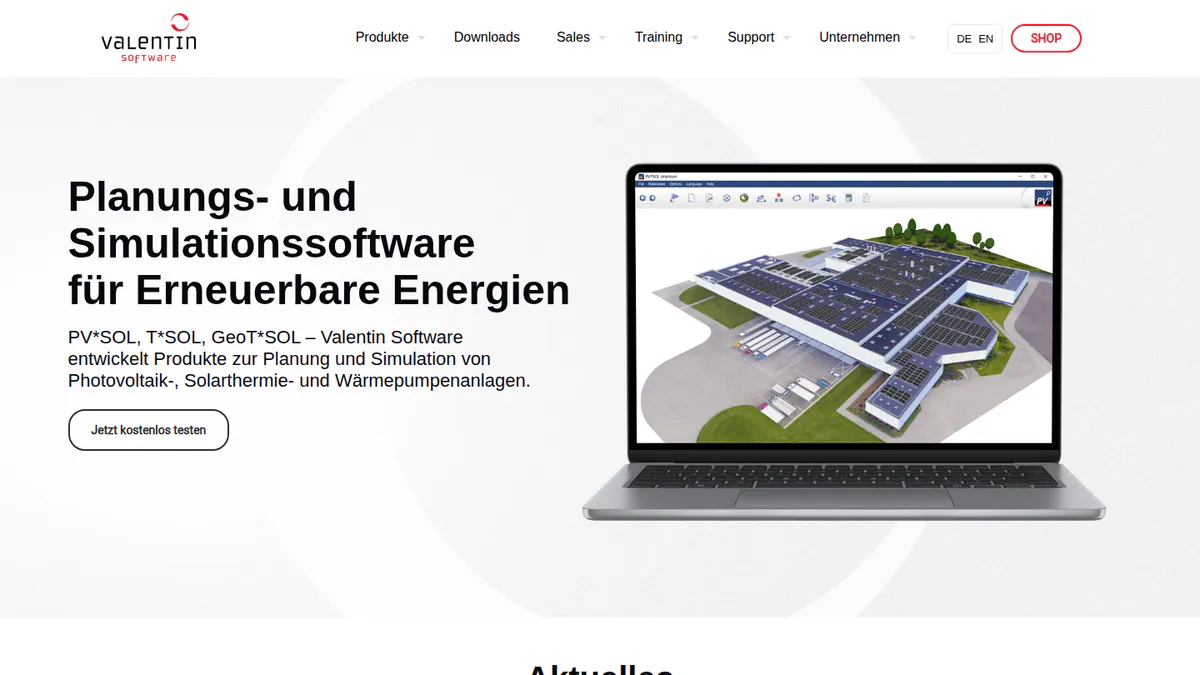
What it is: German firm Valentin Software makes PV*SOL premium, desktop 3D design and simulation software. It is popular with European installers and planners for home and C&I systems. The 2026 version came out on 24 November 2025.
Why we picked it: It models shading, storage and household loads in more detail than the free brand tools on this page. Its prices are published, including a short 3-month licence.
Key features:
- 3D design with detailed shading analysis.
- Yield simulation using Meteonorm 9 climate data (a weather dataset).
- AC- and DC-coupled battery storage.
- Heat pump and EV loads with per-consumer tariffs.
- Customer presentation export (PDF, DOCX).
Pricing: PV*SOL premium 2026 costs EUR 845 per year per named user plus VAT. The shop also lists an extension price of EUR 802.75. A 3-month licence is EUR 285. The 2D PV*SOL costs EUR 585 per year. A 30-day trial is on offer. Checked October 2026 on the Valentin shop.
Pros (from our research):
- You know the cost up front, and a 3-month licence covers a busy season.
- A new version every year keeps it current.
- You can pass project data and results to your CRM or ERP as JSON.
Cons (from our research):
- It is desktop software, so you cannot design in a browser.
- It has no CRM or e-signature for closing the sale.
- Each named user needs a paid seat, plus VAT.
Reviews: G2 4.2/5 from 12 reviews, with ease of use 8.2/10 and support 7.5/10 (checked October 2026).
What we could not confirm: how deep its stringing and electrical tools go. G2 shows no review themes.
Read our full PV*SOL premium review or our PV*SOL alternatives.
Want to see PV*SOL premium working? Book a demo with the SolarSoftwares team.
Book a demoYour request goes by email to the SolarSoftwares team. A time is set only after we reply. It does not change any score or ranking.
6. Solargraf: best only if you are moving to Enphase hardware
Best for: US and Canadian installers moving to Enphase kit who want permit plan sets straight from the design. Score: 66.7/100.
vs SolarEdge Designer: It swaps one inverter maker’s tool for another’s, since Enphase owns Solargraf. It adds permit-ready SLDs, three-line diagrams and NEC 2026 plan sets, from USD 2,799 a year.
What it is: Enphase bought Sofdesk, the maker of Solargraf, in 2021. Today it is Enphase’s design, proposal, finance and permit platform for home and small business work. We could not tell whether it blocks non-Enphase kit, so test your usual hardware in a demo.
Why we picked it: Its yearly prices are on its own site, and one tool takes you from proposal to permit. That makes it the natural pick if you are moving to Enphase kit.
Key features:
- 3D design with automatic roofline and obstruction detection.
- Shading analysis checked against NREL and NYSERDA data, per Solargraf.
- Permit-ready SLDs, three-line diagrams and plan sets, with a database of 14,000+ AHJs (local permit offices).
- Solar plus battery savings proposals.
- Built-in TPO and loan finance, plus a CRM.
Pricing: Starter is USD 2,799 a year for 240 projects and 2 users. Small Business is USD 4,799 and Teams is USD 6,399. Enterprise is USD 12,999 for 1,500 projects and unlimited users, with the API included. Checked October 2026 on Solargraf pricing.
Pros (from user reviews): From Capterra reviews.
- Good shading and 3D tools, which most find easy once past a short learning curve.
- One tool covers everything from proposal to permit.
- Proposals and contracts are easy for clients to follow.
Cons (from user reviews): From Capterra reviews.
- It crashes often.
- Wrong property data confuses the 3D tool.
- It is expensive, and support wait times have grown.
Reviews: Capterra 3.2/5 from 15 reviews, with ease of use 3.7/5 and support 3.4/5 (checked October 2026). No G2 listing found.
Read our full Solargraf review or our Solargraf alternatives.
Want to see Solargraf working? Book a demo with the SolarSoftwares team.
Book a demoYour request goes by email to the SolarSoftwares team. A time is set only after we reply. It does not change any score or ranking.
7. Huawei SmartDesign 2.0: best for Huawei FusionSolar installers
Best for: Installers who already fit Huawei FusionSolar kit. Score: 54.8/100.
vs SolarEdge Designer: The same brand-tool model, but for Huawei hardware, with automatic layout and one-click electrical design.
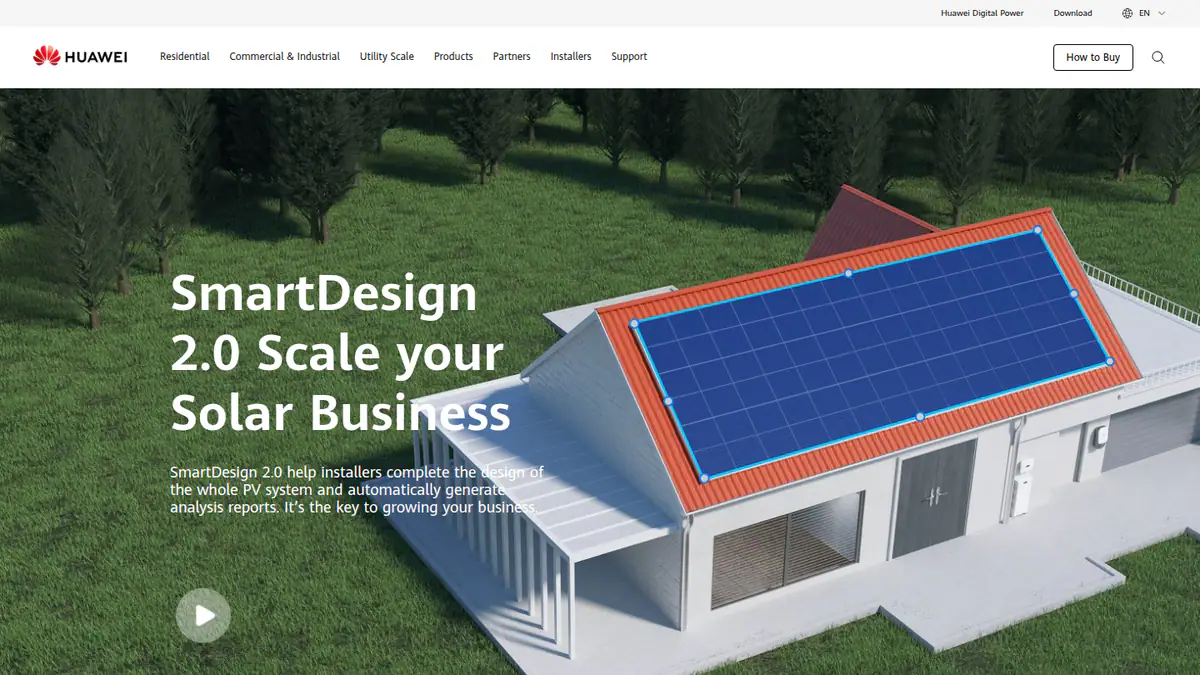
What it is: Huawei Digital Power offers Huawei SmartDesign 2.0, a browser design tool for rooftop PV and storage. It is aimed at installers in the Huawei FusionSolar range, with local pages across Europe and Asia. It launched in July 2022 and is still sold as version 2.0.
Why we picked it: It is the one inverter-brand designer that made our top 7, and it does Designer’s job for Huawei kit. Automatic layout and one-click electrical design cover the main tasks you would lose.
Key features:
- Design from satellite imagery without a site visit.
- Automatic module layout and one-click electrical design.
- Storage size advice.
- 3D design report and cost-benefit summary.
Pricing: Huawei does not publish a price or say how you get access. Ask your Huawei distributor. Checked October 2026 on the Huawei SmartDesign page.
Pros (from our research):
- Automatic layout and one-click electrical design save drawing time.
- It works in PC and mobile browsers, so you can design on site.
- You can compare several design options side by side for the customer.
Cons (from our research):
- It only designs with Huawei equipment.
- We found no public release notes since 2022.
- No user reviews, so you cannot check other installers’ experience.
Reviews: No user reviews found on G2 or Capterra as of October 2026.
What we could not confirm: whether its electrical output includes full SLDs or only stringing.
Want to see Huawei SmartDesign 2.0 working? Book a demo with the SolarSoftwares team.
Book a demoYour request goes by email to the SolarSoftwares team. A time is set only after we reply. It does not change any score or ranking.
SurgePV (unscored): for readers comparing roof modelling, array layout and proposals in one browser project. Compare required imports, design depth and local outputs on your own project. The numbered scores above do not include it.
Sources checked 27 October 2026: SurgePV product information · SolarSoftwares SurgePV review
Book a demo of SurgePV with the SolarSoftwares team.
Book a demoYour request goes by email to the SolarSoftwares team. A time is set only after we reply. It does not change any score or ranking.
How do the 7 SolarEdge Designer alternatives compare?
This table compares hardware ties, price and outputs.
Product | Owner / hardware tie | Price (checked October 2026) | 3D layout | Shading | Proposal or report | Permit plan sets |
|---|---|---|---|---|---|---|
SolarEdge | Free (2018 source) | Yes | Yes | Homeowner proposal | Not mentioned | |
Independent | GBP 4/project | Imagery design | Yes (July 2026 update) | Web/PDF, eSignature | No | |
Independent | USD 159/user/mo | Yes | Yes, bankable (Premium) | Yes, with financing | Enterprise only | |
Partner-funded | Free core | Yes | Yes | Web, e-sign, payments | SolarAPP+ integration | |
USD 159/mo | Yes | Yes | Pro tier | No | ||
Independent | EUR 845/yr + VAT | Yes | Yes, detailed | PDF/DOCX presentation | No | |
Enphase | USD 2,799/yr | Yes | Yes | Yes, with financing | Yes (NEC 2026) | |
Huawei | Not published | Yes | Not detailed | 3D design report | No |
Also considered
- iSolarDesign (scored 54.0/100): Sungrow’s web and app designer, with 3D layout, a wiring design canvas and MLPE (module-level power electronics) support. It covers Sungrow devices only. Shading simulation is not explicit, and its free status comes from pv Europe, not Sungrow.
- Sunny Design (scored 53.5/100): SMA’s free planning tool, with storage, off-grid and hybrid design and tablet apps. Sunny Design PRO costs EUR 600 per year net, with a 1-month free trial (SMA). Every device named is SMA, release notes are undated and proposal output is basic.
- GoodWe EzDesigner (scored 50.9/100): Free since October 2024 with a SEMS (GoodWe monitoring portal) login, per energynomics. It offers shading, battery retrofit sizing and a branded PDF report. It is GoodWe-only, its facts come from distributors and trade press, and we found no dated updates since October 2024.
- Fronius Solar.creator (scored 49.5/100): A free configurator that suggests Fronius inverters and batteries, with a yield and economic report. We found no 3D roof layout or shading on Fronius’s pages. One Austrian forum thread calls its automatic functions "a bit limited".
- Enphase System Builder (no match for this job): A free Enphase parts reference for each Enphase Energy System, with no layout, stringing or yield. Enphase’s design tool is Solargraf, ranked 6th above.
How do you choose a SolarEdge Designer alternative?
- If you fit several brands in the UK, Ireland or Australia, pick Pylon and pay per project.
- If you run a US home sales team, pick Aurora Solar.
- If your budget is zero and you want brand freedom, pick OpenSolar.
- Moving to another inverter brand? Use that maker’s own designer: SmartDesign for Huawei, or (also considered) Sunny Design, iSolarDesign, EzDesigner or Solar.creator.
- Only if you are moving to Enphase hardware, pick Solargraf. It adds NEC permit plan sets from USD 2,799 a year.
- If most of your work is commercial rooftop or carport, pick HelioScope. For heat pumps and storage in European homes, pick PV*SOL premium or Sunny Design PRO.
- If you still fit SolarEdge on most jobs, keep Designer for stringing and add a neutral proposal tool.
See also our shading analysis and battery design guides, and the residential solar design software ranking.
Want more choices? Browse every tool we checked in our design and simulation category.
SolarEdge Designer alternatives FAQs
Why would anyone leave a free tool like SolarEdge Designer?
Mainly hardware lock-in. Designs and stringing follow SolarEdge kit, so multi-brand installers need another tool. Our sources date from 2018-2020, and we found no G2 or Capterra listing. We could not reach SolarEdge’s product page in October 2026.
Is SolarEdge Designer free, or are there hidden costs?
SolarEdge’s 2018 launch release calls it free. We could not confirm current terms on SolarEdge’s site in October 2026, so check before you rely on it. The real cost is the hardware tie, because designs and stringing follow SolarEdge inverters and optimisers.
Is there a free brand-neutral alternative to SolarEdge Designer?
Yes. OpenSolar’s core platform is free. Hardware and finance partners fund it, not one inverter maker. Since 16 April 2026 its API and accounting connectors cost extra, at unpublished rates (checked October 2026). It also adds e-signature, payments and permit links.
Can I keep using SolarEdge Designer alongside a paid tool?
Yes. Because it is free, you can keep it for SolarEdge stringing checks. A neutral tool such as Pylon (GBP 4 per project, checked October 2026) can then handle proposals and other brands. We found no documented project import, so expect to redraw the layout.
Which SolarEdge Designer alternative is best for commercial and industrial work?
HelioScope is the main pick. It covers projects up to 30 MW DC (30 megawatts of direct-current panel power) on Enterprise. It starts at USD 159 per month (checked October 2026). PV*SOL premium suits European C&I sites with storage. See our commercial solar design software ranking for more.
Sources
Checked 22 to 25 October 2026.
- SolarEdge Designer: 2018 SolarEdge press release (pv magazine USA), Solar Power World, January 2020
- Pylon: pricing, July 2026 update, Capterra, G2
- Aurora Solar: pricing, G2, Capterra
- OpenSolar: pricing notice, news, G2
- HelioScope: pricing, G2
- PV*SOL premium: shop, 2026 release, G2
- Solargraf: pricing, Q2 2026 highlights, Capterra
- Huawei SmartDesign 2.0: product page, PV Tech
- iSolarDesign: pv Europe, v4.0 manual, Sungrow product page, November 2025 release
- Sunny Design: SMA product page
- GoodWe EzDesigner: energynomics, VP Solar, Krannich, Energías Renovables
- Fronius Solar.creator: product page, pv magazine USA, April 2022, energiesparhaus.at forum
- Enphase System Builder: Enphase page
Last updated 28 October 2026. Next scheduled review: 23 January 2027.