EasySolar alternatives are solar design and sales-offer tools you can use instead of EasySolar, a Polish app for quick PV design. Pylon ranks first at 83.9/100, and OpenSolar’s core is free.
This guide ranks 10 tools that do the same job for small teams that quote on the spot. We could not confirm that EasySolar is still sold or updated.
Why do installers look for an EasySolar alternative?
EasySolar is a Polish app for quick PV design and sales offers: draw panels on a roof photo or map, add prices, send a branded PDF. Small teams used it to quote on the spot, so the best EasySolar alternatives need to do the same job.
The main reason to look elsewhere is that we could not confirm that EasySolar is still sold or updated. Its website did not come up in five searches, and its newest dated coverage is a sponsored article from February 2020. Apptopia shows its Android app was last updated in 2016. That does not prove it has closed, but you cannot plan your sales process around it.
We also found no current price, no confirmed free plan and no user reviews on G2, Capterra or the App Store. So our ranking favours tools that are clearly active, publish a price and suit small teams.
EasySolar at a glance
Item | EasySolar (checked October 2026) |
|---|---|
What it is | PV design and offer app from Poznan, Poland (founded 2012): design on a roof photo or Google Maps, financial analysis, branded PDF offers |
Status | Unconfirmed: company site not reached. Android app last updated 2016 (Apptopia). No dated news after 2020 |
Pricing | No verified current price. No company pricing page reached |
Ratings | None found on G2, Capterra or the App Store. Google Play rating not available |
Who it still suits | Only existing users whose app still works for simple offers. We could not confirm it takes new customers |
Source: Apptopia listing and trade press, checked October 2026.
Quick picks
Rank | Product | Best for | Starting price (company page, checked October 2026) | Free plan / trial | Score /100 |
|---|---|---|---|---|---|
1 | Pay-per-job pricing (UK, IE, AU) | ✓ GBP 4 per project | 5 free project credits | 83.9 | |
2 | US teams that want 3D shading | ✓ USD 159/user/month | No free plan | 81.4 | |
3 | Free design and proposals | ✓ Free core platform | Free plan | 77.1 | |
4 | US permit packs | ? USD 2,799/year (2 users) | Not stated | 70.6 | |
5 | India | ✓ USD 159/month (international list) | Demo only | 67.5 | |
6 | Australian pay-as-you-go quotes | ✓ 4 per project (AUD implied) | 5 free projects | 66.7 | |
7 | Battery and off-grid jobs (AU, NZ) | ✓ USD 135/month (annual) | None stated | 66.6 | |
8 | Germany, Austria, Switzerland | Quote only | Demo only | 66.3 | |
9 | US teams with many reps | Quote only | Demo only | 65.5 | |
10 | Lead capture plus proposals | ◐ Not confirmed | Not confirmed | 61.5 |
✓ Verified on the company’s own pricing page. ◐ Published by the company outside its pricing page (help centre, store or press release). ? We could not read the company’s pricing page, so the figure is not confirmed. Prices checked October 2026.
Quote only means the company shows no public price. You ask it for a quote.
How did the 10 tools score?
- Use-case fit 35%
- User reviews 20%
- Pricing 15%
- Ease of use 10%
- Support 10%
- Momentum 10%
Tool | Score chart | Score |
|---|---|---|
83.9 out of 100 | 83.9 | |
81.4 out of 100 | 81.4 | |
77.1 out of 100 | 77.1 | |
70.6 out of 100 | 70.6 | |
67.5 out of 100 | 67.5 | |
66.7 out of 100 | 66.7 | |
66.6 out of 100 | 66.6 | |
66.3 out of 100 | 66.3 | |
65.5 out of 100 | 65.5 | |
61.5 out of 100 | 61.5 |
Each bar shows the weighted score out of 100.
Sub-scores at a glance (0-10)
Product | Use-case fit | User reviews | Pricing | Ease of use | Support | Momentum | Total /100 |
|---|---|---|---|---|---|---|---|
8.9 | 6.7 | 8.0 | 7.5 | 10.0 | 10.0 | 83.9 | |
8.9 | 7.9 | 8.0 | 7.5 | 7.5 | 7.5 | 81.4 | |
8.9 | 5.0 | 9.0 | 7.5 | 5.0 | 10.0 | 77.1 | |
10.0 | 3.3 | 6.0 | 5.0 | 5.0 | 10.0 | 70.6 | |
6.7 | 6.3 | 6.0 | 7.5 | 10.0 | 5.0 | 67.5 | |
7.8 | 5.0 | 8.0 | 5.0 | 5.0 | 7.5 | 66.7 | |
8.9 | 5.0 | 7.0 | 5.0 | 5.0 | 5.0 | 66.6 | |
7.8 | 6.6 | 4.0 | 7.5 | 7.5 | 5.0 | 66.3 | |
7.8 | 6.1 | 4.0 | 5.0 | 5.0 | 10.0 | 65.5 | |
6.7 | 6.6 | 3.0 | 7.5 | 10.0 | 3.0 | 61.5 |
A 5.0 on reviews, ease, support or momentum is our neutral score. We use it when public evidence is thin. It is not a judgement.
How did we choose and score these EasySolar alternatives?
How the score is weighted
- Use-case fit 35%
- User reviews 20%
- Pricing 15%
- Ease of use 10%
- Support 10%
- Momentum 10%
We scored 13 tools from 22 to 25 October 2026 and ranked the top 10. The other three are under Also considered. This was desk research. We did not test any tool hands-on. EasySolar itself is not ranked. Fit here means EasySolar’s job, which is fast layouts, sales offers and simple savings figures for small teams.
- Use-case fit (35%): Layout, proposals and financial figures for small sales teams.
- User reviews (20%): Ratings on G2, Capterra and Trustpilot. A tool with fewer than eight reviews gets 5 out of 10 here.
- Pricing (15%): Tools with a public price or a free start score higher.
- Ease of use, support and momentum (10% each): Review sub-scores and dated releases. A tool with no evidence gets a middle score.
Tools whose core facts we could not check on the company’s own site lose 2 points. Read the full method.
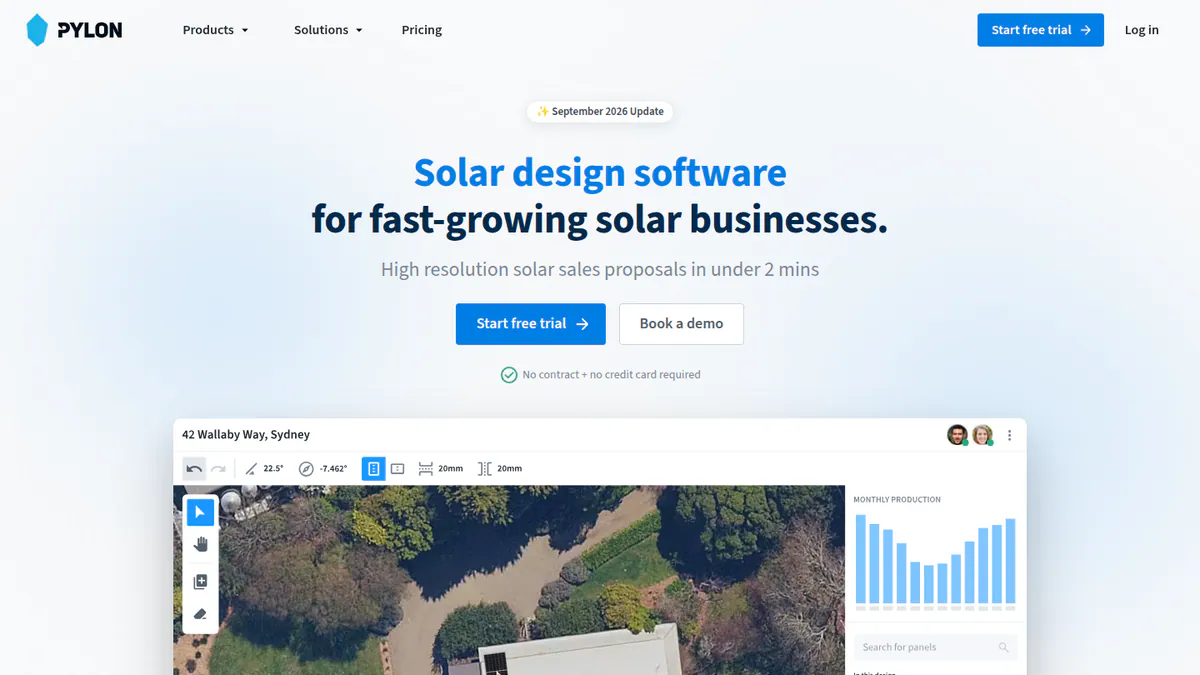
1. Pylon: best for small teams that want pay-per-job pricing
Best for: Solo and small installers in the UK, Ireland and Australia who quote a handful of jobs a month. Score: 83.9/100.
vs EasySolar: Pylon shows its price up front and shipped dated updates through July 2026. We found no dated EasySolar update after 2020.
What it is: Pylon is an Australian design and proposal tool with an optional CRM (software that tracks customers and sales). Pricing is per project. There is no monthly minimum, and you can add as many users as you like.
Why we picked it: It scored top marks for support and recent updates, and its 25 Capterra reviews are strong. A small team can start with free credits and no card.
Key features:
- Panel and battery layouts on aerial images.
- Financial projections and load profiles in the proposal.
- Web and PDF proposals, with an eSignature add-on.
- MCS (UK certification scheme) reports and STC/PDRS (Australian incentive schemes) support.
Pricing: Standard costs GBP 4 per project, up to 30 kW DC. Pro costs GBP 10 per project. Enterprise is quote only. The CRM add-on starts from GBP 49 per user per month. New accounts get five free Standard credits. Checked October 2026 on the Pylon UK pricing page.
Pros (from user reviews):
- Small operators pay only for the jobs they quote (Capterra).
- Newcomers find it friendly, helped by a clear manual (Capterra).
- Reviewers say the proposals are thorough (G2).
Cons (from reviews and our research):
- Aerial photos are sharper in some areas than others, and Nearmap links work unevenly (Capterra).
- Modelling a customer’s power use is clumsy (Capterra).
- We found only UK prices in GBP, so US and Australian buyers must ask.
Reviews: Capterra 4.6/5 (25 reviews) and G2 4.3/5 (2 reviews), checked October 2026.
Read our full Pylon review or our Pylon alternatives.
Want to see Pylon working? Book a demo with the SolarSoftwares team.
Book a demoYour request goes by email to the SolarSoftwares team. A time is set only after we reply. It does not change any score or ranking.
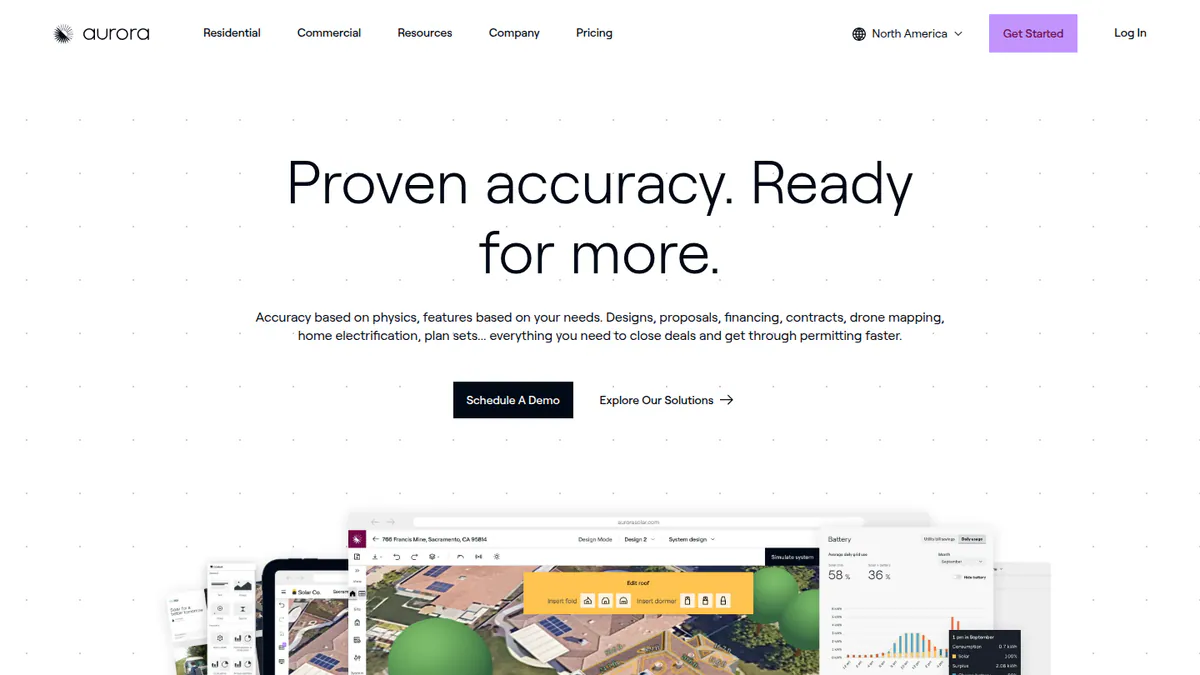
2. Aurora Solar: best for US teams that want detailed 3D shading
Best for: US home and light-commercial installers who have outgrown a photo-based quoting app. Score: 81.4/100.
vs EasySolar: Aurora gives far deeper shading and an active company. At USD 159 per user per month, it is a big step up for a one- or two-person team.
What it is: Aurora Solar Inc. sells this cloud tool for design, shading and sales proposals. Its price list is in US dollars and aimed at North American firms.
Why we picked it: Its 121 G2 reviews give it one of the largest review bases here. The company is active and its prices are public.
Key features:
- Cloud 3D design, with LIDAR (laser height data) assisted modelling on Premium.
- Shade analysis and production simulation.
- Proposals with financing, including tax-credit estimates (US credit rules change, check current law) and TPO (a deal where the customer pays for power instead of buying the panels).
- Battery modelling on Premium.
Pricing: Basic costs USD 159 per user per month, or USD 135 a month billed annually. Basic is for one user and up to 50 projects a month. Premium costs USD 259 a month (USD 220 billed annually). Enterprise is custom. No free plan. Checked October 2026 on the Aurora Solar pricing page.
Pros (from user reviews):
- Shade reports and output estimates are accurate (Capterra).
- Users praise the customer service (G2).
- Training videos and a knowledge base shorten the learning time (Capterra).
Cons (from user reviews):
- Proposal and financial features feel thin for the cost (Capterra).
- Links to other software are weak, says one G2 reviewer.
- Older 2019 reviews report heavy memory use on weak computers (Capterra).
Reviews: G2 4.7/5 (121 reviews) and Capterra 4.1/5 (7 reviews), checked October 2026.
Read our full Aurora Solar review or our Aurora Solar alternatives.
Want to see Aurora Solar working? Book a demo with the SolarSoftwares team.
Book a demoYour request goes by email to the SolarSoftwares team. A time is set only after we reply. It does not change any score or ranking.
3. OpenSolar: best free EasySolar replacement
Best for: Small installers who want design and proposals with no licence fee. Score: 77.1/100.
vs EasySolar: OpenSolar’s core is free and it ships dated releases, such as OS 3.0 in September 2025. EasySolar’s last confirmed app update was in 2016.
What it is: OpenSolar charges nothing for its core design and proposal app. Its income comes from hardware and finance partners, paid imagery and a supplier shop, and the company cites use in more than 160 countries.
Why we picked it: It costs nothing to start, which matters if you are leaving a tool you may have paid little for. It also ships dated releases.
Key features:
- 2D and 3D roof layouts with shading, at no cost.
- AI design in OS 3.0.
- Proposals customers can sign and pay from online.
- Built-in finance options.
Pricing: The core costs nothing. The company says it "will always be free for you to use". Since 16 April 2026, API access and the Xero and QuickBooks connectors cost extra, at unpublished rates. Premium images are optional and paid. Checked October 2026 on the OpenSolar pricing notice.
Pros (from reviews and our research):
- Adding and moving panels is very easy (G2).
- A reviewer uses the app to show figures in the field, which suits on-site selling (G2).
- The company says the free core has unlimited users, so the whole team can join.
Cons (from user reviews):
- Layouts lack automatic tweaks, so an engineer still checks them (G2).
- The interface looks dated (G2).
- A reviewer says it is "not completely free" (G2).
Reviews: G2 4.8/5 (3 reviews), checked October 2026.
Read our full OpenSolar review or our OpenSolar alternatives.
Want to see OpenSolar working? Book a demo with the SolarSoftwares team.
Book a demoYour request goes by email to the SolarSoftwares team. A time is set only after we reply. It does not change any score or ranking.
4. Solargraf: best for US installers who also need permit packs
Best for: US and Canadian home installers who want design, proposals, finance and permits in one plan. Score: 70.6/100.
vs EasySolar: Solargraf goes well past a quoting app, with permit-ready SLDs (single-line diagrams, simple drawings of how the wires connect) and plan sets (permit drawing packages). The cheapest bundle, though, is USD 2,799 a year.
What it is: Enphase owns Solargraf, which joined it with Sofdesk in 2021. It bundles design, proposals, finance and permit packs, mostly for US and Canadian firms.
Why we picked it: It scored the highest fit of any tool here for design, proposals and finance. Weak Capterra reviews pull its overall score down.
Key features:
- Auto roofline and obstacle detection.
- Permit-ready SLDs, three-line diagrams and plan sets to NEC 2026 (the US electrical code).
- Proposals with solar and battery savings.
- TPO and loan finance through Concert, LightReach and EnFin.
Pricing: Plans are yearly. Starter costs USD 2,799 (240 projects, 2 users). Small Business costs USD 4,799 (480 projects, 4 users). Teams costs USD 6,399, and Enterprise USD 12,999. Checked October 2026 on the Solargraf pricing page.
Pros (from user reviews):
- Design is easy, with good shading and 3D tools.
- Reviewers like running a job from proposal to permit in one place.
- Proposals and contracts are easy for clients to follow.
Cons (from user reviews):
- It can crash, and wrong property data can confuse the 3D tool.
- Reviewers find it expensive next to other options.
- Support waits have grown longer.
Reviews: Capterra 3.2/5 (15 reviews), checked October 2026.
Read our full Solargraf review or our Solargraf alternatives.
Want to see Solargraf working? Book a demo with the SolarSoftwares team.
Book a demoYour request goes by email to the SolarSoftwares team. A time is set only after we reply. It does not change any score or ranking.
5. Arka 360: best for installers in India
Best for: Indian installers, and US installers who want unlimited projects for a flat fee. Score: 67.5/100.
vs EasySolar: Like EasySolar, it pairs fast design with sales proposals. It adds stringing and has 137 G2 reviews, where we found none for EasySolar.
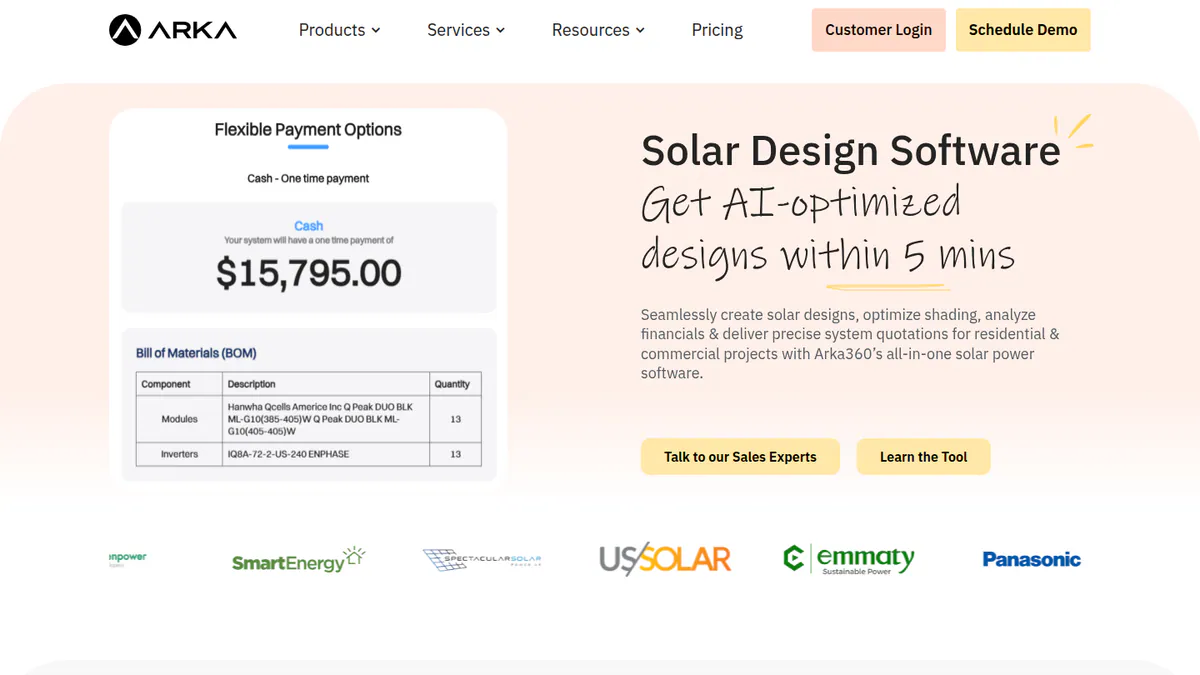
What it is: Arka 360, the company formerly known as The Solar Labs, makes a cloud design and proposal tool with a light CRM. It runs from Bengaluru and Allen, Texas.
Why we picked it: Reviewers rate its support highly, and it has the most G2 reviews on this page. Flat US plans with unlimited projects keep costs simple.
Key features:
- 3D design of roofs and ground mounts, with shade analysis.
- Stringing (how panels wire into inverters), including micro-inverter and optimiser design.
- Sales proposals and generation reports.
- AI design generation and permitting checks.
Pricing: The international-list Basic costs USD 159 a month or USD 1,699 a year, with unlimited projects. US Premium costs USD 199 a month. Indian plans are priced in INR plus 18% GST, but the page shows two conflicting INR price sets, so ask for a written quote. Checked October 2026 on the Arka 360 pricing page. Demo only.
Pros (from user reviews):
- Fourteen G2 reviewers single out how easy it is to use.
- Reviewers trust its shade analysis and its estimates of how much power the panels will make for quotes.
- 3D views help close deals, and support staff are caring.
Cons (from user reviews):
- Big jobs of 3 MWp and up make it lag.
- Some features are missing, and the structure options confuse some users.
- Bigger teams hit limits on multiple users.
Reviews: G2 4.3/5 (137 reviews), checked October 2026.
Read our full Arka 360 review or our Arka 360 alternatives.
Want to see Arka 360 working? Book a demo with the SolarSoftwares team.
Book a demoYour request goes by email to the SolarSoftwares team. A time is set only after we reply. It does not change any score or ranking.
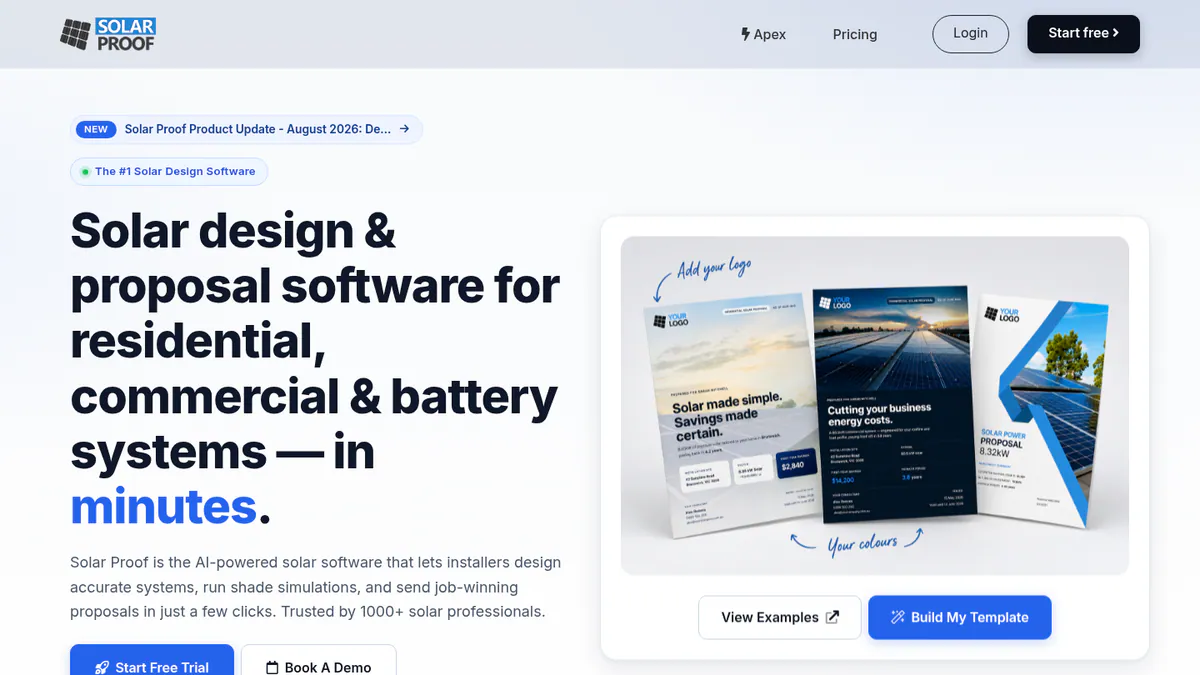
6. Solar Proof: best for Australian pay-as-you-go quoting
Best for: Small Australian installers who quote with STC and battery rebates (Australian incentive schemes). Score: 66.7/100.
vs EasySolar: It keeps a low-commitment model, with credits per project. Unlike EasySolar, it posted a dated product update in August 2026.
What it is: Solar Proof comes from Kingscliff in New South Wales. It handles design, proposals and rebate quotes, and it is written only for Australian rules.
Why we picked it: It keeps a low-commitment model, with project credits that never expire. Its prices are public.
Key features:
- Design on Nearmap or Metromap images.
- 3D shade analysis with shade loss for each panel.
- An SLD editor in the browser that pulls data from the quote.
- Automatic STC, Cheaper Home Batteries and VEEC rebate sums.
Pricing: Pay As You Go costs 4 per project in credits that never expire, with five free projects. Pro starts from 99 a month, and paying yearly saves 20%. The page shows only a dollar symbol, so AUD is implied. Checked October 2026 on the Solar Proof pricing page.
Pros (from our research):
- Credits never expire, so a quiet month costs nothing.
- Rebates are worked out for you, which cuts quoting errors.
- You can try the SLD editor free, without an account.
Cons (from our research):
- It is built for Australian rules only.
- Pro prices for each team size are not on the pricing page.
- On pay-as-you-go, the SLD editor needs In-Depth projects, which use 3 credits.
Reviews: No user reviews found as of October 2026.
What we could not confirm: The currency, and whether GST (Australia’s sales tax) is included.
Want to see Solar Proof working? Book a demo with the SolarSoftwares team.
Book a demoYour request goes by email to the SolarSoftwares team. A time is set only after we reply. It does not change any score or ranking.
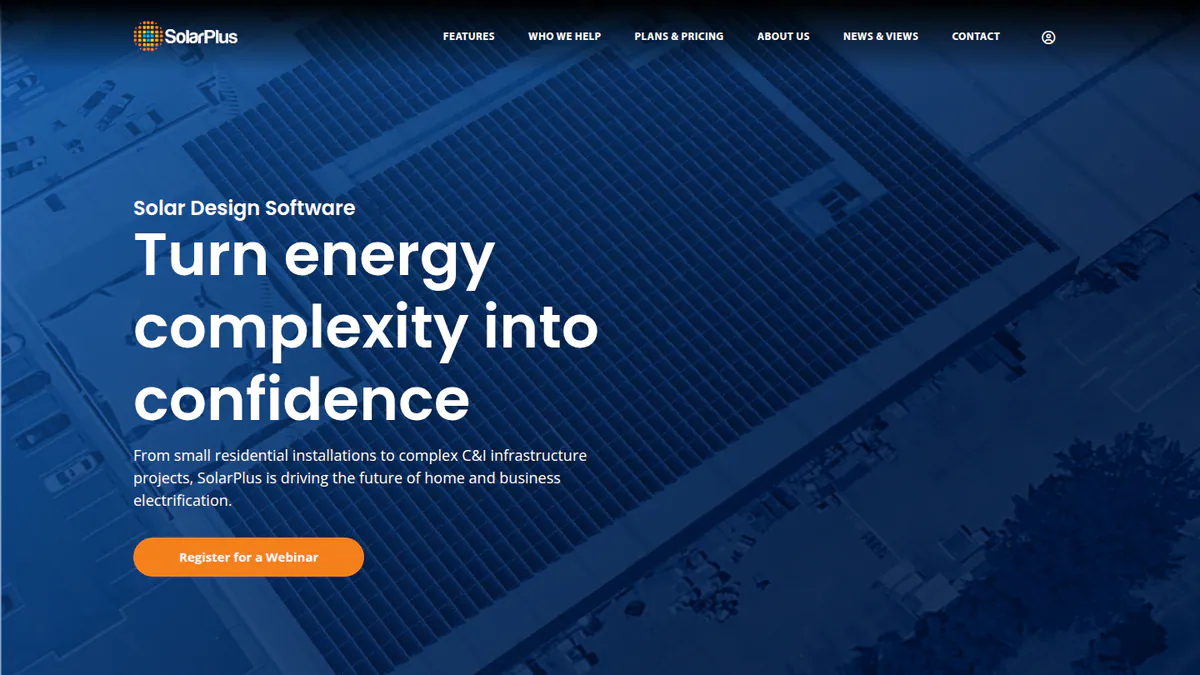
7. SolarPlus: best for battery and off-grid jobs in Australia and New Zealand
Best for: Australian and New Zealand installers who design batteries, off-grid systems and commercial and industrial (C&I) jobs. Score: 66.6/100.
vs EasySolar: SolarPlus offers far deeper battery and off-grid design. Its team plans start at USD 135 a month for up to 5 designers.
What it is: SolarPlus is design, quoting and sales software from Healesville, Victoria, founded in 2011. It adds a light CRM and install job packs.
Why we picked it: It scored highly for fit on proposals and finance, with deep battery design. Only one review keeps it lower in the list.
Key features:
- RoofMap auto panel layout on aerial images.
- Battery sizing with peak shaving (cutting your highest power use) and tariffs.
- Off-grid loads and backup generator sizing.
- Proposals clients accept online, with finance payments.
Pricing: Starter costs USD 135 a month paid yearly, or USD 150 monthly, for 5 designers. Pro costs USD 260 or USD 300 for 10 designers. Complete costs USD 450 or USD 520. Each plan caps the kW you can quote. Onboarding packs are AUD 500 or AUD 1,000. Checked October 2026 on the SolarPlus pricing page.
Pros (from our research):
- One plan covers several designers, so you do not pay per seat.
- Off-grid and generator design suit remote jobs.
- Install job packs carry the sale through to the crew.
Cons (from our research):
- Plans cap quoted volume, such as 300 kW of home systems on Starter.
- Onboarding packs can add up to AUD 1,000.
- With one G2 review, there is little user feedback.
Reviews: G2 4.5/5 (1 review), checked October 2026.
Want to see SolarPlus working? Book a demo with the SolarSoftwares team.
Book a demoYour request goes by email to the SolarSoftwares team. A time is set only after we reply. It does not change any score or ranking.
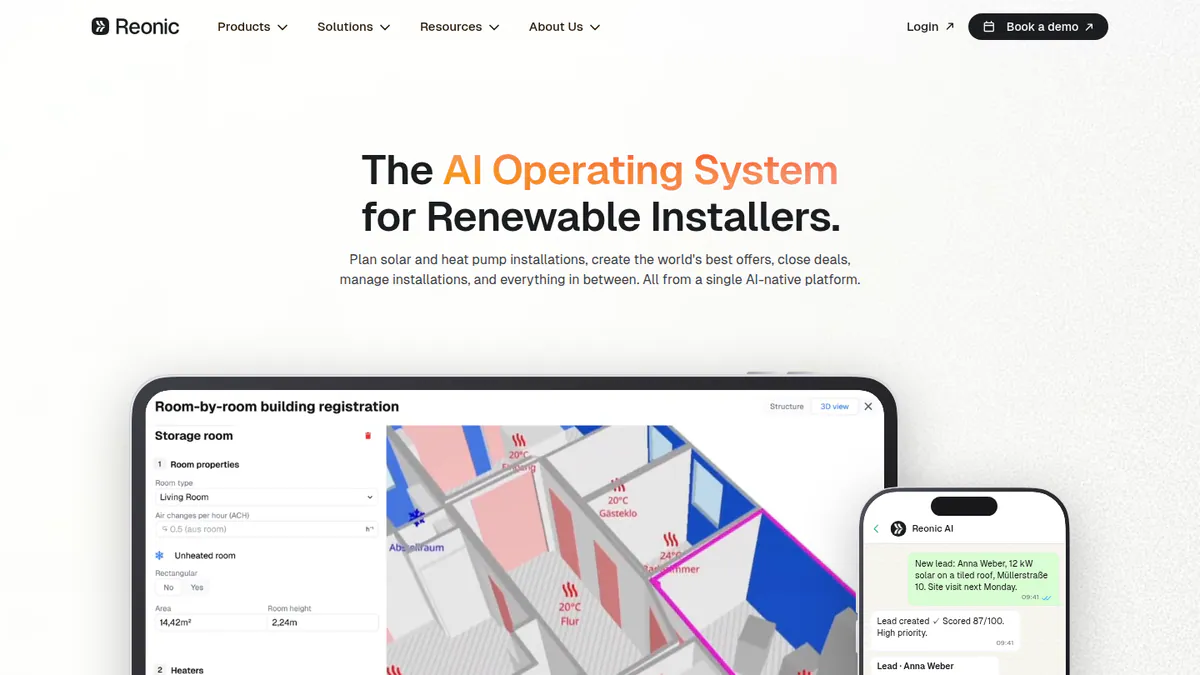
8. Reonic: best for installers in Germany, Austria and Switzerland
Best for: Installers in Germany, Austria and Switzerland who sell solar with batteries, wallboxes (home EV chargers) and heat pumps. Score: 66.3/100.
vs EasySolar: Like EasySolar, Reonic comes from mainland Europe. Unlike it, Reonic is clearly active and raised a EUR 13M Series A funding round in September 2024.
What it is: Reonic is an all-in-one platform from Reonic GmbH in Augsburg and Berlin. It covers 3D design, shading, proposals, CRM and project management.
Why we picked it: It is an active platform from mainland Europe, close to EasySolar’s home market. Its 33 Trustpilot reviews average 4.5.
Key features:
- 3D roof models from satellite, aerial or drone scans.
- Proposal builder with profit figures and e-signature.
- CRM and project management with a customer portal.
- Heat pump plans alongside PV and batteries.
Pricing: Quote only. There is no price list. You book a free demo instead. Checked October 2026 on the Reonic product page.
Pros (from user reviews):
- Heat loss and system design tools have a clean interface (UK review, March 2026).
- Onboarding support is excellent (UK review, March 2026).
- Energy-flow simulation and fast proposals improved sales (German review, September 2024).
Cons (from our research):
- No published prices, so you need a demo to budget.
- Grid registration and KfW services work in Germany only.
- Poland is not among its listed markets.
Reviews: Trustpilot 4.5/5 (33 reviews), checked October 2026. Its Capterra listing has 0 reviews.
See our Reonic alternatives guide.
Want to see Reonic working? Book a demo with the SolarSoftwares team.
Book a demoYour request goes by email to the SolarSoftwares team. A time is set only after we reply. It does not change any score or ranking.
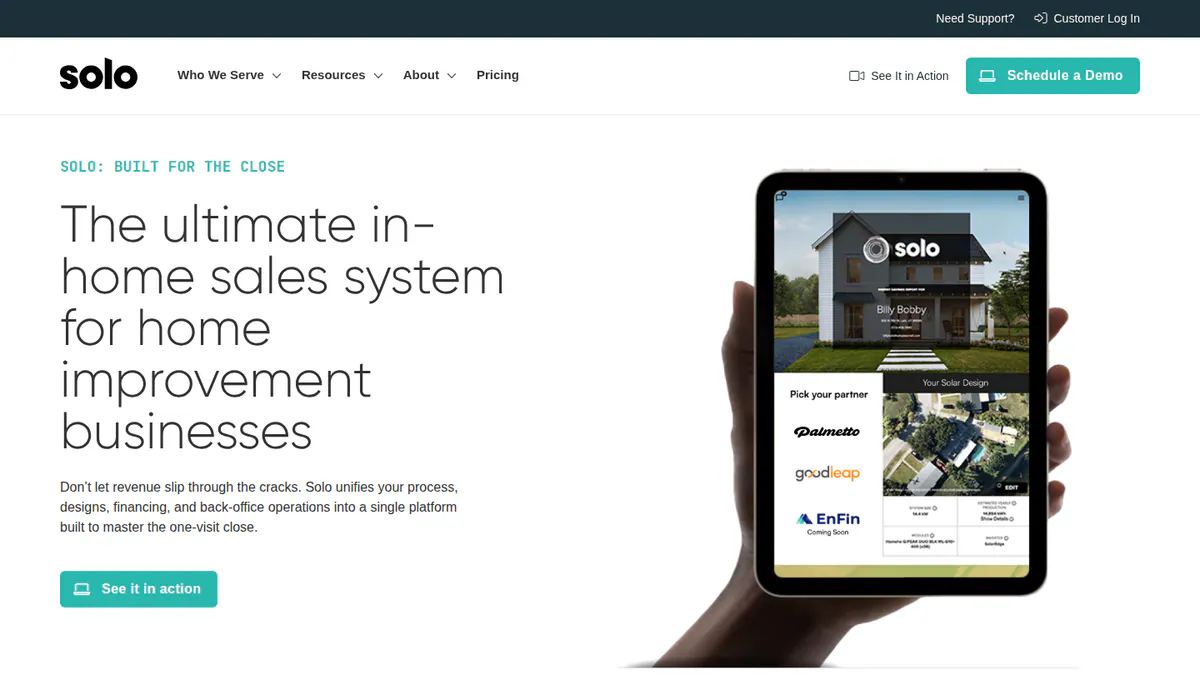
9. Solo: best for US sales teams with many reps
Best for: US home solar dealers and installers with several reps. Score: 65.5/100.
vs EasySolar: Solo is built for reps who quote in the customer’s home, as EasySolar was. But it works in the US only and has no public price.
What it is: Solo is an AI-assisted design, proposal and finance platform from Lehi, Utah. It bought SolarNexus in 2023.
Why we picked it: It is built for reps who quote in the home, the job EasySolar was made for. Reviewers on G2 rate it well, and updates are recent.
Key features:
- AI auto-design that finds roof edges and obstructions.
- Finance marketplace with Sungage, GoodLeap and LightReach.
- Built-in checks against lender, utility and AHJ (local permit office) rules.
- CRM links to Salesforce, HubSpot and Enerflo.
Pricing: Solo does not publish prices. It says cost is "based on usage, support level, and scale", with unlimited users and onboarding included. Checked October 2026 on the Solo pricing page.
Pros (from reviews and our research):
- New reps are easy to train (Capterra review, December 2025).
- Release notes are dated monthly through April 2026.
- Growing teams add reps with no seat fee.
Cons (from reviews and our research):
- Reps can change too many settings, which hurts quality control (same review).
- Lender and utility checks cover the US only.
- You need a sales call to get a price.
Reviews: G2 4.6/5 (12 reviews), checked October 2026.
Read our full Solo review or our Solo alternatives.
Want to see Solo working? Book a demo with the SolarSoftwares team.
Book a demoYour request goes by email to the SolarSoftwares team. A time is set only after we reply. It does not change any score or ranking.
10. solarVis Sales Engine: best for lead capture and proposals in one tool
Best for: Small and mid-sized installers who want lead forms, design and proposals together. Score: 61.5/100.
vs EasySolar: It covers a similar design-to-offer flow and adds lead capture. As with EasySolar, though, we could not reach its website.
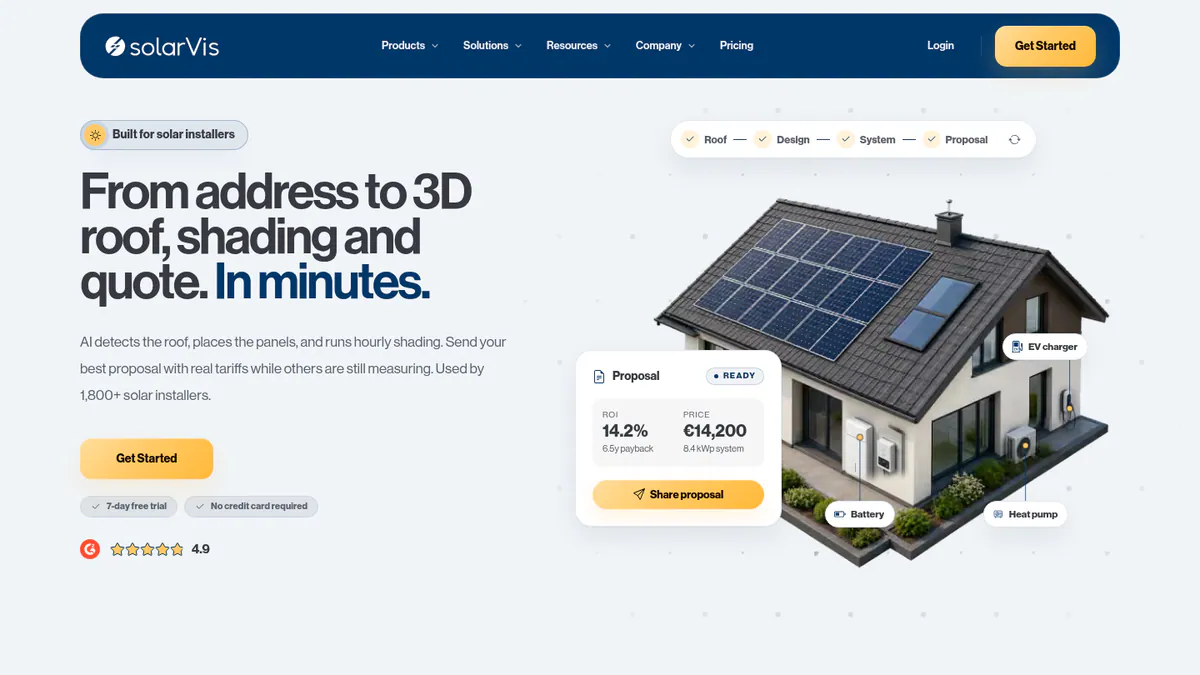
What it is: solarVis, based in Ankara, Turkey, sells an all-in-one solar sales platform. Note: we could not open its website, so its features come from its G2 and Software Advice listings, and its price is unconfirmed.
Why we picked it: It combines lead capture with design and proposals, and its G2 reviews are strong. Its price is unconfirmed, so it ranks last here.
Key features:
- Branded solar calculator and landing pages to capture leads.
- 3D and 2D roof design with AI panel placement.
- Battery, heat pump and EV charger modelling.
- Built-in CRM with an 8-stage pipeline.
Pricing: Not confirmed. We could not reach the company’s pricing page in October 2026.
Pros (from user reviews):
- Remote site checks cut first-visit time, by about 40% for one reviewer (G2).
- The calculators and AI agent bring in more qualified leads (G2).
- Proposals are clear, and the team adds features users ask for (G2).
Cons (from user reviews):
- Satellite image quality varies by location (G2).
- Complex roofs with many faces are hard to draw (G2).
- Some graphs confuse customers, and exports are limited (G2).
Reviews: G2 4.9/5 (11 reviews, one incentivised), checked October 2026.
Want to see solarVis Sales Engine working? Book a demo with the SolarSoftwares team.
Book a demoYour request goes by email to the SolarSoftwares team. A time is set only after we reply. It does not change any score or ranking.
SurgePV (unscored): for readers comparing roof modelling, array layout and proposals in one browser project. Compare required imports, design depth and local outputs on your own project. The numbered scores above do not include it.
Sources checked 27 October 2026: SurgePV product information · SolarSoftwares SurgePV review
Book a demo of SurgePV with the SolarSoftwares team.
Book a demoYour request goes by email to the SolarSoftwares team. A time is set only after we reply. It does not change any score or ranking.
How do the 10 EasySolar alternatives compare?
Product | Entry price (checked October 2026) | Free start | Price published | Field or app use in our sources | Main regions |
|---|---|---|---|---|---|
EasySolar (reference) | No verified price | Not confirmed | No | Android app, last updated 2016 | Poland, EU |
GBP 4/project | 5 free credits | Yes (UK) | Not documented | UK, IE, AU, US | |
USD 159/user/month | No | Yes | Not documented | US | |
Free | Free core | Core only | Interactive app used in the field (G2) | Global | |
USD 2,799/year | Not stated | Yes | Not documented | US, Canada | |
USD 159/month | Demo only | Yes | Not documented | India, US | |
4/project (AUD implied) | 5 free projects | Partly | Not documented | Australia | |
USD 135/month | No | Yes | Not documented | Australia, NZ | |
Quote only | Demo only | No | Mobile app module listed | Germany, Austria, Switzerland | |
Quote only | Demo only | No | Not documented | US | |
solarVis | Not confirmed | Not confirmed | Not confirmed | Not documented | Turkey, EU |
Also considered
- Enerflo: Scored 58.2/100. It is a US-only sales-to-install layer with a flat monthly fee and a 12-month minimum, so it does not suit small teams. See our Enerflo alternatives.
- Enact (Design & Proposals): Scored 53.3/100. We could not reach its website, found no confirmed price and found no user reviews. See our Enact alternatives.
- Solar Monkey: Scored 50.8/100. This Dutch tool serves European installers and merged with Eturnity in March 2026. We could not reach its pricing page and found no user reviews.
How do you choose an EasySolar alternative?
- If you left EasySolar because you want to pay only when you quote, pick Pylon (UK, Ireland, Australia) or Solar Proof (Australia).
- If you do not want a licence fee, pick OpenSolar.
- If you sell in the US and want deeper shading, pick Aurora Solar. If you also need permit packs, pick Solargraf.
- If you work in Germany, Austria or Switzerland and sell heat pumps too, book a Reonic demo.
- If you are in India, pick Arka 360.
- If you design batteries and off-grid systems in Australia or New Zealand, pick SolarPlus.
- If you run a US team with many reps, shortlist Solo.
None of the ranked tools lists Polish-market features in our sources. Polish installers should ask each company about local tariffs and net-billing rules before switching.
For wider lists, see design and proposal software and free proposal software. Also see our notes for small installers, site survey apps and the proposals and sales hub. For a ranked list across every segment, see our best solar design software ranking.
Want more choices? Browse every tool we checked in our design and simulation category.
How do you switch from EasySolar?
- Save your data now. Export or copy your customer list and past PDF offers while the app still opens.
- Write down your prices. EasySolar used prices you typed in by hand, so list your panel, inverter and labour prices and margins.
- Rebuild your offer template. Add your logo, terms and payback wording to the new tool.
- Run one real job in both. Compare layout, output and savings before you send the new offer.
- Test it on site. Try the new tool on the phone or tablet you carry before you rely on it in a customer’s home.
EasySolar alternatives FAQs
Is EasySolar still available?
We could not confirm that it is, as of October 2026. Its website did not appear in five searches, and its newest dated coverage is from February 2020. Apptopia shows its Android app was last updated in 2016. Contact the company before you rely on it.
What is the best alternative to the EasySolar app?
Pylon is the best EasySolar app alternative in our October 2026 ranking, at 83.9/100. It costs GBP 4 per project with unlimited users and five free credits. OpenSolar is the best free option, and Aurora Solar suits US teams that want detailed 3D shading.
Is there a free mobile app for solar PV design and proposals?
Yes, OpenSolar. Its core design and proposal platform is free, and a G2 reviewer uses its app in the field. API access and accounting connectors have cost extra since 16 April 2026. Test the app on your own device first.
How much does EasySolar cost?
We could not find a current price. The company showed none as of October 2026. Older third-party articles quoted EUR 20 or PLN 80 per user per month, and a sponsored 2020 article quoted PLN 79 net a month. Treat these as out of date.
Which solar design app works on a phone or tablet in the field?
OpenSolar is the clearest case in our October 2026 sources. A G2 reviewer uses its app to show customers figures on site. Reonic lists a mobile app module but does not describe it. Test any tool on your own device first.
Sources
All read 22 to 23 October 2026. We checked the page plan on 25 October 2026.
- EasySolar: Apptopia, Gramwzielone (2020), PV Europe, InnoEnergy
- Pylon: UK pricing, Capterra, G2, July 2026 update
- Aurora Solar: pricing, G2, Capterra, G2 review
- OpenSolar: pricing notice, free platform, news, G2
- Solargraf: pricing, Capterra, Q2 2026 highlights
- Arka 360: pricing, G2
- Solar Proof: pricing, product, SLD editor
- SolarPlus: pricing, features, G2
- Reonic: product, Trustpilot, Capterra
- Solo: pricing, integrations, G2, Capterra review, April 2026 release notes
- solarVis Sales Engine: G2, Software Advice
- Enerflo: FAQ
Last updated 28 October 2026. Next scheduled review: 23 January 2027.