All-in-one solar software is one subscription that runs the whole solar business, from the first lead to the final invoice and after-sales care. Payaca ranks first on this list, at 81.0/100.
Payaca is the only one of 13 platforms we scored that documents all seven jobs in one system. It starts at GBP 299 a month for new UK businesses. No product does every job perfectly, so the real choice is which gaps you can live with.
What does "all-in-one" mean on this page?
Most "all-in-one" platforms cover the sales half: lead, design, proposal, signature.
This page asks a different question. How much of the company can one subscription run after the contract is signed? We scored coverage across seven jobs: leads and CRM (software that tracks customers and sales), design, proposals with e-signature, permit or grid paperwork, project delivery and scheduling, stock and invoicing, and after-sales. The comparison table below shows the results.
In practice, design-led tools stop at the signed proposal, and operations-led tools have thin design. This page sits in our CRM and lead management category.
Quick picks: best all-in-one solar software
Rank | Product | Best for | Starting price (company page, checked October 2026) | Free plan / trial | Score /100 |
|---|---|---|---|---|---|
1 | Enquiry to invoice in one system (UK) | ✓ GBP 299 per month ex VAT (new businesses) | Demo only | 81.0 | |
2 | Per-job pricing for the sales half | ✓ GBP 4 per project. CRM from GBP 49 per user per month | 5 free project credits | 76.2 | |
3 | US design and sales core, with a separate CRM | ✓ USD 159 per user per month | None stated | 67.8 | |
4 | Free sales core | ✓ Free core platform | Free core platform | 66.4 | |
5 | Design plus light CRM (India, US) | ✓ USD 159 per month (international list) | Demo only | 64.5 | |
6 | CRM-led US suite | ✓ From USD 59 per user per month | Not confirmed | 58.8 | |
7 | US sales through permit plan sets | ? USD 2,799 per year | Not stated by the company | 56.0 |
✓ Verified on the company’s own pricing page. ◐ Published by the company outside its pricing page (help centre, store or press release). ? We could not read the company’s pricing page, so the figure is not confirmed. Prices checked October 2026.
How the 7 tools scored
- Use-case fit 35%
- User reviews 20%
- Pricing 15%
- Ease of use 10%
- Support 10%
- Momentum 10%
Tool | Score chart | Score |
|---|---|---|
81 out of 100 | 81.0 | |
76.2 out of 100 | 76.2 | |
67.8 out of 100 | 67.8 | |
66.4 out of 100 | 66.4 | |
64.5 out of 100 | 64.5 | |
58.8 out of 100 | 58.8 | |
56 out of 100 | 56.0 |
Each bar shows the weighted score out of 100.
Sub-scores at a glance (0-10)
Product | Use-case fit | User reviews | Pricing | Ease of use | Support | Momentum | Total /100 |
|---|---|---|---|---|---|---|---|
7.5 | 7.1 | 7.0 | 10.0 | 10.0 | 10.0 | 81.0 | |
6.7 | 6.7 | 8.0 | 7.5 | 10.0 | 10.0 | 76.2 | |
5.0 | 7.9 | 8.0 | 7.5 | 7.5 | 7.5 | 67.8 | |
5.8 | 5.0 | 9.0 | 7.5 | 5.0 | 10.0 | 66.4 | |
5.8 | 6.3 | 6.0 | 7.5 | 10.0 | 5.0 | 64.5 | |
6.7 | 5.0 | 7.0 | 5.0 | 5.0 | 5.0 | 58.8 | |
5.8 | 3.3 | 6.0 | 5.0 | 5.0 | 10.0 | 56.0 |
A 5.0 on reviews, ease, support or momentum is our neutral score. We use it when public evidence is thin. It is not a judgement.
How did we rank these all-in-one solar platforms?
How the score is weighted
- Use-case fit 35%
- User reviews 20%
- Pricing 15%
- Ease of use 10%
- Support 10%
- Momentum 10%
We scored 13 products from 22 to 24 October 2026 and ranked the top 7. The other 6 are under "Also considered". We used company documents, pricing pages, trade press and public user reviews.
This was desk research. We did not run projects in any tool. We scored each product on six measures.
- Use-case fit (35%): How well it does this page’s job, based on how many of seven jobs it documents. Work after the signature counts as much as the sales half.
- User reviews (20%): G2 and Capterra ratings. Ratings from only a few reviews count for less.
- Pricing (15%): Published prices score higher than prices you must ask for, or prices we could not check.
- Ease of use, support and momentum (10% each): Review sub-scores and dated product updates. Without evidence, each gets a middle score.
None fell below our minimum fit score (4 out of 10). Products whose core facts we could not confirm on the company’s site lose 2 points. SurgePV is not part of this ranking. Read the full method: how we score software.
Which jobs does each all-in-one platform document?
"Not documented" means we found no evidence, not that the feature is missing.
Product | Leads and CRM | Design | Proposal and e-sign | Permit or grid paperwork | Projects and scheduling | Stock and invoicing | After-sales |
|---|---|---|---|---|---|---|---|
Yes | Limited release (Glow) | Yes | MCS and DNO (UK) | Yes | Yes | Customer portal | |
Add-on | Yes | Yes (e-sign add-on) | MCS reports (UK), STC (AU) | Not documented | Xero integration | Not documented | |
Not documented | Yes | Yes | Plan sets (Enterprise) | Not documented | Not documented | Not documented | |
Lead capture | Yes | Yes | SolarAPP+ integration | Not documented | Paid connectors | Not documented | |
Add-on | Yes | Yes | Permitting checks | Basic | Not documented | Not documented | |
Yes | Basic | Yes | Not documented | Yes | Inventory | Not documented | |
Basic | Yes | Yes, with financing | Plan sets (NEC 2026) | Not documented | Not documented | Not documented |
1. Payaca: best for UK installers running enquiry to invoice in one system
Best for: UK and Irish clean-tech installers who want sales, delivery and finance in one system. Score: 81.0/100.
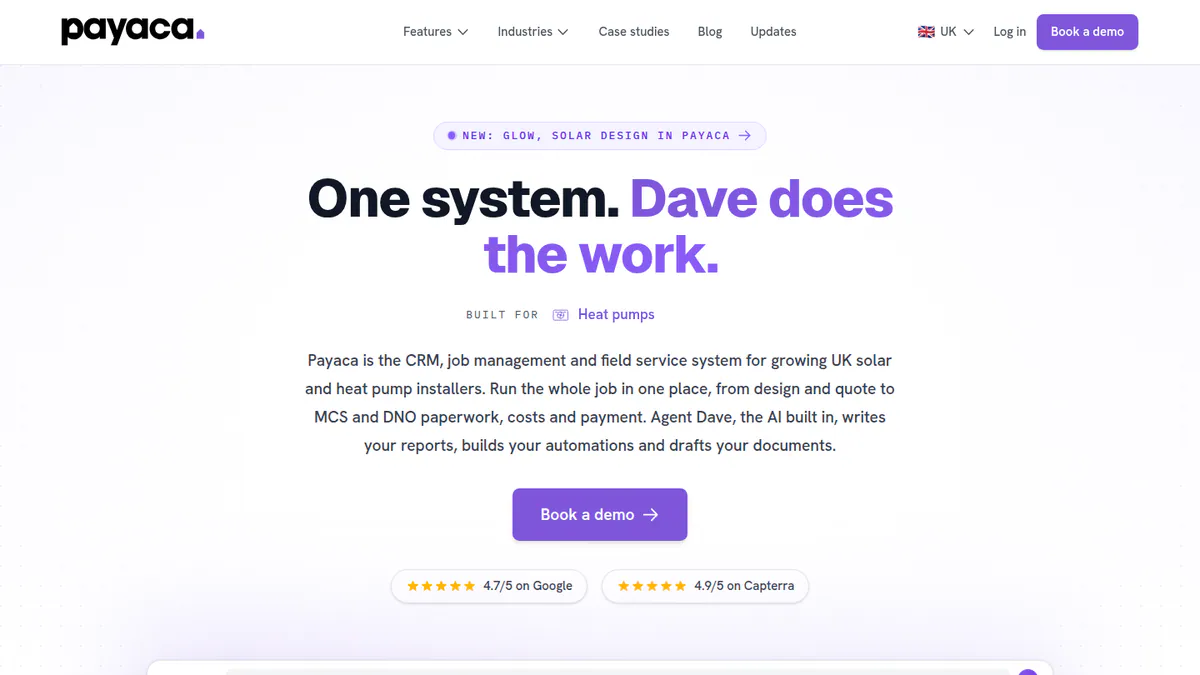
What it is: Payaca is a UK-built clean-tech platform, not solar-only, that runs the job from enquiry to commissioned install. Small and mid-sized installers of solar, batteries, heat pumps and EV chargers use it. Its solar design module, Glow, entered limited release in September-October 2026, and it also links to OpenSolar and Easy PV for design.
Why we picked it: It scored top marks for ease of use, support and momentum, with dated product updates through October 2026. Its UK prices are published, including a cheaper plan for new businesses.
Key features:
- CRM pipeline from enquiry to commissioned install.
- Proposals with e-signature, a customer portal and Stripe deposits.
- MCS (Microgeneration Certification Scheme) paperwork and DNO (distribution network operator) G98/G99 grid applications through ENA Connect.
- Map-based scheduling and an offline field app with timesheets.
- Stock and purchase orders per project.
- Invoicing with Xero and QuickBooks sync.
Pricing: UK Accelerator is GBP 299 per month (GBP 249 billed annually) for new install businesses, for 12 months and up to 25 users. Growth is GBP 1,199 per month (GBP 999 annually) with 25 users and GBP 1,500 one-off onboarding. Scale is GBP 1,999 and Scale Max GBP 3,199. Enterprise is custom. All prices exclude VAT. US plans start at USD 444 per month. Checked October 2026 on the Payaca pricing page.
Pros (from user reviews):
- Intuitive and easy to use (Capterra).
- Interactive multi-option quotes, and one reviewer cut admin work by over 60% (Capterra).
- The support team responds and acts on feedback (Capterra).
Cons (from user reviews):
- Some data mapped incorrectly in the Xero sync (October 2025 review, Capterra).
- One email address per project is awkward for repeat customers (Capterra).
- The mobile app is weaker than the web app, and the layout changes often (Capterra).
Reviews: Capterra 4.9/5 (19 reviews) and G2 4.0/5 (1 review), checked October 2026. Most date from 2021-2024, and none is clearly from a solar installer.
Want to see Payaca working? Book a demo with the SolarSoftwares team.
Book a demoYour request goes by email to the SolarSoftwares team. A time is set only after we reply. It does not change any score or ranking.
2. Pylon: best for small installers paying per job for the sales half
Best for: UK, Irish and Australian installers who want to avoid a monthly platform fee. Score: 76.2/100.
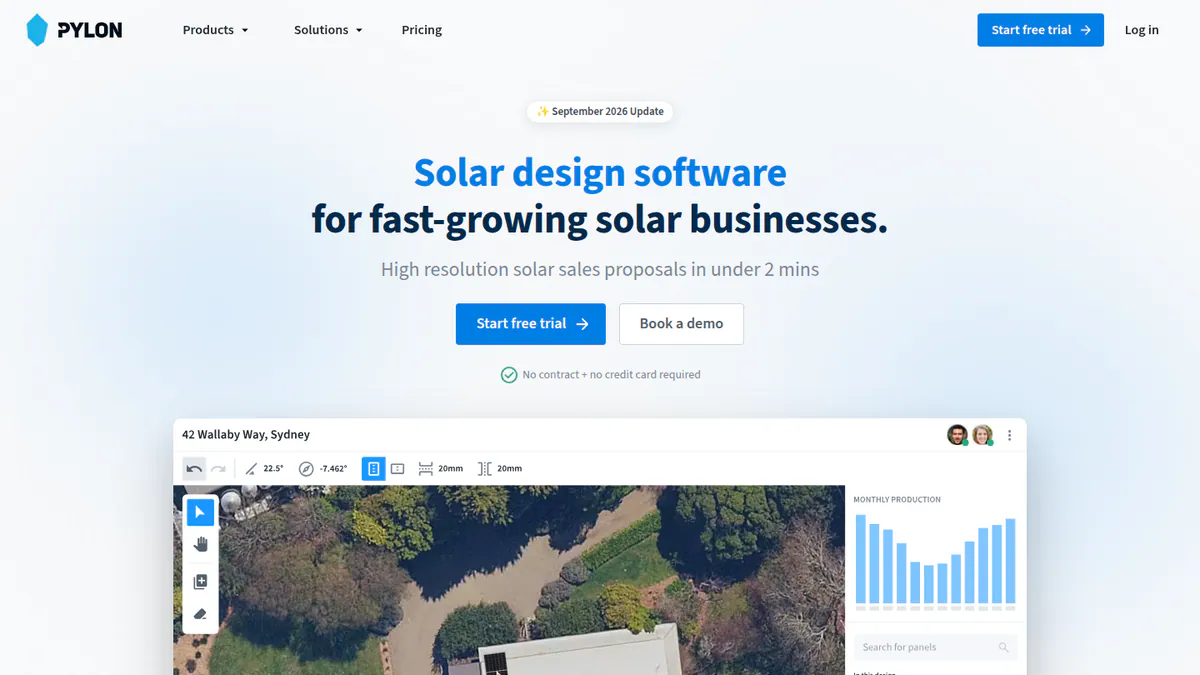
What it is: Pylon, based in Sydney, makes a design and proposal tool with an optional CRM and unlimited users. Small and mid-sized installers in Australia, the UK, Ireland and the US buy it. It stops at the signed proposal. We found no delivery or scheduling, though it links to ServiceM8 for jobs and Xero for accounts.
Why we picked it: You pay per project with unlimited users, so cost follows your sales volume. It also scored top marks for support, with monthly product updates through July 2026.
Key features:
- Solar and battery design on aerial photos, with editable SLDs (single-line diagrams) since July 2026.
- Web and PDF proposals with an eSignature add-on.
- CRM add-on with email sync, lead processor, SMS and web forms.
- MCS reports (UK) and STC (small-scale technology certificate) incentives (Australia).
- Per-project credit pricing with unlimited users.
Pricing: Standard is GBP 4 per project up to 30 kW DC. Pro is GBP 10 per project and adds custom load profiles and commercial sizes (99 kW and up). Enterprise is quote only. The Solar CRM add-on starts from GBP 49 per user per month. You get five free Standard credits on signup. Checked October 2026 on the Pylon UK pricing page.
Pros (from user reviews):
- Pay-per-use suits small operators and is cheap per job (Capterra).
- Most Capterra users find the interface friendly, and a manual helps beginners, though one G2 reviewer says it takes time to pick up.
- Detailed proposals (G2).
Cons (from reviews and our research):
- Imagery quality varies by location, and the Nearmap link is inconsistent (Capterra).
- Usage modelling is awkward (Capterra).
- It stops at the signed proposal, so scheduling and invoicing run in ServiceM8 and Xero.
Reviews: Capterra 4.6/5 (25 reviews) and G2 4.3/5 (2 reviews), checked October 2026. Most Capterra reviews date from 2021-2023.
What we could not confirm: USD or AUD prices, and which plan covers systems from 30 to 99 kW.
Read our full Pylon review or our Pylon alternatives.
Want to see Pylon working? Book a demo with the SolarSoftwares team.
Book a demoYour request goes by email to the SolarSoftwares team. A time is set only after we reply. It does not change any score or ranking.
3. Aurora Solar: best for US design and sales teams pairing it with a separate CRM
Best for: US home solar teams that already run a CRM. Score: 67.8/100.
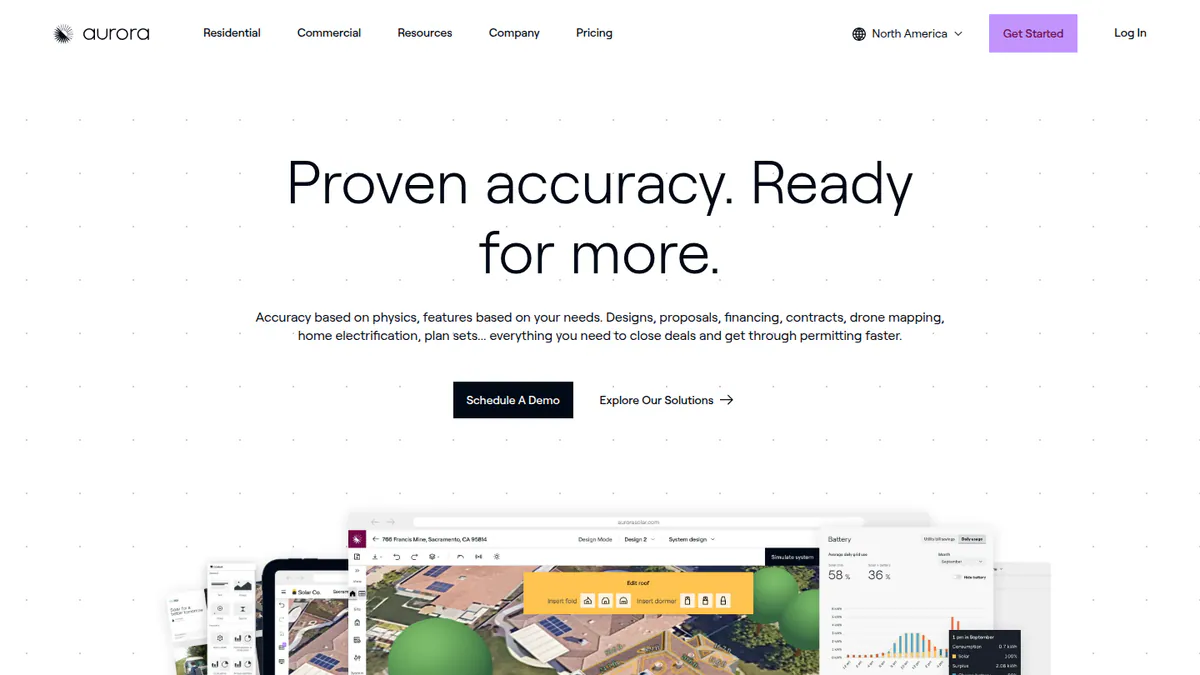
What it is: Aurora Solar Inc. makes this cloud 3D platform. US home and light commercial installers use it to design, simulate and send proposals. With no documented CRM, delivery or invoicing, it is the sales core of a wider stack.
Why we picked it: It has 121 G2 reviews at 4.7/5 and published per-user prices. It earns its place as the design and sales layer of a wider stack.
Key features:
- 3D design with LIDAR-assisted (laser height data) modelling on Premium.
- Shade analysis and bankable (accepted by lenders) shade reports.
- Production simulation and battery modelling.
- Sales proposals with financing.
- Plan sets, unlimited users and API on Enterprise.
Pricing: Basic is USD 159 per user per month (USD 135 billed annually). Premium is USD 259 (USD 220 annually). Enterprise is custom, per project, with plan sets and engineering stamps. Checked October 2026 on the Aurora pricing page.
Pros (from user reviews):
- Accurate shade reports and production estimates (Capterra).
- Accurate design and strong customer service (G2).
- Videos and a knowledge base make it easy to learn (Capterra).
Cons (from user reviews):
- Few connections to other software (G2).
- Proposal and financial features are limited for the cost (Capterra).
- Heavy memory use on weaker machines (2019 reviews, Capterra).
Reviews: G2 4.7/5 (121 reviews) and Capterra 4.1/5 (7 reviews), checked October 2026.
Read our full Aurora Solar review or our Aurora Solar alternatives.
Want to see Aurora Solar working? Book a demo with the SolarSoftwares team.
Book a demoYour request goes by email to the SolarSoftwares team. A time is set only after we reply. It does not change any score or ranking.
4. OpenSolar: best for a free sales core with accounting connectors
Best for: Installers who want the sales half with no licence cost. Score: 66.4/100.
What it is: OpenSolar Inc. gives away its design, proposal and sales platform and earns from hardware and finance partners. Home and small commercial installers around the world sign up. Its extras are accounting connectors, SolarAPP+ permits, a hardware shop and lead capture, but we found no delivery or scheduling.
Why we picked it: It is the only free core platform here, and its paid Xero and QuickBooks connectors reach into your accounts. Dated releases show steady work on it.
Key features:
- Free 3D and 2D rooftop design with shading.
- Interactive proposals with e-signature and payment collection.
- Permit connections such as SolarAPP+ (an automated US permit approval system).
- A hardware shop with distributors, and lead capture.
- Paid Xero and QuickBooks connectors.
Pricing: The core platform is free. Since 16 April 2026, API access (30-day free trial) and the Xero and QuickBooks connectors cost extra. OpenSolar does not publish the rates. Premium imagery is optional. Checked October 2026 on the OpenSolar pricing notice.
Pros (from reviews and our research):
- Adding, removing and changing panels is very easy (G2).
- An interactive app that gives information in the field (G2).
- The core is free, so trying it costs only staff time.
Cons (from reviews and our research):
- Panel design needs engineering review (G2).
- The interface feels dated (G2).
- Connectors and API access cost extra at unpublished rates, so one reviewer calls it "not completely free" (G2).
Reviews: G2 4.8/5 (3 reviews), checked October 2026.
Read our full OpenSolar review or our OpenSolar alternatives.
Want to see OpenSolar working? Book a demo with the SolarSoftwares team.
Book a demoYour request goes by email to the SolarSoftwares team. A time is set only after we reply. It does not change any score or ranking.
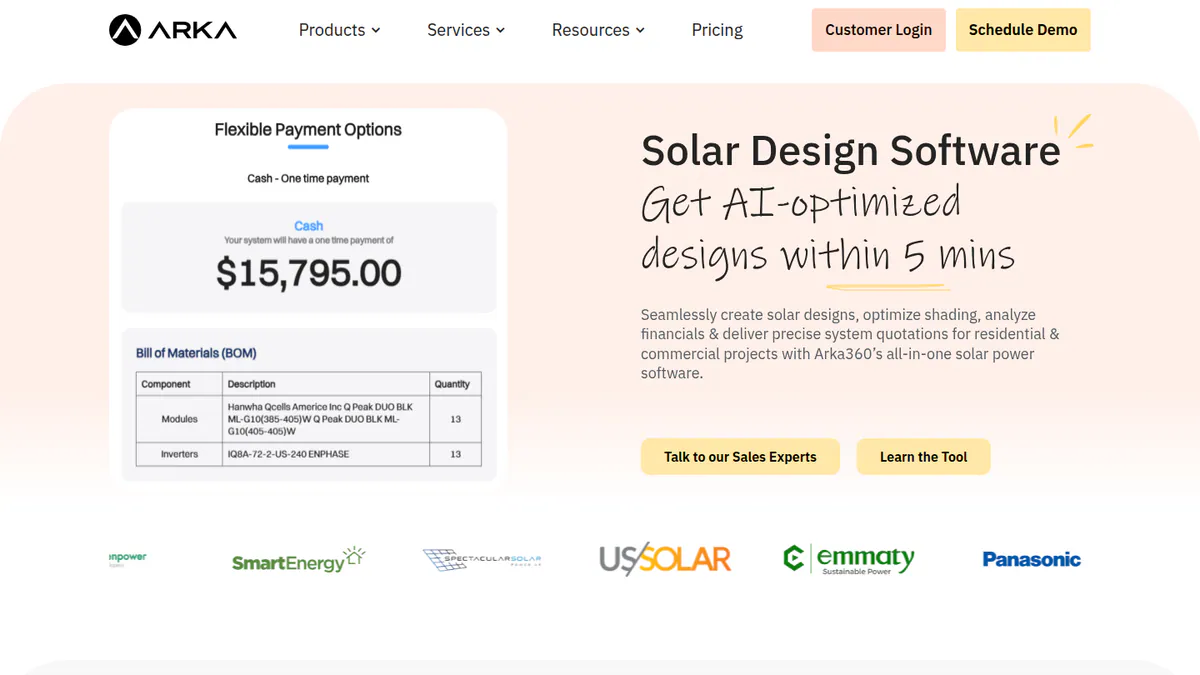
5. Arka 360: best for India and US installers wanting design plus a light CRM
Best for: Design-led teams in India and the US. Score: 64.5/100.
What it is: Arka 360, once called The Solar Labs, is a cloud design and proposal platform. Home and commercial installers use it, mainly in India, with a US offering. It has a lead management add-on and basic project tracking, but we found no scheduling, stock or invoicing.
Why we picked it: It pairs design with a lead management add-on, has 137 G2 reviews and shows US prices. It scored top marks for support.
Key features:
- 3D rooftop and ground-mount design with shading analysis.
- Stringing, SLD export and API (Premium).
- Sales proposals and generation reports.
- Lead management CRM add-on.
- AI design generation and permitting checks.
Pricing: The international-list Basic is USD 159 per month (USD 1,699 per year). Premium is USD 199 per month (USD 1,999 per year). Enterprise is USD 999 per month (USD 9,999 per year). The Indian page shows two conflicting INR price sets, so we have not quoted them. Checked October 2026 on the Arka 360 pricing page.
Pros (from user reviews):
- Easy to use, with many useful tools (14 mentions on G2).
- Shadow analysis and project estimates (G2).
- 3D views help close deals, and support staff are caring (G2).
Cons (from user reviews):
- Missing features and a confusing structure choice (G2).
- Lag on projects of 3 MWp (megawatts peak) and above (G2).
- Limits on multiple users (G2).
Reviews: G2 4.3/5 (137 reviews), checked October 2026.
Read our full Arka 360 review or our Arka 360 alternatives.
Want to see Arka 360 working? Book a demo with the SolarSoftwares team.
Book a demoYour request goes by email to the SolarSoftwares team. A time is set only after we reply. It does not change any score or ranking.
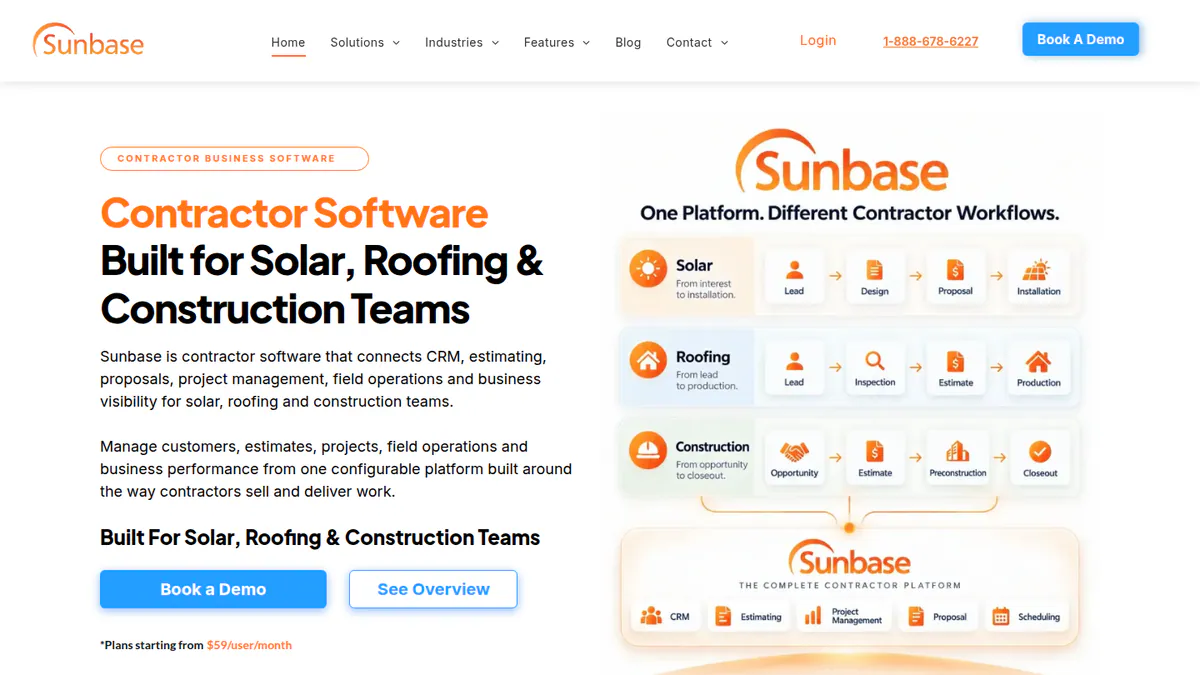
6. Sunbase: best for US installers wanting CRM, projects and inventory modules
Best for: US home installers who want a CRM-led suite. Score: 58.8/100.
What it is: Sunbase Data sells a modular CRM and contractor suite to US home solar installers and roofers. On paper it covers more operations than the design-led tools, plus a basic design tool with shading. Public proof of how well the modules work is thin.
Why we picked it: It is CRM-led, with project, workflow and inventory modules in one suite. It suits US installers who want sales and delivery in one CRM.
Key features:
- Solar CRM with lead and sales pipeline management.
- Proposals, estimates and e-sign contracts.
- Built-in solar design with shading and a production estimate.
- Project management and workflow automation.
- Inventory and asset management, plus financial reporting.
Pricing: Sunbase says "plans start from USD 59 per user per month". The final price is a custom quote by users, modules and onboarding. Checked October 2026 on the Sunbase pricing page.
Pros (from reviews and our research):
- Automated emails and tasks save time managing projects (one Capterra review).
- You can see a starting price per user before you talk to sales.
- No long-term contracts, and you can cancel any time (company design page).
Cons (from reviews and our research):
- Setup is hard for admins without technical skills (Capterra).
- The final price is a custom quote by users, modules and onboarding.
- Only one user review to judge it on, and G2 shows no rating.
Reviews: Capterra 4.0/5 (1 review), checked October 2026. That is too few to rely on.
What we could not confirm: named app connections. The company pages we checked list none.
Read our full Sunbase review or our Sunbase alternatives.
Want to see Sunbase working? Book a demo with the SolarSoftwares team.
Book a demoYour request goes by email to the SolarSoftwares team. A time is set only after we reply. It does not change any score or ranking.
7. Solargraf: best for US residential sales through permit plan sets
Best for: US and Canadian installers who make their own permit packages. Score: 56.0/100.
What it is: Solargraf, owned by Enphase Energy, handles home solar design, proposals, financing and permits for US and Canadian installers. It produces NEC 2026 (US electrical code) plan sets, backed by an AHJ (local permitting authority) database of 14,000+ jurisdictions. It stops before scheduling and invoicing.
Why we picked it: It takes US jobs from proposal to permit-ready plan sets on every plan, backed by its AHJ database. Its prices are published, and releases come often.
Key features:
- 3D design with automatic roofline and obstruction detection.
- Permit-ready SLDs, three-line diagrams and plan sets on all plans.
- AHJ database of 14,000+ jurisdictions.
- Proposals with solar-plus-battery savings modelling.
- CRM, sales dashboard and public API.
Pricing: Starter is USD 2,799 per year (240 projects, 2 users). Small Business is USD 4,799, and Teams is USD 6,399. Enterprise is USD 12,999 (1,500 projects, unlimited users, API). Checked October 2026 on the Solargraf pricing page.
Pros (from user reviews):
- An easy design tool with good shading and 3D (Capterra).
- Covers proposal through to permitting (Capterra).
- Client-friendly proposals and contracts (Capterra).
Cons (from reviews and our research):
- Frequent crashes and wrong property data (Capterra).
- Expensive, and support wait times have grown (Capterra).
- Extra projects cost USD 9 to 11 each beyond the plan bundle, and extra users USD 960 to 1,440.
Reviews: Capterra 3.2/5 (15 reviews), checked October 2026. We found no G2 listing.
What we could not confirm: whether the extra project and user fees are annual or one-time.
Read our full Solargraf review or our Solargraf alternatives.
Want to see Solargraf working? Book a demo with the SolarSoftwares team.
Book a demoYour request goes by email to the SolarSoftwares team. A time is set only after we reply. It does not change any score or ranking.
SurgePV (unscored): for readers comparing design, electrical documentation and proposals in one workspace. A separate CRM and monitoring stack are still needed. The numbered scores above do not include it.
Sources checked 27 October 2026: SurgePV product information · SolarSoftwares SurgePV review
Book a demo of SurgePV with the SolarSoftwares team.
Book a demoYour request goes by email to the SolarSoftwares team. A time is set only after we reply. It does not change any score or ranking.
Also considered
These six were scored but sit below the top 7.
- Solo (scored 55.7/100): an AI design, proposal and financing layer for US sales teams that sits on top of your CRM. It does not run delivery or invoicing, and it publishes no prices.
- SolarNexus (scored 53.4/100): a Solo-owned business suite for US installers, from USD 90 per licence (3 minimum). It has no user reviews and no release notes after February 2024, and it may not be sold to new customers.
- Easy PV (scored 50.6/100): Midsummer’s free design, MCS and DNO paperwork tool for UK domestic installers (Pro GBP 35 + VAT per user per month, no contract). It has no invoicing or crew scheduling, and its last dated update is February 2023.
- Solar Monkey (scored 45.0/100): a Dutch design and quoting platform that merged with Eturnity in March 2026. We could not confirm its features or prices on its own site, and it has no user reviews.
- Enact (Design & Proposals) (scored 44.6/100): design, proposals and fleet monitoring, plus PVCAD permit drawings after it bought PVComplete in January 2026. Its features come only from trade press, and we could not confirm its prices.
- SolarHub CRM (scored 42.1/100): a low-cost Australian CRM with a free tier for up to 3 users (paid from USD 29 per month, per Capterra). Its prices conflict between sources, and it documents no operations, stock or invoicing.
- Operations platforms with CRM (Coperniq, Scoop Solar): Strong on projects, dispatch and O&M (operations and maintenance), light on design. They are ranked in our solar project management and field service management guides.
- Multi-trade contractor tools (JobNimbus, Contractor+, SalesRabbit): Not solar-specific and not scored here. See software for solar and roofing companies.
- Solar Proof: An Australian all-in-one not yet covered by our research.
How do you choose all-in-one solar software?
- UK or Irish installer wanting enquiry to invoice in one system? Pick Payaca. New businesses start on Accelerator.
- Small, and mainly need the sales half? Pick Pylon (per project) or OpenSolar (free). Run delivery and accounts in ServiceM8, Xero or QuickBooks.
- If you sell in the US and permits are the bottleneck, pick Solargraf.
- Already have a CRM and want a well-reviewed design and proposal layer? Pick Aurora.
- Running a US sales team on Salesforce or HubSpot? Look at Solo (also considered) rather than moving everything.
- For a CRM-led US suite, shortlist Sunbase and ask for references.
- In India, pick Arka 360. In Australia on a tiny budget, try SolarHub CRM’s free tier (also considered).
For single jobs, see our solar CRM, design and proposal and solar ERP rankings, or the best solar software for each job.
Want more choices? Browse every tool we checked in our operations and project management category.
All-in-one solar software FAQs
What is the best all-in-one solar business software?
Payaca is the best all-in-one solar software in our October 2026 ranking, at 81.0/100. It runs the job from lead to invoice, with an after-sales portal, though its solar design module is still in limited release. Pylon (76.2) is the top pick for the sales half on a per-project budget.
Is an all-in-one solar platform better than a dedicated CRM like Salesforce?
A solar platform gives you solar stages and paperwork out of the box. Salesforce gives you depth, but you build solar workflows yourself. You can also keep Salesforce and add a solar layer. Solo, which we also considered, lists it as a connection (October 2026).
What should a true end-to-end solar platform include?
It should cover seven jobs: leads and CRM, design, proposals with e-signature, permit or grid paperwork, project delivery and scheduling, stock and invoicing, and after-sales. Of the 13 products we scored in October 2026, only Payaca documents all seven. Its design module (Glow) is still in limited release.
How much does all-in-one solar software cost compared to multiple tools?
As of October 2026, Payaca costs GBP 299 a month for new UK businesses and GBP 1,199 on Growth. OpenSolar’s core is free but leaves delivery to another tool. Pylon charges GBP 4 a job plus GBP 49 per CRM user a month.
Do I need separate solar CRM software and project management tools?
Not if your platform documents both, as Payaca and Sunbase do (October 2026). SolarNexus, which we also considered, does too. Design-led tools such as Pylon, Aurora and OpenSolar do not. With those, you would add a tool from our solar project management ranking.
Can I switch solar platforms without stalling active projects?
Yes, if you run both for a while. New leads go into the new platform, while jobs in permitting or install finish in the old one. Check onboarding terms. As of October 2026, Payaca charges GBP 1,500 on Growth, and Solo (also considered) includes concierge onboarding.
Sources
All checked 22 to 24 October 2026.
- Payaca: pricing, product updates, Capterra, G2
- Pylon: pricing, July 2026 update, Capterra, G2
- Aurora Solar: pricing, G2, Capterra
- OpenSolar: pricing notice, news, G2
- Arka 360: pricing, G2
- Sunbase: pricing, Capterra
- Solargraf: pricing, Q2 2026 highlights, Capterra
- Solo: pricing, April 2026 release notes, G2, Capterra
- SolarNexus: solutions, 2024 release notes
- Easy PV: pricing and features
- Solar Monkey: Solar Magazine, March 2026
- Enact: Solar Power World, January 2026, Solar Builder
- SolarHub CRM: Capterra
Last updated 28 October 2026. Next scheduled review: 23 January 2027.