Solar software helps an installer design systems, send proposals and run jobs. Pylon ranks first overall on this list, at 73.6/100, for design, proposals and a CRM (software that tracks customers and sales) paid per project.
"Solar software" covers six jobs, from home design to monitoring. No product we studied does them all well. So we give the top pick for each job first. Then we rank the seven platforms that cover the most of your workflow.
Which solar software is the top pick for each job?
Job | Top pick on this page | Specialist to compare | Full ranking |
|---|---|---|---|
Residential design and proposals | |||
C&I and utility design, yield | None in the overall ranking | HelioScope, PVsyst, RatedPower | |
Sales, financing and permits (US) | Enerflo for dealer sales | ||
CRM | Payaca (#1 for solar CRM) | ||
Projects and field service | |||
Monitoring and O&M | None in the overall ranking |
Residential design and proposals: Pylon
Pylon ranks first for solar proposal software. If design matters more than price, Aurora Solar ranks first for solar design software. On a zero budget, see free solar design software. One-person shops, see our small-installer picks and the design and simulation category.
C&I and utility design and yield: use a specialist
C&I (commercial and industrial) and utility tools each cover one job, so none made the overall ranking. HelioScope handles C&I roofs, carports and ground mounts. Its Basic plan is USD 159 a month, for up to 1.25 MW DC. Enterprise goes up to 30 MW DC. PVsyst ranks first for bankable yield simulation (figures lenders accept) at CHF 700 a year. RatedPower ranks first for utility-scale design. Start with our C&I solar software guide.
Sales, financing and permits: Solargraf
Only Solargraf lists permit plan sets (the drawings a permit office reviews) on every plan, next to proposals and financing. Large US dealers with a design tool should compare Enerflo. See solar sales software, solar permitting software and the proposals and sales category. We do not rank lenders or financing rates.
CRM, projects and field service: Coperniq
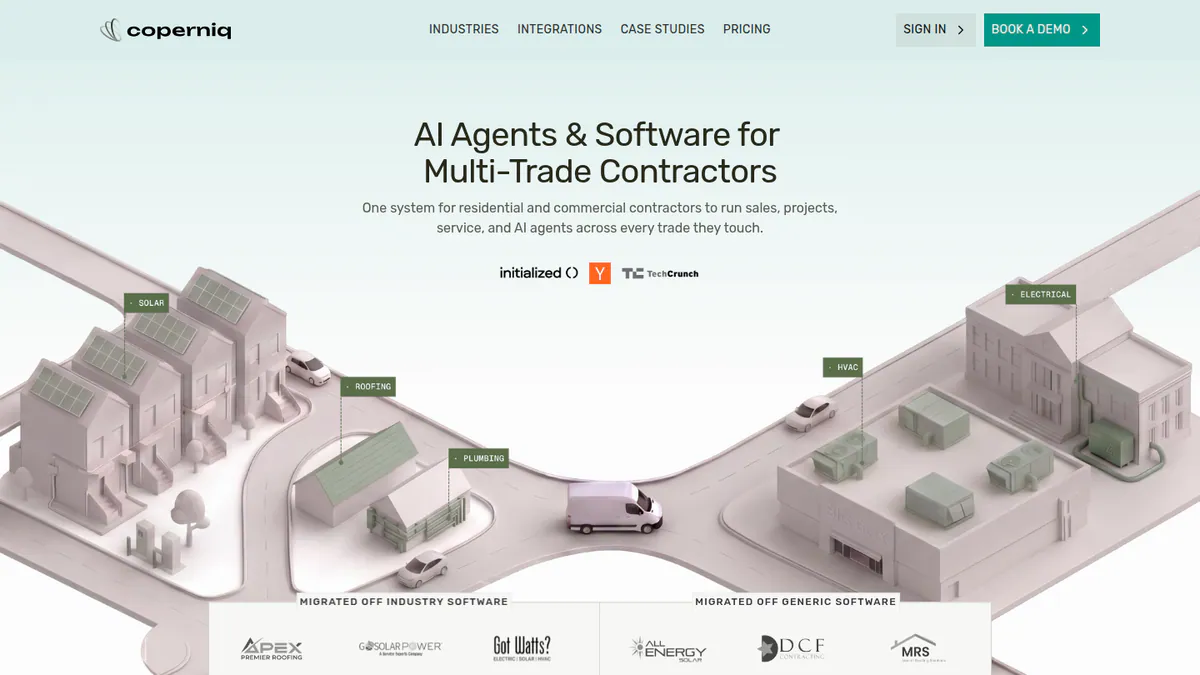
Coperniq puts CRM, projects from survey to PTO (permission to operate), dispatch and O&M (operations and maintenance) work orders in one system. It ranks first for solar project management. For a dedicated CRM, Payaca ranks first for solar CRM, with free options in the free solar CRM section. EPCs (engineering, procurement and construction firms) should see CRM for solar EPCs.
Scoop Solar ranks first for solar field service management. See also the CRM and lead management and operations and project management categories.
Monitoring and O&M: no overall pick
Installers usually monitor through the inverter maker’s portal or a fleet platform. Our only monitoring product, PowerTrack from AlsoEnergy (a Stem company), works with any hardware and targets C&I and utility fleets. See solar monitoring software, fleet monitoring for installers, solar O&M software and the monitoring and asset management category.
Quick picks
Rank | Product | Best for | Starting price (company page, checked October 2026) | Pricing model | Free plan / trial | Score /100 |
|---|---|---|---|---|---|---|
1 | Design, proposals and CRM paid per project | ✓ GBP 4 per project | Per project, unlimited users | 5 free project credits | 73.6 | |
2 | US residential design-to-proposal on per-seat budgets | ✓ USD 159 per user per month | Per user, monthly or annual | None stated | 65.8 | |
3 | Design to signed proposal and payment at no subscription | ✓ Free | Free core. Paid API and connectors | Free plan | 64.2 | |
4 | Design with light CRM in India and the US | ✓ USD 159 per month (international list) | Monthly or yearly plans | Demo only | 62.3 | |
5 | US residential proposals with permit plan sets | ? USD 2,799 per year | Annual bundle of projects and users | Not stated by the company | 53.7 | |
6 | CRM, projects, crews and O&M in one system | ✓ USD 90 per user per month (Field) | Per user, per month | Demo only | 52.3 | |
7 | US dealer sales-to-install across existing tools | Quote only | Flat monthly fee by volume, 12-month minimum | Demo only | 49.2 |
✓ Verified on the company’s own pricing page. ◐ Published by the company outside its pricing page (help centre, store or press release). ? We could not read the company’s pricing page, so the figure is not confirmed. Prices checked October 2026.
Quote only means the company shows no public price. You ask it for a quote.
How the 7 tools scored
- Use-case fit 35%
- User reviews 20%
- Pricing 15%
- Ease of use 10%
- Support 10%
- Momentum 10%
Tool | Score chart | Score |
|---|---|---|
73.6 out of 100 | 73.6 | |
65.8 out of 100 | 65.8 | |
64.2 out of 100 | 64.2 | |
62.3 out of 100 | 62.3 | |
53.7 out of 100 | 53.7 | |
52.3 out of 100 | 52.3 | |
49.2 out of 100 | 49.2 |
Each bar shows the weighted score out of 100.
Sub-scores at a glance (0-10)
Product | Use-case fit | User reviews | Pricing | Ease of use | Support | Momentum | Total /100 |
|---|---|---|---|---|---|---|---|
5.9 | 6.7 | 8.0 | 7.5 | 10.0 | 10.0 | 73.6 | |
4.4 | 7.9 | 8.0 | 7.5 | 7.5 | 7.5 | 65.8 | |
5.2 | 5.0 | 9.0 | 7.5 | 5.0 | 10.0 | 64.2 | |
5.2 | 6.3 | 6.0 | 7.5 | 10.0 | 5.0 | 62.3 | |
5.2 | 3.3 | 6.0 | 5.0 | 5.0 | 10.0 | 53.7 | |
4.8 | 5.0 | 7.0 | 5.0 | 5.0 | 5.0 | 52.3 | |
5.2 | 5.0 | 4.0 | 5.0 | 5.0 | 5.0 | 49.2 |
A 5.0 on reviews, ease, support or momentum is our neutral score. We use it when public evidence is thin. It is not a judgement.
How did we rank these solar software platforms?
How the score is weighted
- Use-case fit 35%
- User reviews 20%
- Pricing 15%
- Ease of use 10%
- Support 10%
- Momentum 10%
We scored 15 products from 22 to 24 October 2026, ranked 7 and list 8 under Also considered. We used company docs, pricing pages, release notes and public user reviews. This was desk research. We did not run projects in any tool. The six criteria:
- Use-case fit (35%): How much of your workflow it covers with listed features, across design, proposals, sales, CRM, operations and monitoring.
- User reviews (20%): G2 and Capterra ratings. A rating from only a few reviews counts for less, and no public reviews means a neutral 5.0.
- Pricing transparency (15%): Published prices score above quote-only.
- Ease of use, support and product momentum (10% each): Review sub-scores and dated releases, neutral without evidence.
Only seven products cleared our minimum match score (4 out of 10). Scores are specific to each page, so a tool can score differently elsewhere. Read the full method: how we score software.
1. Pylon: best for design, proposals and CRM paid per project
Best for: Small and mid-sized home and light commercial installers in the UK, Australia and Ireland. Score: 73.6/100.
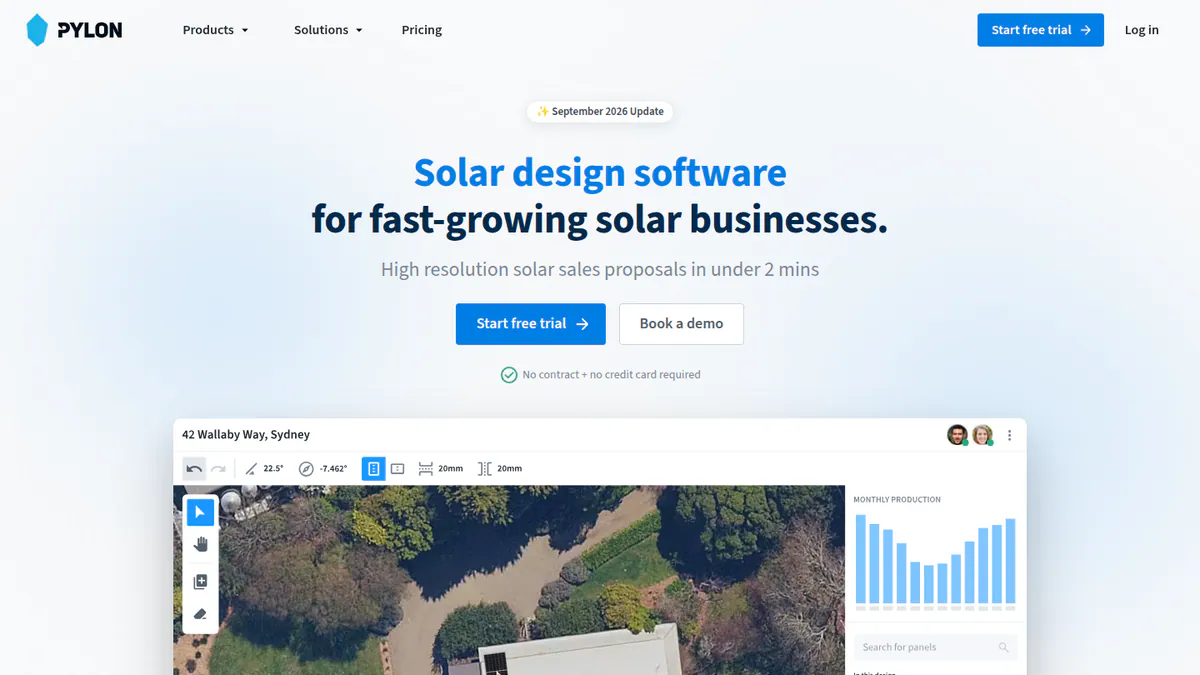
What it is: Pylon, built in Sydney, Australia, combines design, proposals and an optional solar CRM. Small installers use it to go from roof to signed quote. Note: we could only confirm its UK prices, so check the price in your own currency.
Why we picked it: It covers design, proposals and an optional CRM, and you pay only when you design a job. Regular dated updates, such as the SLD (single-line diagram) editor in July 2026, show steady work on it.
Key features:
- Solar and battery design on aerial imagery, with editable SLDs (single-line wiring diagrams) since July 2026.
- Web and PDF proposals with eSignature and payments.
- CRM add-on with email sync, SMS, web forms and a lead processor.
- MCS (UK certification) reports and STC/PDRS (Australian rebate schemes) incentives.
- Financial projections, load profiles and an API (a way for other software to connect) with webhooks.
Pricing: Standard is GBP 4 per project, up to 30 kW DC. Pro is GBP 10 per project and adds custom load profiles and commercial sizes (99 kW+). Enterprise is quote only. The CRM add-on starts at GBP 49 per user per month, and the payment gateway costs 2.5% per transaction. Unlimited users and no monthly minimum. The Irish page shows the same plans in euros: EUR 4 and EUR 10 per project, with CRM from EUR 49 per user per month. Checked October 2026 on the Pylon UK pricing page.
Pros (from user reviews):
- Paying per job keeps costs low for small operators in quiet months (Capterra).
- Most users find the layout friendly, and the manual helps beginners get going.
- Proposals come out detailed and complete (G2).
Cons (from reviews and our research):
- Imagery quality and age vary by location.
- Some find usage modelling awkward, even though the rest is easy to pick up.
- The CRM is a paid add-on per user, so per-project pricing does not cover sales seats.
Reviews: Capterra 4.6/5 (25 reviews) and G2 4.3/5 (2 reviews), checked October 2026. Capterra rates support 4.9/5. Most reviews date from 2021 to 2023.
What we could not confirm: USD and AUD prices, and which plan covers systems from 30 to 99 kW.
Read our full Pylon review or our Pylon alternatives.
Want to see Pylon working? Book a demo with the SolarSoftwares team.
Book a demoYour request goes by email to the SolarSoftwares team. A time is set only after we reply. It does not change any score or ranking.
2. Aurora Solar: best for US residential design-to-proposal on per-seat budgets
Best for: US home installers whose designers and sales staff work in one cloud tool. Score: 65.8/100.
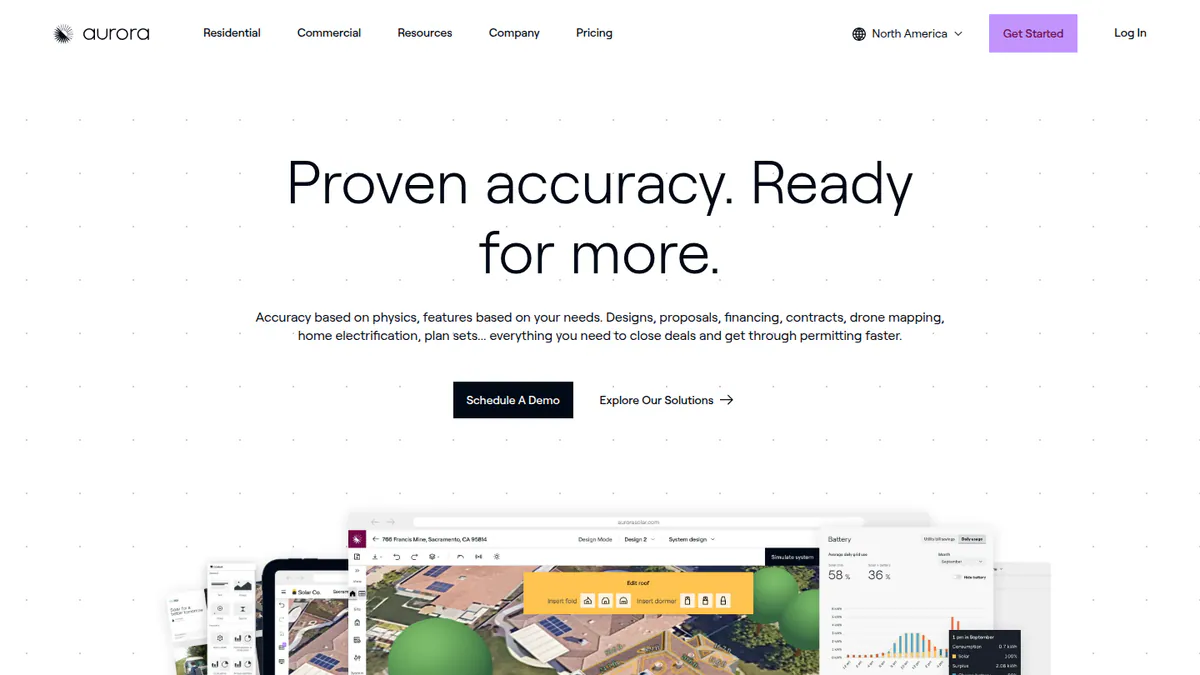
What it is: Aurora Solar Inc makes this cloud tool for 3D design, simulation and sales proposals.
Why we picked it: It covers design through financed proposals, with a G2 rating of 4.7/5 from over a hundred reviews. Per-seat prices are published.
Key features:
- LIDAR-assisted (laser height data) 3D models and shade analysis, with bankable shade reports on Premium.
- Battery modelling (Premium).
- Proposals with tax-credit estimates (US credit rules change, check current law) and TPO (third-party ownership, where the customer pays for power instead of buying the panels) financing options.
- Plan sets with engineering stamps, drone mapping, AI site models and unlimited users on Enterprise.
- A Design API for linking other tools.
Pricing: Basic is USD 159 per user per month (USD 135 billed annually), with 50 projects a month. Premium is USD 259 (USD 220 annually). Enterprise is custom and priced per project. No free trial is stated. Checked October 2026 on the Aurora pricing page.
Pros (from user reviews):
- Accurate shade reports and production estimates (Capterra).
- Accurate design and strong customer service (G2).
- Videos and a knowledge base make it easy to learn.
Cons (from reviews and our research):
- Limited links with other software.
- Some reviewers find the proposal and finance tools thin for the cost.
- No CRM, operations or monitoring, and Basic is capped at 50 projects a month per seat.
Reviews: G2 4.7/5 (121 reviews) and Capterra 4.1/5 (7 reviews), checked October 2026.
Read our full Aurora Solar review or our Aurora Solar alternatives.
Want to see Aurora Solar working? Book a demo with the SolarSoftwares team.
Book a demoYour request goes by email to the SolarSoftwares team. A time is set only after we reply. It does not change any score or ranking.
3. OpenSolar: best for design to signed proposal and payment at no subscription
Best for: Home and small commercial installers anywhere who want a full sales workflow with no monthly fee. Score: 64.2/100.
What it is: OpenSolar Inc runs a free design, proposal and sales platform, paid for by hardware and finance partners. It cites use in 160+ countries.
Why we picked it: It takes a job from design to signed proposal and payment with no subscription. Dated releases through 2026, such as AI lead generation, show the product is moving.
Key features:
- 3D and 2D rooftop design with shading, and AI design since OS 3.0 (September 2025).
- Interactive web proposals with e-signature, payment collection and built-in finance options.
- AI lead generation and PROfile for lead capture, with sales tools added in August 2026.
- Permitting link with SolarAPP+, and accounting connectors for Xero and QuickBooks.
Pricing: The core platform is free. Since 16 April 2026, API access and the Xero and QuickBooks connectors are paid, but the rates are not published. API access is usage-based through the OpenSolar Wallet, with a 30-day free trial. The connectors cost a monthly fee per company. Premium imagery is optional and paid. Checked October 2026 on the OpenSolar pricing notice.
Pros (from reviews and our research):
- Adding, removing and changing panels is very easy (G2).
- The interactive app gives reps useful information in the field.
- Design and proposals cost nothing, so you can sell without a subscription.
Cons (from reviews and our research):
- Panel layouts still need an engineering check, as there is little automatic tuning.
- The interface works but feels dated next to the easy panel tools.
- "Not completely free": API and accounting connectors are paid, and the fees are not published.
Reviews: G2 4.8/5 (3 reviews), checked October 2026. Too few to rely on.
Read our full OpenSolar review or our OpenSolar alternatives.
Want to see OpenSolar working? Book a demo with the SolarSoftwares team.
Book a demoYour request goes by email to the SolarSoftwares team. A time is set only after we reply. It does not change any score or ranking.
4. Arka 360: best for design with light CRM in India and the US
Best for: Installers in India and the US who want design, proposals and basic lead tracking together. Score: 62.3/100.
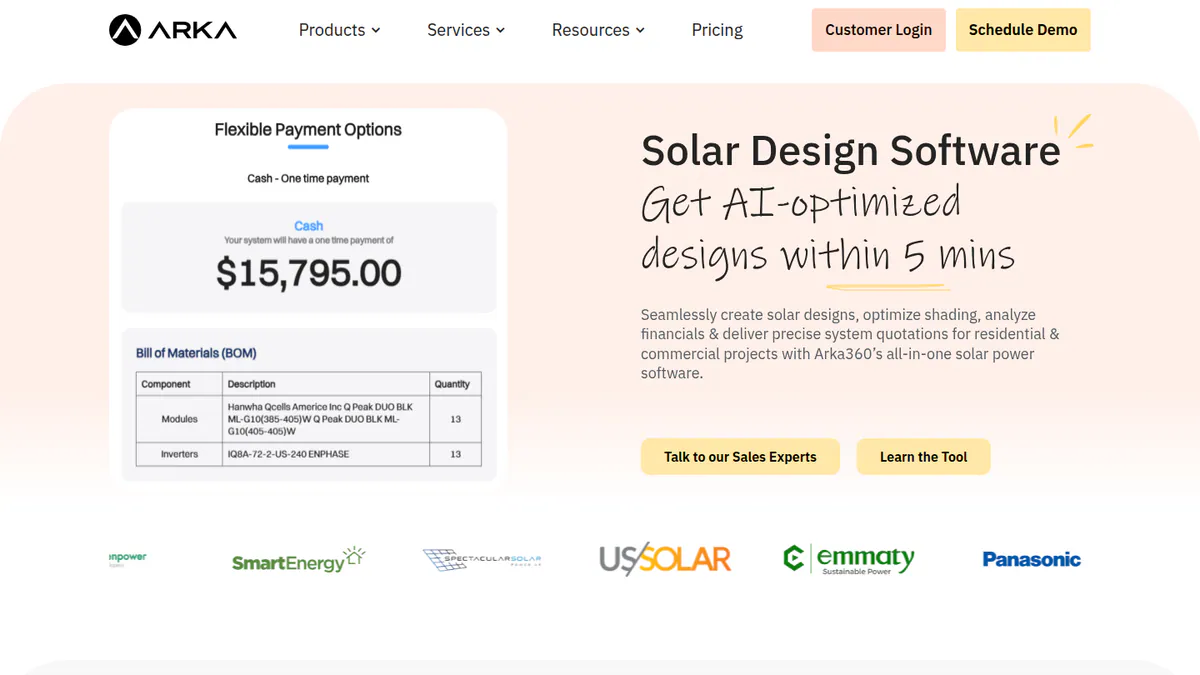
What it is: Arka 360, once called The Solar Labs, is a cloud design and proposal platform with a lead management CRM add-on. It is run from Bengaluru and Allen, Texas, and serves home and commercial installers.
Why we picked it: It pairs design and proposals with a lead management add-on at published US prices. G2 users give its support high marks.
Key features:
- 3D rooftop and ground-mount design with shading and AI design.
- Stringing for micro-inverters and optimisers.
- Proposals and generation reports, plus lead management (add-on).
- SLD export and permitting checks (US Premium).
- 3D export to SketchUp and PVsyst, and an API (Premium).
Pricing: The international-list Basic is USD 159 per month (USD 1,699 per year). Premium is USD 199 per month (USD 1,999 per year) and adds SLD export, optimiser design, SketchUp/PVsyst 3D export and API. Enterprise is USD 999 per month (USD 9,999 per year). The Indian pricing page shows two conflicting INR price sets, so we have not quoted them. Checked October 2026 on the Arka 360 pricing page.
Pros (from user reviews):
- Very easy to use, with many useful tools (14 mentions on G2).
- Shadow analysis and project estimates help you size and price jobs quickly.
- 3D views help close deals, and support staff are caring.
Cons (from user reviews):
- Some features are missing, and the choice of mounting structures can confuse.
- Lag on projects of 3 MWp (megawatts peak) and above.
- Limits on multiple users.
Reviews: G2 4.3/5 (137 reviews), checked October 2026. G2 rates support 9.2/10.
Read our full Arka 360 review or our Arka 360 alternatives.
Want to see Arka 360 working? Book a demo with the SolarSoftwares team.
Book a demoYour request goes by email to the SolarSoftwares team. A time is set only after we reply. It does not change any score or ranking.
5. Solargraf: best for US residential proposals with permit plan sets
Best for: US and Canadian home installers who want design, proposals, financing and permit packages without a drafter. Score: 53.7/100.
What it is: Enphase Energy owns Solargraf, a design, proposal, financing and permit tool for home installers. Weak reviews hold it back.
Why we picked it: It covers design, proposals, financing, permits and CRM for one annual price. Its releases are dated through 2026.
Key features:
- 3D design with automatic roofline detection, and shading analysis the company says is validated by NREL and NYSERDA (US public energy bodies).
- Proposals with solar-plus-battery savings and built-in TPO and loan financing partners.
- Permit-ready SLDs, three-line diagrams and plan sets (NEC 2026, the US electrical code) on all plans.
- An AHJ database of 14,000+ jurisdictions.
- CRM with a sales dashboard.
- Public API (Enterprise, or a USD 4,000 per year add-on), with dated releases in February and June 2026.
Pricing: Starter is USD 2,799 per year (240 projects, 2 users). Small Business is USD 4,799 (480 projects, 4 users). Teams is USD 6,399 (720 projects, 6 users). Enterprise is USD 12,999 (1,500 projects, unlimited users, public API). Extra projects cost USD 9 to 11 each, and extra users USD 960 to 1,440, by plan. Checked October 2026 on the Solargraf pricing page.
Pros (from user reviews):
- Good shading and 3D design tools (Capterra).
- One tool takes a job from proposal to permit, so fewer hand-offs.
- Proposals and contracts that clients find easy to follow.
Cons (from user reviews):
- Frequent crashes and wrong property data.
- Expensive next to other options, and support waits have grown.
- A learning curve at the start.
Reviews: Capterra 3.2/5 (15 reviews), checked October 2026. We found no G2 listing.
Read our full Solargraf review or our Solargraf alternatives.
Want to see Solargraf working? Book a demo with the SolarSoftwares team.
Book a demoYour request goes by email to the SolarSoftwares team. A time is set only after we reply. It does not change any score or ranking.
6. Coperniq: best for CRM, projects, crews and O&M in one system
Best for: Small and mid-sized US installers and service firms that want one operations platform. Score: 52.3/100.
What it is: US firm Coperniq Inc built this operations platform for solar, storage and other trades. It is the only product in this ranking built around delivery, not design.
Why we picked it: It is our pick for CRM, projects and field service in the by-job table above. Its per-seat prices are published.
Key features:
- CRM with the project pipeline inside the customer record.
- Phase workflows from survey, design and permit through install, inspection and PTO.
- Scheduling and dispatch with route optimisation and live technician tracking.
- Offline iOS and Android field app with forms and GPS photos.
- O&M memberships and work orders, spare-parts stock, a homeowner portal and asset monitoring alerts.
- AI voice agent for 24/7 call handling, and invoicing and payments in Office.
Pricing: Field is USD 90 per user per month, for the technician app. Office is USD 200 per user per month, with CRM, scheduling, work orders, invoicing, project financials, workflows and reporting. AI features and add-ons are priced separately. Demo only. Checked October 2026 on the Coperniq pricing page.
Pros (from our research):
- Covers CRM, projects, field service and O&M with published per-seat prices.
- Cheaper Field seats for crews who only need the app.
- The offline field app with GPS photos lets crews work without signal.
Cons (from our research):
- No design or proposal engine, so you need a design tool too.
- No public user reviews to judge it by.
- Office seats at USD 200 per user per month add up fast, and AI features cost extra.
Reviews: No user reviews found as of October 2026. G2 shows no rating and Capterra shows 0 reviews.
What we could not confirm: How deep its monitoring goes, natively or through other tools.
Want to see Coperniq working? Book a demo with the SolarSoftwares team.
Book a demoYour request goes by email to the SolarSoftwares team. A time is set only after we reply. It does not change any score or ranking.
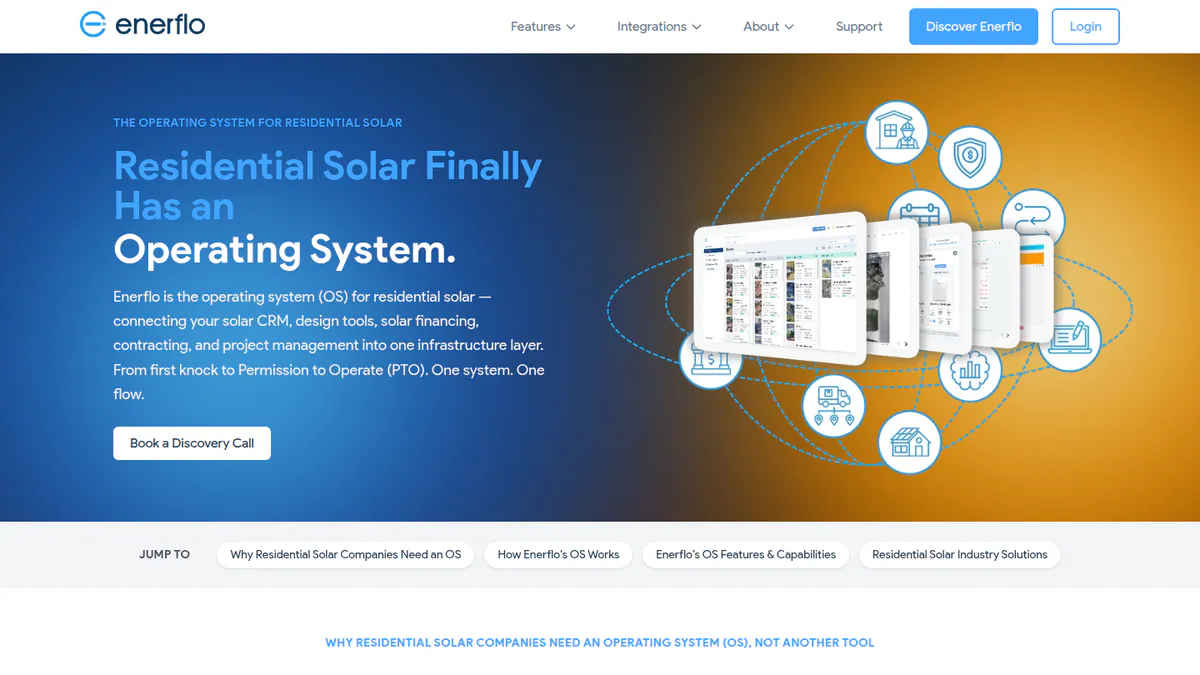
7. Enerflo: best for US dealer sales-to-install across existing tools
Best for: US dealers that keep their design tool and CRM but need one sales-to-install layer. Score: 49.2/100.
What it is: Mid-sized and large US home dealers, installers and EPCs run sales-to-install work through Enerflo. It sits on top of your design tool and CRM, not in place of them.
Why we picked it: It joins a dealer’s existing design tool and CRM into one flow from sale to install. Loan and TPO routing are built in.
Key features:
- Links to Aurora Solar, OpenSolar, Scanifly and Solargraf for design, and to Salesforce, HubSpot, Zoho and SalesRabbit for CRM.
- Sales pipeline and proposals with battery sizing and e-sign (Sales Core), plus Virtual Sales Rep self-serve quoting.
- Loan, TPO and cash routing across finance partners (Lendflo), and contract packets (Docflo).
- Install tracking with milestones and change orders, and a white-label customer portal.
- Domo-powered reporting, and REST and GraphQL APIs with webhooks.
Pricing: Quote only. You pay a flat monthly fee based on average monthly volume, with no per-seat or per-proposal fees. There is also a one-time setup fee and a 12-month minimum. Checked October 2026 on the Enerflo FAQ.
Pros (from our research):
- No per-seat fees, which suits large rep teams.
- The most named design and CRM integrations here.
- Covers the handoff from signed contract to install.
Cons (from our research):
- US only.
- A 12-month minimum, a setup fee and no published price.
- Only 2 user reviews, with no visible text to judge it by.
Reviews: G2 5.0/5 (2 reviews), checked October 2026. Too few to rely on, and the text was not visible.
Read our full Enerflo review or our Enerflo alternatives.
Want to see Enerflo working? Book a demo with the SolarSoftwares team.
Book a demoYour request goes by email to the SolarSoftwares team. A time is set only after we reply. It does not change any score or ranking.
SurgePV (unscored): for readers comparing the design-to-proposal part of an installer workflow. It is not a built-in CRM or fleet-monitoring platform. Check local outputs. The numbered scores above do not include it.
Sources checked 27 October 2026: SurgePV product information · SolarSoftwares SurgePV review
Book a demo of SurgePV with the SolarSoftwares team.
Book a demoYour request goes by email to the SolarSoftwares team. A time is set only after we reply. It does not change any score or ranking.
How do the 7 solar software platforms compare?
Product | Design | Proposals | CRM | Projects and field service | Permits | Starting price |
|---|---|---|---|---|---|---|
Yes, incl. SLD | Yes, eSignature | Add-on | Not documented | Not documented | GBP 4/project | |
Yes, 3D LIDAR | Yes, with financing | Not documented | Not documented | Plan sets (Enterprise) | USD 159/user/mo | |
Yes | Yes, e-sign and payments | Lead capture | Not documented | SolarAPP+ integration | Free | |
Yes, incl. SLD export | Yes | Lead management add-on | Not documented | Permitting checks | USD 159/mo | |
Yes | Yes, with financing | Yes | Not documented | SLDs, three-lines, plan sets | USD 2,799/yr | |
Not documented | AI sales tools | Yes | Yes, incl. O&M | Permit stage tracking | USD 90/user/mo | |
Via integrations | Yes, with financing | Pipeline. Integrates CRMs | Install tracker | Not documented | Quote only |
Also considered
All eight fell below the minimum match score for fit (4 out of 10) because each covers one job, not the wider workflow. Their total scores are shown for reference.
- PV*SOL premium: desktop design and simulation for European home and C&I work, with no sales or operations features. Scored 55.6/100, but its fit is too narrow.
- RatedPower: utility-scale design and engineering only. Scored 52.5/100.
- HelioScope: C&I design only (scored 52.3/100), ranked in commercial solar design software.
- PVsyst: the yield reference for engineers and lenders’ advisers, not a sales tool. Scored 52.3/100.
- PVcase Ground Mount: utility-scale layout and civil design in AutoCAD only. Scored 50.5/100.
- Scanifly: drone and remote site models plus a survey app (scored 43.8/100). See solar site survey apps.
- Scoop Solar: field service and project operations only, first in our field service ranking. Scored 41.3/100 here.
- PowerTrack: C&I and utility fleet monitoring only (scored 28.8/100).
How do you choose solar software?
- Small home installer in the UK, Australia or Ireland? Pick Pylon.
- US home team that budgets per seat? Pick Aurora Solar and add a CRM and an operations tool.
- Zero budget? Start with OpenSolar and see our free solar software list for the other jobs.
- Selling in India? Compare Arka 360 once the company confirms INR prices.
- US permit packages hold you up? Pick Solargraf.
- Problems after the sale, with crews, PTO and service visits? Pick Coperniq.
- Large US dealer on several design tools and CRMs? Shortlist Enerflo.
- C&I or utility projects? Use our C&I solar software guide.
- Want one company for most jobs? Read all-in-one solar software, or see solar software for small business.
Solar software FAQs
What software do solar installers use?
Usually several: design and proposals, CRM, project or field service, monitoring and accounting. As of October 2026, three platforms cover the most of that stack. Pylon covers design, proposals and a CRM add-on. Solargraf covers design, proposals, permits and CRM, and Coperniq covers CRM, projects, field service and O&M.
What is the best solar design software?
For US home design, Aurora Solar ranks first in our solar design software list, from USD 159 per user per month (checked October 2026). Pylon is cheaper per job at GBP 4 a project, and OpenSolar is free. For C&I and utility work, use HelioScope, PVsyst or RatedPower.
Do I need separate solar CRM and project management software?
Not always. Coperniq’s Office plan (USD 200 per user per month, checked October 2026) combines CRM, scheduling, work orders and project workflows. Some design tools have a CRM, such as Pylon’s add-on from GBP 49 per user per month. Then you may only need project tracking on top.
How should I compare pricing between solar software platforms?
Compare cost per project at your volume. Pylon charges GBP 4 per project, Solargraf Starter USD 2,799 a year for 240 projects, and Aurora Basic USD 159 per user per month for up to 50 projects. Add setup fees and minimum terms, such as Enerflo’s 12 months (checked October 2026).
Can one platform cover design, proposals and operations?
Not fully, in our October 2026 research. Pylon and Solargraf stop at proposals, permits and CRM. Coperniq covers CRM through O&M but has no design engine. Most installers pair one design tool with one operations platform.
Is there free solar software for installers?
Yes. OpenSolar’s core platform is free, paid for by hardware and finance partners. API access and accounting connectors have been paid since 16 April 2026. See our free solar software page for free tools in other jobs.
Sources
All checked 22 to 24 October 2026.
- Pylon: pricing, July 2026 update, Capterra, G2
- Aurora Solar: pricing, G2, Capterra
- OpenSolar: pricing notice, features, news, G2
- Arka 360: pricing, G2
- Solargraf: pricing, Q2 2026 highlights, Enphase release, Capterra
- Coperniq: pricing, solar page, products
- Enerflo: FAQ and pricing model, product overview, G2
- Also considered: HelioScope pricing, PVsyst shop, RatedPower pricing, PVcase Ground Mount, Scanifly, Scoop Solar, PowerTrack App Store listing, PV*SOL shop
Last updated 28 October 2026. Next scheduled review: 23 January 2027.