Key takeaways
- A short and an open fail differently. A short costs power in full sun. An open costs nothing until shade arrives, then exposes the shaded cells.
- In an invented 20-module string, one shorted substring cuts string power by 1.7% but its own module’s power by 34.8%.
- With an example 2% noise band, string output alone could miss that short. Module voltage or an I-V curve should show it. A thermal image may.
- The named causes are heat, reverse-bias thermal runaway, lightning surges and manufacturing damage. The sources disagree on whether lightning leaves a diode open or short.
- A step in an I-V curve or a warm substring is not proof. Shade and dirt look the same, so test the diode before replacing a module.
To catch diode faults in thermal surveys, see the best solar thermal inspection software.
Bypass diode failure at a glance
| Item | Detail |
|---|---|
| What the diode does | Gade and Shiradkar (PV Tech, December 2017) say it stops high reverse voltage across cells when they are shaded. See solar panel module. |
| Failure modes | Short: the diode conducts both ways. Open: it conducts neither way. |
| Where it shows | String power, module voltage, I-V curve, thermal image or a diode test. See signs by method. |
Why does bypass diode failure matter for O&M teams?
A short loses power every sunny day. An open can leave shaded cells to overheat.
Gade and Shiradkar write that open-circuit failures are regarded as safety risks. Sitemark says losses can reach a third of a module’s nominal production per substring (a company statement, the example on this page uses three substrings). See O&M and work orders.
What are the two failure modes, open and short?
A short diode conducts both ways, so its substring is always bypassed. An open diode conducts neither way, so it acts as if it were not there.
| Mode | What happens | When it costs power | Source |
|---|---|---|---|
| Short | The substring is bypassed all the time. Mühleisen and others call these diodes "blown" or "shot through". With one diode per substring, a short costs about a third of the module. | Every sunny hour, in full light. | Gade and Shiradkar 2017. Mühleisen and others 2024 |
| Open | The diode is absent in effect. Shaded cells are exposed to reverse voltage, and "the temperatures can reach very high values". | Only when part of the module is shaded or its cells mismatch. | Gade and Shiradkar 2017 |
What causes a bypass diode to fail?
The sources name heat, reverse-bias runaway, lightning surges and manufacturing damage. They describe how diodes die, not how often. They do not agree on one cause.
- Long forward-bias heating. An NREL failure analysis of shunted diodes from one rooftop found melt-through on the Schottky die. It judged the cause long-term forward-bias overstress, not static discharge such as lightning. The proposed trigger was uneven irradiance: the modules sat in two orientations.
- Reverse-bias thermal runaway. Posbic and others (NREL workshop, February 2013) say a diode that has just been active is hot. It then sees reverse voltage and can pass leakage current above its limit. They report destruction "most likely in the open mode, although shorted diodes have also been seen". Uchida and others (same workshop) confirmed thermal runaway in Schottky diodes in 90 °C chamber tests, with results varying by junction box design.
- Lightning surges. IEA PVPS Task 13 (2014) says typical lightning-induced defects are open-circuit bypass diodes. Hamada and others (Energies, November 2023) found that in indirect-surge tests every destroyed Schottky diode ended short-circuited. A short may not show at once: when sunlight returns, current can circulate through the shorted diode and overheat it.
- Manufacturing and ageing. Gade and Shiradkar say electrostatic discharge was a major cause on production lines. Mühleisen and others add that cell cracks or solder defects can keep a diode conducting. They found no cause for their sample.
How does a failed bypass diode show up?
A short shows as lost voltage and a warm substring. An open hides until shade, so it needs a test under partial shading.
| Method | Short | Open |
|---|---|---|
| String or inverter output | Loses one substring of voltage: 1.7% in the example. | No loss in full light. Mühleisen and others say an open fault can interrupt a string and lose yield. |
| Module voltage | Gade and Shiradkar: one third of open-circuit voltage is lost, visible with a multimeter. SolarEdge’s Module Voltage Mismatch alert covers burnt diodes among other causes. | None in sun. |
| I-V curve | IEA PVPS Task 13 (2014) says a low Voc can indicate a failed diode. Fluke lists shorted diodes among causes of low Voc and of steps. | Gade and Shiradkar: needs I-V tracing under partial shading, or a diode checker. |
Thermal, electroluminescence and bench methods follow.
| Method | Short | Open |
|---|---|---|
| Thermal image | Sitemark says a bypassed substring runs hotter than normal cells in the same module. | IEA 2014 lists missing or open diodes with shorted ones for a warmer substring. Mühleisen and others show burn marks. |
| Electroluminescence | Gade and Shiradkar: the affected substring appears dark. | Not stated |
| Diode test (multimeter) | Mühleisen and others: shorted diodes mostly read 0 V in both directions. | Of 10 non-conducting diodes, most read OL, but 4 read 1.6 to 3.0 V. The voltages can mislead. |
Not stated means the source we cite does not say. Look-alikes and limits for each method:
- String or inverter output: soiling, shade, degradation and noise hide small losses. See mismatch loss.
- Module voltage: the alert is not diode-specific. See module-level monitoring.
- I-V curve: Fluke also lists shade, dirt and damaged cells as causes of steps. See I-V curve tracing.
- Thermal image: temperature rise varies by case. See thermal inspection and anomaly classification.
- Electroluminescence: needs a dark or powered module. See electroluminescence testing.
- Diode test: working diodes read about 0.11 to 0.17 V forward. That is 14 working diodes among 36 taken from modules about 10 years old.
Worked example: what one failed diode costs a string
All numbers here are example. The string has 20 modules. Each has 3 substrings, one diode per substring, and 34.0 V and 10.0 A at maximum power. The diode drop is 0.5 V. The simple series rule holds the current at 10.0 A. A bypassed substring gives up its voltage plus one diode drop.
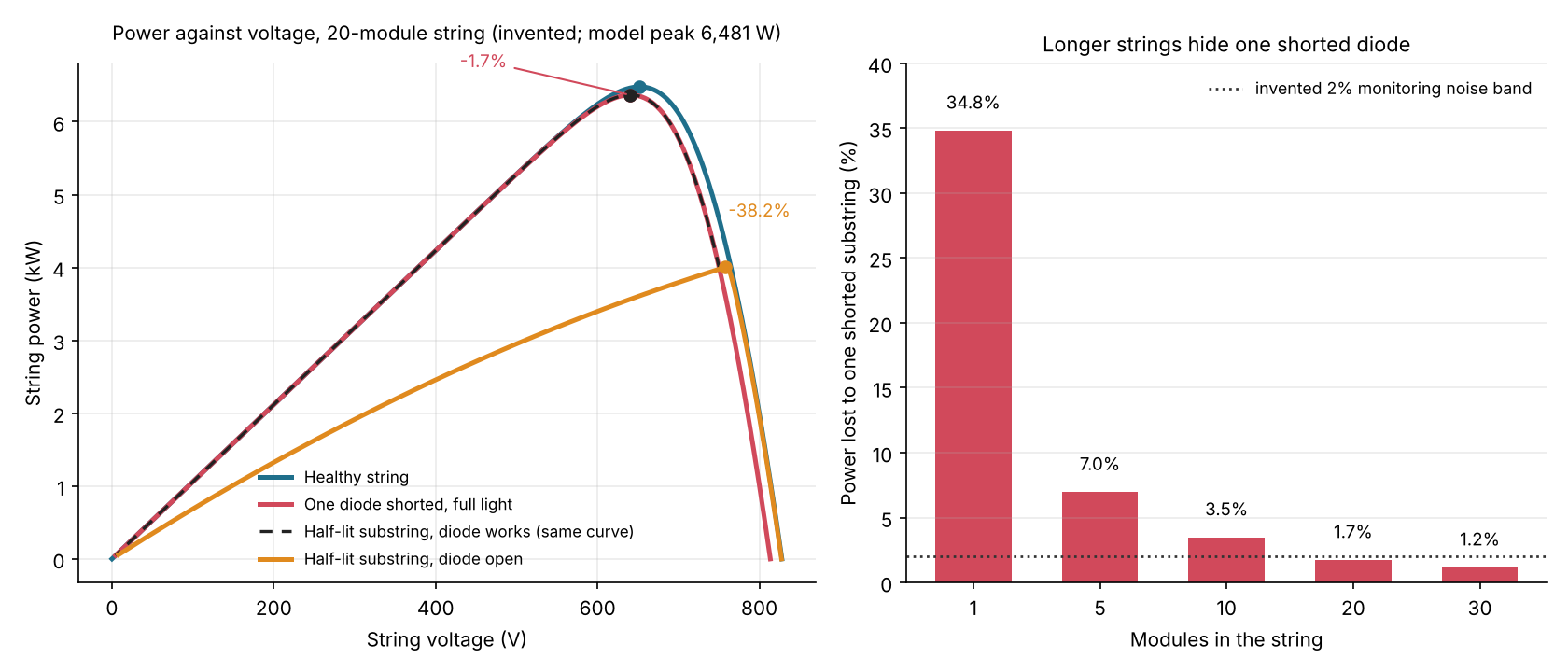
Figure 1. A shorted diode costs 1.7% of a 20-module string but 34.8% of its own module. An open diode costs 38.2% only under shade (example module). The left panel is a single-diode model whose healthy peak is 6,481 W, so compare percentages, not watts.
The table compares each case with the healthy string.
| Case (example module) | Voltage at maximum power (V) | Power (W) | Change | Outside a 2% noise band? |
|---|---|---|---|---|
| Healthy | 680.0 | 6,800 | 0.0% | Baseline |
| One diode shorted, full light | 668.2 | 6,682 | -1.7% | No |
| The same module on its own | 22.2 | 221.7 | -34.8% | Yes |
| One diode open, full light | 680.0 | 6,800 | 0.0% | No change to see |
| One substring at 50% light, diode working | 668.2 | 6,682 | -1.7% | No |
| One substring at 50% light, diode open | 680.0 | 3,400 | -38.2% (model) | Yes |
The simple rule and a single-diode model of the same string both give 1.74% for the short. For the open diode the simple rule gives -50.0%, an upper bound, because voltage rises as current falls. The rule holds the voltage at 680.0 V, while the model gives 757.7 V and a 38.2% loss for the same shade. Neither model includes reverse breakdown, so neither shows the heating risk. Both treat a short as an ideal 0.5 V drop. Mühleisen and others measured about 0.4 to 3.2 Ω on shorted diodes, so real shorts are less ideal.
A short and a normally bypassed shaded substring cost the same power here, so power alone cannot separate them. A longer string dilutes the fault. It falls inside the 2% band from 18 modules up. The band is example. See shading analysis.
Bypass diode failure calculator
Enter string size, module values, shorted substrings, shade and a noise band. It gives the string loss, the single-module loss and the string length at which one short hides in the noise. Defaults are example.
What do O&M teams do about a failed bypass diode?
They confirm the fault, rule out look-alikes, then repair or replace. The order is our suggestion. The sources describe the parts.
- Flag the module. The trigger can be an alert, a thermal finding, an I-V step or a string comparison.
- Rule out shade and dirt. Sitemark says bypassing is expected behaviour, and in most cases it is reversible. Clean or clear, then re-test.
- Test the diode. Check module Voc for a third lost, run a diode test, or trace the curve under partial shading for an open.
- Repair or replace. Sitemark says the full module must be changed if replacing the diode is not an option. Gade and Shiradkar say a module may need replacing if the junction box cannot be swapped in the field.
- Record and look for a pattern. Log the module, finding and re-test in a work order. Check neighbours in the same orientation or batch.
Treat a suspected open diode as a safety item until you test it.
How solar software handles bypass diode failure
Only Sitemark and Scopito name a diode fault. Raptor Maps flags an activated diode without saying whether it failed, and SolarEdge and Fluke give partial signals. The ratings follow each page’s wording. Partly means the page gives a related signal, not a diode-specific finding.
| Software | Bypass diode findings? | Source and date |
|---|---|---|
| Raptor Maps | Partly (activated diode, failed or not is not stated) | Anomaly glossary, copyright 2025. October 2026 |
| Sitemark | Yes | Help page, date stamp 22 September 2026. October 2026 |
| Scopito | Yes (service with software) | Solar inspection page, updated 17 November 2025. October 2026 |
| SolarEdge monitoring | Partly | Monitoring updates page, undated, footer 2024. October 2026 |
| Fluke I-V tracers and TruTest Solar | Partly | Fluke blog pages, no date, footer 2026. October 2026 |
What each page says:
- Raptor Maps: anomaly "Diode": "A diode anomaly indicates an activated bypass diode, typically 1/3 of the module." Default priority Medium. "Diode Multi" covers multiple activated diodes.
- Sitemark: "Diode (single/multi)" and "Single / Double Bypassed" types. Losses up to a third of nominal production per substring. For a damaged diode it says: "The full PV module must be changed if replacing the diode is not an option."
- Scopito: thermal inspection lists "diode issues" with hot spots, string failures and PID. Reports show a "diode fault" with its location. Analysts assign severity levels.
- SolarEdge monitoring: the update says its Module Voltage Mismatch alert reports underperforming module locations due to "burnt bypass diodes, faulty connections, potential hotspots, or other reasons". The alert is not diode-specific.
- Fluke I-V tracers and TruTest Solar: Fluke blog pages list shorted bypass diodes as a cause of low Voc and of curve steps. They give no diode-specific procedure and do not say the software flags them.
For tools that tag diode faults in drone and thermal surveys, see the best solar drone inspection software and the best solar thermal inspection software.
Common mistakes with bypass diode failure
FAQs
Can a thermal image show a failed bypass diode?
Often, but not always. IEA PVPS Task 13 (2014) and Sitemark both describe a warmer substring. The size of the rise varies by case, so confirm with an I-V trace or a diode test. See thermal inspection.
Does an open bypass diode reduce output in full sun?
No, not in full light. Gade and Shiradkar say open failures only affect performance under shading. In the example an open diode loses nothing at full light, and up to 38.2% in the single-diode model with one substring at half light. The simple rule gives 50.0% as an upper bound.
How do you test a bypass diode?
Check module Voc for a third lost, which Gade and Shiradkar say a multimeter can show for a short. Mühleisen and others used diode mode. Of their 10 open diodes, most read OL but four read 1.6 to 3.0 V, so a reading alone is not proof.
Is a failed bypass diode a fire risk?
An open diode can be. Gade and Shiradkar say that in a worst case the temperatures can pose a threat of fire hazard. No source here gives fire rates. Hamada and others say a lightning short can burn out when sunlight returns.
Related terms
- Anomaly classification: how inspection software labels diode findings and severity.
- Hotspot: a cell running hotter than its neighbours.
- Mismatch loss: power lost when wired modules cannot all run at their own peak.
Next step: pick a survey tool from the best solar drone inspection software, and pair it with the best solar monitoring software for fleet alerts.
Sources
All sources checked October 2026. The papers and company pages were re-opened on 30 October 2026. The page does not quote IEC standard text.
- Papers and reports. Gade and Shiradkar, PV Tech, December 2017, pp. 59-61. Mühleisen and others, Science and Technology for Energy Transition 79, 18 (2024). NREL, Failure analysis of field-failed bypass diodes (NREL/JA-5K00-73209, Progress in Photovoltaics 28(9)). Hamada and others, Energies 16, 7792 (2023). IEA PVPS Task 13, Review of Failures of Photovoltaic Modules (March 2014).
- Workshop presentations (not peer reviewed). Posbic and others, NREL workshop, February 2013, and Uchida and others, same workshop. Both pages returned a 404 error when we checked again in November 2026. We keep the claims because we read them on the live pages in an earlier check, but the links no longer work. Search energy.gov or the NLR site for the PV Module Reliability Workshop 2013 proceedings if you need the originals.
- Companies. Raptor Maps anomaly glossary. Sitemark thermal anomaly types. Scopito. SolarEdge monitoring updates. Fluke, diagnosing hardware failures. Fluke, how to analyze an I-V curve.
Last updated 30 October 2026. Next scheduled review: 30 January 2027.