Skelion alternatives are solar design tools you can use instead of Skelion. Skelion is a plug-in that places solar panels on SketchUp models and runs a shade check. SketchUp is a 3D drawing program. Aurora Solar ranks first at 85.3/100. PV*SOL premium ranks second at 80.3/100.
Skelion looks cheap at USD 200 a year, but you also pay for SketchUp. That is two subscriptions for one narrow job. Support is thin, as the list below shows. Many designers now want a tool that works on its own.
For a ranked list across every segment, see our best solar design software ranking.
Why do installers look for Skelion alternatives?
- Two bills, not one. Skelion Pro costs USD 200 a year per licence. SketchUp is a separate subscription on top.
- A 10-panel wall. A SketchUp forum user reports the free version caps at 10 panels. The thread from June 2025 got no answer from the company.
- Thin support, no roadmap. Support runs through a contact form. We found no version number or release dates, and its feature pages would not load for us.
- A narrow tool. Our research lists layout, shading on the 3D model and an energy estimate. We found no electrical design, customer proposals or lender-grade yield reports. Yield is how much power the panels will make, and banks use these reports to judge a project.
What you would give up: design inside the SketchUp model you already built, and a low licence price for small jobs.
Skelion at a glance
Item | Skelion (checked October 2026) |
|---|---|
What it is | SketchUp plug-in for placing PV and solar thermal panels, with shading and an energy estimate |
Pricing | Pro USD 200 a year per licence. Packs of 2 to 5 licences from USD 350 to USD 600 a year. SketchUp paid separately |
Free version | Yes, capped at 10 panels (user report, not company) |
Ratings | No G2, Capterra, Trustpilot or app store listing found (October 2026) |
Still suits | Designers who already model buildings in SketchUp and only need a quick panel layout and shade view |
Source: Skelion Pro page, checked October 2026.
Quick picks
Rank | Product | Best for | Starting price (company page, checked October 2026) | Host program needed | Score /100 |
|---|---|---|---|---|---|
1 | Browser 3D design plus proposals | ✓ USD 159 per user a month | None (browser) | 85.3 | |
2 | Desktop 3D shading and yield in Europe | ✓ EUR 845 a year + VAT | None (desktop) | 80.3 | |
3 | Bankable yield from 3D shade scenes | ✓ CHF 700 a year | None (Windows) | 74.3 | |
4 | C&I roofs inside AutoCAD | Quote only | AutoCAD (plug-in) | 73.5 | |
5 | Free design and proposals | ✓ Free core platform | None (browser) | 73.2 | |
6 | C&I shading and yield in a browser | ✓ USD 159 a month | None (browser) | 73.1 | |
7 | Utility-scale ground plants | Quote only | None (browser) | 72.0 | |
8 | Cloud design that exports back to SketchUp | ✓ USD 159 a month (international list) | None (browser) | 71.3 | |
9 | 3D models from drone photos | Quote only | None (cloud and app) | 71.0 | |
10 | Ground-mount layouts in AutoCAD | Quote only | AutoCAD (plug-in) | 69.9 |
✓ Verified on the company’s own pricing page. ◐ Published by the company outside its pricing page (help centre, store or press release). ? We could not read the company’s pricing page, so the figure is not confirmed. Prices checked October 2026.
Quote only means the company shows no public price. You ask it for a quote.
How the 10 tools scored
- Use-case fit 35%
- User reviews 20%
- Pricing 15%
- Ease of use 10%
- Support 10%
- Momentum 10%
Tool | Score chart | Score |
|---|---|---|
85.3 out of 100 | 85.3 | |
80.3 out of 100 | 80.3 | |
74.3 out of 100 | 74.3 | |
73.5 out of 100 | 73.5 | |
73.2 out of 100 | 73.2 | |
73.1 out of 100 | 73.1 | |
72 out of 100 | 72.0 | |
71.3 out of 100 | 71.3 | |
71 out of 100 | 71.0 | |
69.9 out of 100 | 69.9 |
Each bar shows the weighted score out of 100.
Sub-scores at a glance (0-10)
Product | Use-case fit | User reviews | Pricing | Ease of use | Support | Momentum | Total /100 |
|---|---|---|---|---|---|---|---|
10.0 | 7.9 | 8.0 | 7.5 | 7.5 | 7.5 | 85.3 | |
10.0 | 5.4 | 8.0 | 7.5 | 7.5 | 7.5 | 80.3 | |
7.8 | 6.3 | 8.0 | 5.0 | 7.5 | 10.0 | 74.3 | |
7.8 | 6.4 | 4.0 | 10.0 | 10.0 | 7.5 | 73.5 | |
7.8 | 5.0 | 9.0 | 7.5 | 5.0 | 10.0 | 73.2 | |
8.9 | 6.2 | 8.0 | 7.5 | 5.0 | 5.0 | 73.1 | |
7.8 | 6.9 | 4.0 | 7.5 | 7.5 | 10.0 | 72.0 | |
7.8 | 6.3 | 6.0 | 7.5 | 10.0 | 5.0 | 71.3 | |
10.0 | 5.0 | 4.0 | 5.0 | 5.0 | 10.0 | 71.0 | |
7.8 | 8.3 | 4.0 | 7.5 | 7.5 | 5.0 | 69.9 |
A 5.0 on reviews, ease, support or momentum is our neutral score. We use it when public evidence is thin. It is not a judgement.
How did we choose and score these Skelion alternatives?
How the score is weighted
- Use-case fit 35%
- User reviews 20%
- Pricing 15%
- Ease of use 10%
- Support 10%
- Momentum 10%
We scored 13 alternatives from 22 to 25 October 2026 from company pages, pricing and user reviews. This was desk research. We did not test any tool hands-on. All 13 passed our minimum fit score, so we rank the top 10 and list three under Also considered. Skelion is not ranked on its own page.
- Use-case fit (35%): how well a tool does Skelion’s job: panel layout, 3D modelling and shading.
- User reviews (20%): G2 and Capterra ratings. A tool with under eight reviews gets a middle score.
- Pricing (15%): published prices and free entry points beat tools where you have to ask the company for a price.
- Ease of use, support and momentum (10% each): review sub-scores and dated releases.
1. Aurora Solar: best for 3D design and proposals without SketchUp
Best for: US home and light-commercial installers who want to draw, shade and sell in one browser tool. Score: 85.3/100.
vs Skelion: Aurora builds the 3D model in the browser, so you drop SketchUp. It adds sales proposals with financing, but Basic costs USD 1,620 a year per user against Skelion’s USD 200.
What it is: Aurora Solar Inc. makes this browser platform for design, shade checks and sales proposals. Its prices are in USD. They are aimed at US home and light-commercial installers.
Why we picked it: It covers every part of Skelion’s job, from 3D model to shade, with no host program. Prices are published, and 121 G2 reviews give a clear picture of it.
Key features:
- 3D roof models in the browser, with modelling assisted by LIDAR (laser height data) on Premium.
- Shade checks on the model, plus shade reports that banks trust on Premium.
- Production simulation and battery modelling.
- Sales proposals that include tax-credit estimates (US credit rules change, check current law) and TPO (a deal where the customer pays for power instead of buying the panels) finance options.
- Buy a ready-made site model from USD 9.99 on Basic, instead of drawing one.
Pricing: Basic is USD 159 per user per month, or USD 135 billed annually (USD 1,620 a year). It covers one user and 50 projects a month. Premium is USD 259, or USD 220 billed annually. Enterprise is custom and priced per project. No free plan. Checked October 2026 on the Aurora pricing page.
Pros (from user reviews):
- Capterra users say shade reports and production numbers are accurate, and LiDAR picks up obstructions.
- A G2 reviewer praises design accuracy and customer service.
- Capterra users learn it from videos and the knowledge base.
Cons (from reviews and our research):
- Capterra users find the proposal and finance tools thin for what it costs.
- Links to other software are limited, says a G2 reviewer.
- Each extra designer is another paid seat.
Reviews: G2 4.7/5 (121 reviews) and Capterra 4.1/5 (7 reviews), checked October 2026.
What we could not confirm: whether there is a free trial, or how far its tools go for stringing and SLDs. Stringing is how panels wire into inverters. An SLD (single-line diagram) is a simple drawing of how the wires connect.
Read our full Aurora Solar review or our Aurora Solar alternatives.
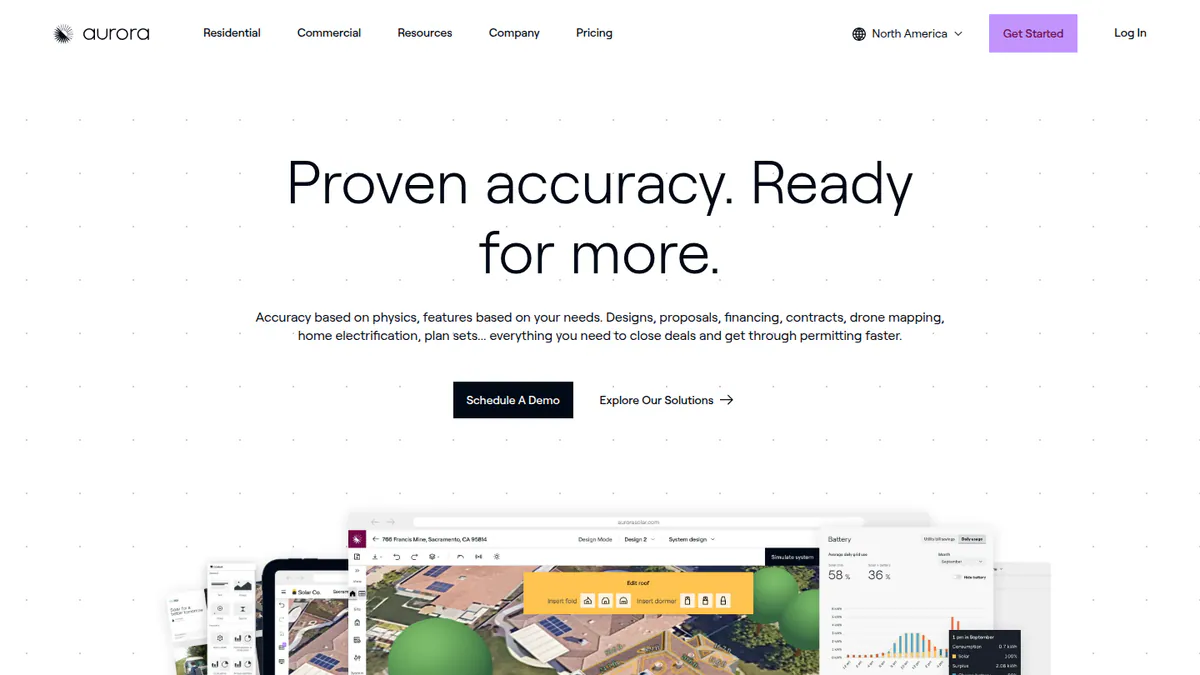
Want to see Aurora Solar working? Book a demo with the SolarSoftwares team.
Book a demoYour request goes by email to the SolarSoftwares team. A time is set only after we reply. It does not change any score or ranking.
2. PV*SOL premium: best for desktop 3D shading and yield in Europe
Best for: European designers who want a full 3D model, shade study and yield in one desktop program. Score: 80.3/100.
vs Skelion: You build the 3D scene inside PV*SOL premium, with no host program. It adds yield, battery, heat pump and EV modelling that Skelion lacks.
What it is: PV*SOL premium comes from Valentin Software, a German firm. It is a desktop program for 3D design and yield. People use it across Europe for homes and C&I (commercial and industrial) work.
Why we picked it: It does Skelion’s core job, 3D layout and shading, and adds yield in the same program. The price is published, and a short licence lowers the risk of trying it.
Key features:
- Build the 3D scene and run detailed shading in one program.
- Meteonorm 9 climate data drives the yield runs.
- AC- and DC-coupled batteries.
- Models heat pumps and EV charging with separate tariffs.
- Customer report as a PDF or Word (DOCX) file.
Pricing: EUR 845 a year per named user plus VAT, or EUR 285 for three months. The 2D version, PV*SOL, costs EUR 585 a year. 30-day trial. Checked October 2026 in the Valentin shop.
Pros (from our research):
- A three-month licence (EUR 285) suits a short run of jobs.
- On G2, 10 reviewers give ease of use 8.2/10.
- It gets a yearly update. The 2026 edition arrived on 24 November 2025.
Cons (from our research):
- A full year costs EUR 845 plus VAT for each named user.
- Customer output is a presentation file, not a web proposal with e-signature.
- Prices are in EUR only.
Reviews: G2 4.2/5 (12 reviews), checked October 2026.
What we could not confirm: stringing and SLD depth, and current trial limits.
Read our full PV*SOL premium review or our PV*SOL alternatives.
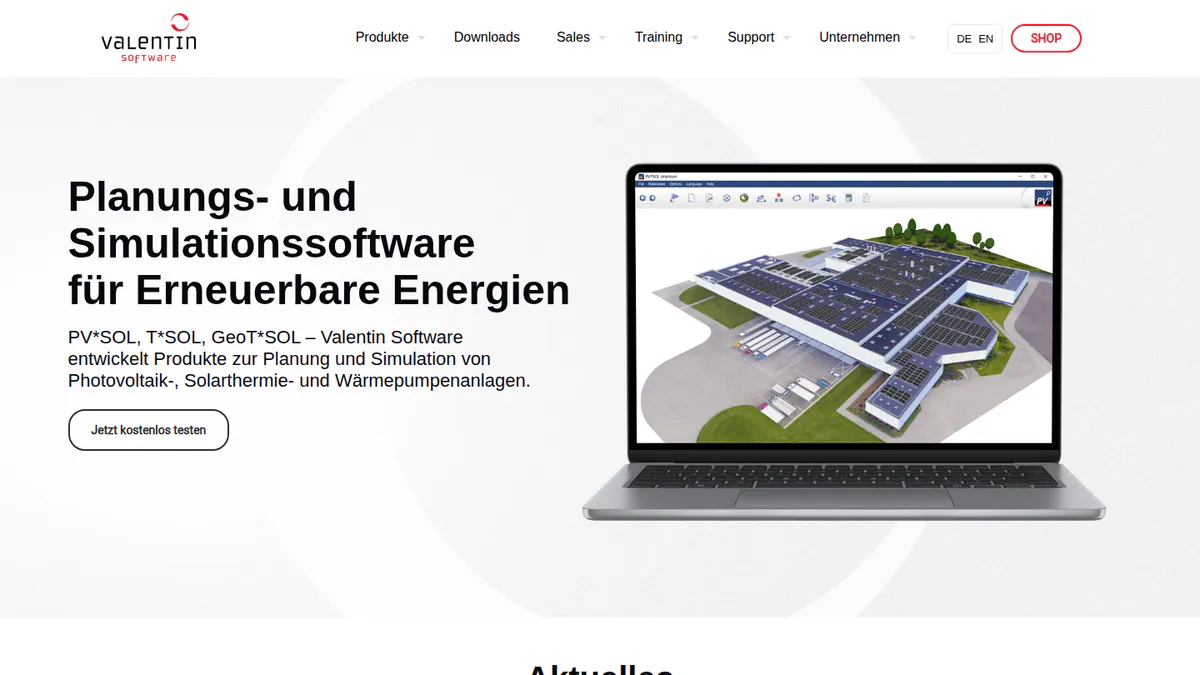
Want to see PV*SOL premium working? Book a demo with the SolarSoftwares team.
Book a demoYour request goes by email to the SolarSoftwares team. A time is set only after we reply. It does not change any score or ranking.
3. PVsyst: best for bankable yield from 3D shade scenes
Best for: Engineers and EPCs (firms that design and build solar plants) who need lender-grade yield and still have SketchUp models to reuse. Score: 74.3/100.
vs Skelion: G2 reviewers say PVsyst works with SketchUp for 3D shade scenes, so your models still have a use. It adds P50/P90 yield (a typical-year and a low-output-year forecast) and loss reports, which Skelion does not offer.
What it is: PVsyst SA in Switzerland makes this Windows simulation program. It is the usual yield reference for engineers, EPCs and lenders’ advisers.
Why we picked it: Reviewers say it works with SketchUp models, so your past modelling keeps its value. Its yield reports are the ones lenders expect.
Key features:
- Near-shade scenes in 3D, with mismatch losses worked out.
- 3D scene import from CAD tools.
- P50/P90 reports with a loss diagram, used for bank finance.
- Models bifacial modules (panels that catch light on both sides) and backtracking trackers (mounts that turn to follow the sun).
- Weather import from Meteonorm 9, PVGIS, NSRDB and Solcast.
Pricing: PVsyst 8 Professional costs CHF 700 a year per seat. Multi-seat discounts run from 5% (2-4 licences) to 20% (10 or more). Student and Classroom licences cost CHF 25 a year. A 30-day evaluation mode comes with a fresh install. Checked October 2026 in the PVsyst shop.
Pros (from user reviews):
- In G2 review themes, users call its modelling and yield results detailed and accurate.
- Reviewers also praise its full loss breakdown.
- They say it works with SketchUp to build 3D shade scenes.
Cons (from user reviews):
- The screens look dated and crowded.
- Newcomers struggle to learn it.
- 3D scene set-up eats time.
Reviews: G2 4.5/5 (22 reviews), checked October 2026.
Read our full PVsyst review or our PVsyst alternatives.
Want to see PVsyst working? Book a demo with the SolarSoftwares team.
Book a demoYour request goes by email to the SolarSoftwares team. A time is set only after we reply. It does not change any score or ranking.
4. PVcase Roof Mount: best for C&I roofs inside AutoCAD
Best for: C&I engineering teams who would rather swap SketchUp for AutoCAD than leave CAD altogether. Score: 73.5/100.
vs Skelion: It is also a plug-in, but for AutoCAD instead of SketchUp. It adds stringing, cable sizing and SLD export, which Skelion lacks.
What it is: PVcase, a Lithuanian firm, sells Roof Mount as an AutoCAD plug-in for commercial roofs. It handles layout, mounting, wiring and yield.
Why we picked it: It keeps the plug-in way of working that Skelion users know. It also adds the electrical design that Skelion lacks.
Key features:
- Turns DWG/DXF (CAD file types) drawings or drone images into roof shapes.
- Auto layouts that respect setbacks, parapets (low walls at the roof edge) and roof clutter.
- Strings, MPPT inputs (where a string of panels feeds the inverter), cable trays, cable sizes and voltage drop.
- SLD and BOM (bill of materials, a parts list) export.
- Shade, irradiance (sunlight strength) and yield checks, with export to PVsyst.
Pricing: One Professional plan. You have to ask the company for a price. Demo only. Checked October 2026 on the PVcase Roof Mount pricing page.
Pros (from reviews and our research):
- G2 review tags point to time saved.
- CAD teams keep working in AutoCAD (G2 tags).
- Users rate it easy to use (9.1/10) with strong support (9.8/10) on G2.
Cons (from our research):
- You must talk to sales to get a price.
- It is built for commercial roofs, not homes.
- PanelClaw ballast reports work only in Eurocode countries such as Germany and Spain.
Reviews: G2 4.6/5 (17 reviews), checked October 2026.
What we could not confirm: whether the price includes AutoCAD or you buy it separately.
See our PVcase alternatives.
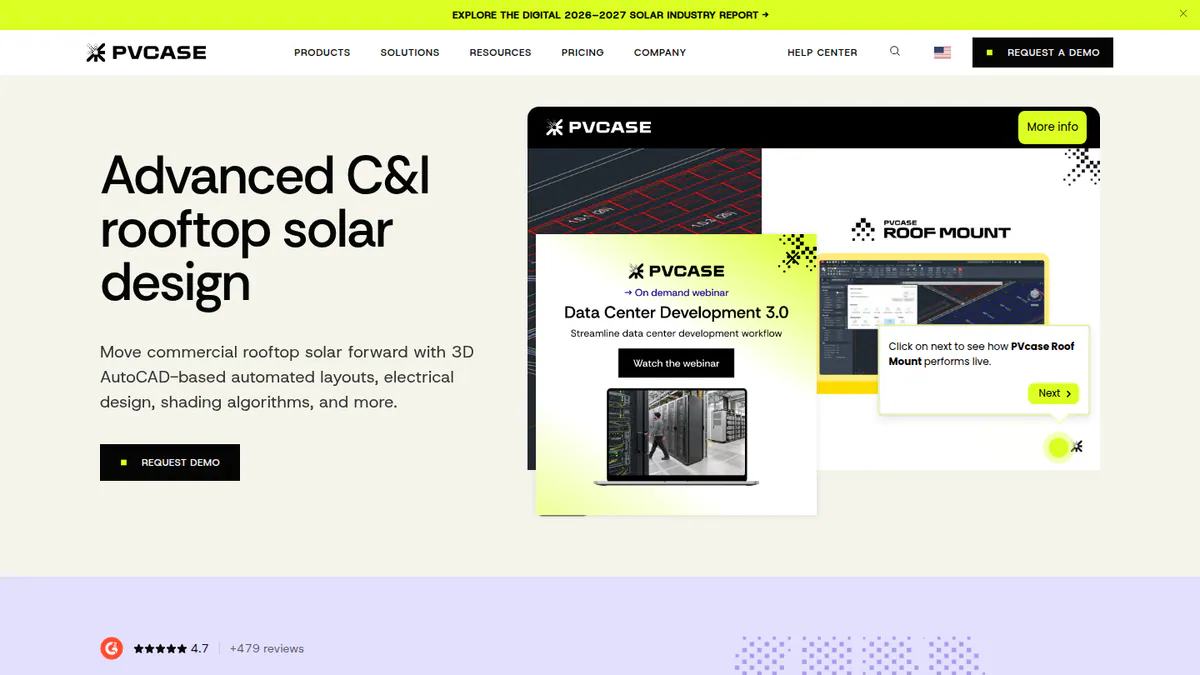
Want to see PVcase Roof Mount working? Book a demo with the SolarSoftwares team.
Book a demoYour request goes by email to the SolarSoftwares team. A time is set only after we reply. It does not change any score or ranking.
5. OpenSolar: best free Skelion alternative
Best for: Home and small commercial installers who want to stop paying for both a plug-in and SketchUp. Score: 73.2/100.
vs Skelion: The core platform is free and runs in a browser, so you pay for neither a plug-in nor SketchUp. It adds proposals with e-signature.
What it is: OpenSolar is a free design, proposal and sales platform from OpenSolar Inc., funded by finance and hardware partners.
Why we picked it: Its free core removes both of Skelion’s bills at once. It still covers 3D design, shade and proposals.
Key features:
- No-cost roof design in 2D or 3D, including shade.
- AI design in OS 3.0.
- Online proposals that customers can sign and pay through.
- Built-in finance options.
- Permit links, including SolarAPP+.
Pricing: The core platform is free. Since 16 April 2026, API Access (usage-based, 30-day free trial) and the Xero and QuickBooks connectors (monthly per organisation) are paid. Rates are not published. Premium imagery is optional and paid. Checked October 2026 on the OpenSolar notice.
Pros (from reviews and our research):
- A G2 reviewer finds adding and moving panels very easy.
- The app is handy in the field (G2).
- OpenSolar says the free core allows unlimited users.
Cons (from user reviews):
- A G2 reviewer says layouts lack automatic adjustment, so an engineer must review them.
- The interface feels dated (G2).
- One reviewer notes it is "not completely free", since some add-ons cost extra.
Reviews: G2 4.8/5 (3 reviews), checked October 2026.
What we could not confirm: the price of API access and connectors, and how deep shading goes beyond the marketing pages.
Read our full OpenSolar review or our OpenSolar alternatives.
Want to see OpenSolar working? Book a demo with the SolarSoftwares team.
Book a demoYour request goes by email to the SolarSoftwares team. A time is set only after we reply. It does not change any score or ranking.
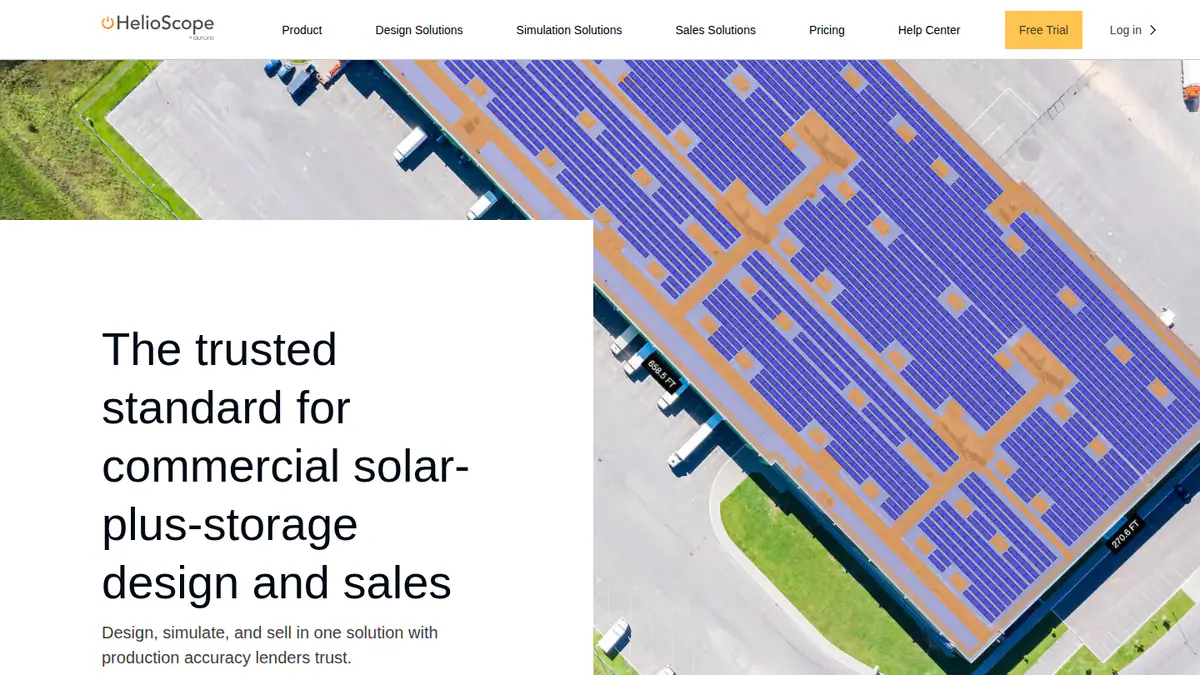
6. HelioScope: best for C&I shading and yield in a browser
Best for: C&I designers who want quick layouts, shading and wiring losses without CAD. Score: 73.1/100.
vs Skelion: HelioScope models shading and wiring losses in a browser for jobs up to 30 MW DC. It costs USD 1,620 a year on Basic, against USD 200 plus SketchUp.
What it is: Aurora Solar Inc. owns HelioScope but sells it as its own product, with a separate login. It runs in a browser and targets commercial and small utility jobs.
Why we picked it: It handles shade and wiring losses on large roofs, where Skelion’s free version runs out of panels. Prices are published, and a free trial is offered.
Key features:
- Rooftop, carport and ground-mount layout.
- Shading and wiring-loss modelling.
- Yield the company puts within 1% of PVsyst.
- LIDAR and AI obstruction detection, plus P90/P95/P99 values (Pro).
- Storage design, with PVsyst export on Enterprise.
Pricing: Basic is USD 159 a month, or USD 1,620 a year if billed yearly (1 user, 10 projects a month, up to 1.25 MW DC). Pro is USD 259 a month or USD 2,640 a year (up to 5 MW DC). Enterprise is custom, priced per project. Free trial offered, length not stated. Checked October 2026 on the HelioScope pricing page.
Pros (from user reviews):
- Reviewers find it quick to learn.
- Layouts, shade and wiring-loss results come back fast.
- It produces reports and SLDs in little time.
Cons (from user reviews):
- It costs too much if you only design now and then.
- Project caps bite on big systems.
- Older reviews cite no battery or tracker support, though the pricing page now lists both.
Reviews: G2 4.5/5 (19 reviews), checked October 2026.
Read our full HelioScope review or our HelioScope alternatives.
Want to see HelioScope working? Book a demo with the SolarSoftwares team.
Book a demoYour request goes by email to the SolarSoftwares team. A time is set only after we reply. It does not change any score or ranking.
7. RatedPower: best for utility-scale ground plants
Best for: Developers and EPCs who used Skelion on large ground sites and now need full plant engineering. Score: 72.0/100.
vs Skelion: RatedPower lays out whole plants on real terrain and produces SLDs, costs and drawings. Skelion only places panels on a model. DWG files go back and forth to AutoCAD.
What it is: RatedPower, part of Enverus, sells pvDesign. It is a cloud tool for utility-scale (very large solar farm) PV, storage and hybrid plants.
Why we picked it: It is the strongest pick here for ground plants, backed by 305 G2 reviews. It does the full plant engineering that Skelion never tried to do.
Key features:
- Plant layouts built from rules for setbacks, roads, slope and earthworks.
- Yield with 3D ray tracing and terrain shade.
- MV/LV (medium and low voltage) electrical design, SLDs and substations.
- Battery and hybrid plants, with dispatch runs.
- Cost and LCOE (lifetime cost per kWh) studies, plus 400+ editable documents.
Pricing: Basic, Advanced and Enterprise tiers. You have to ask the company for every price. Demo only. Checked October 2026 on the RatedPower pricing page.
Pros (from user reviews):
- G2 reviewers mention ease of use most (22 times).
- Feasibility layouts come together fast (18 mentions).
- Automatic electrical diagrams save time.
Cons (from user reviews):
- Layout limits are the top complaint (14 mentions).
- Some features are missing, such as certain BESS (battery storage) and PCS (power conversion) pairs (8 mentions).
- Drawings are hard to customise.
Reviews: G2 4.4/5 (305 reviews), checked October 2026.
Read our full RatedPower review or our RatedPower alternatives.
Want to see RatedPower working? Book a demo with the SolarSoftwares team.
Book a demoYour request goes by email to the SolarSoftwares team. A time is set only after we reply. It does not change any score or ranking.
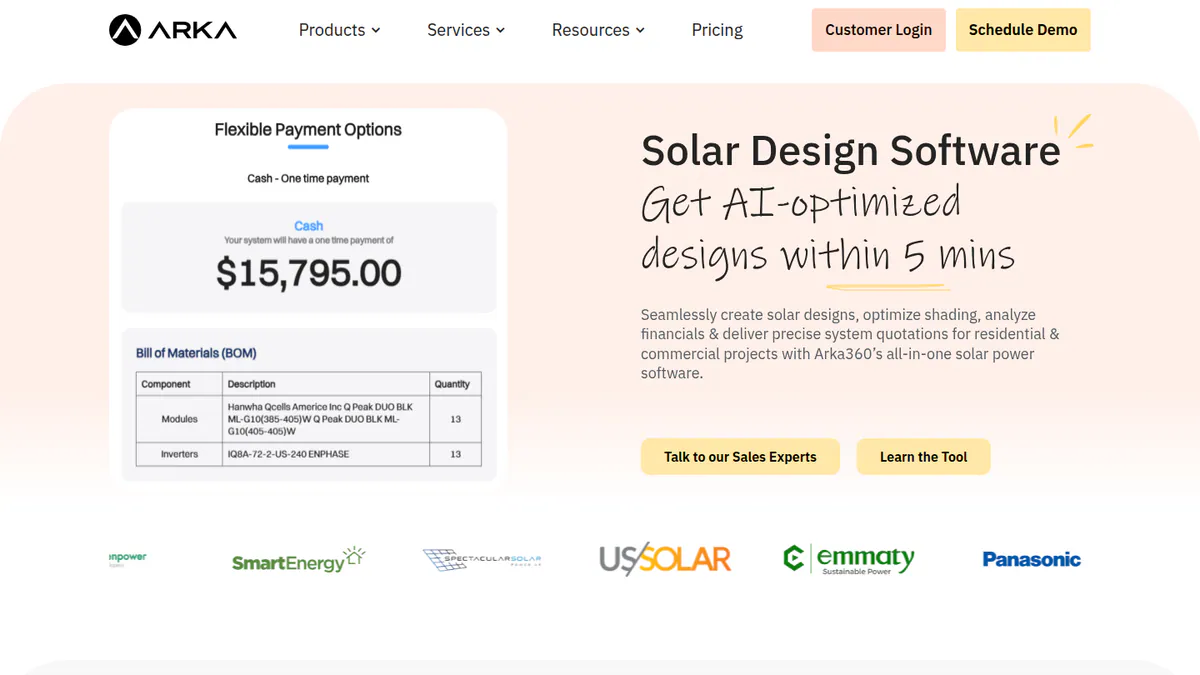
8. Arka 360: best for cloud design that exports back to SketchUp
Best for: Indian and US installers who want cloud design but still use SketchUp for client visuals. Score: 71.3/100.
vs Skelion: You design in the browser, and Premium can export the 3D model to SketchUp and PVsyst. It adds stringing, SLDs and proposals.
What it is: Formerly The Solar Labs, Arka 360 sells browser-based design and proposals with a light CRM (software that tracks customers and sales). The company works from Bengaluru, India, and Allen, Texas.
Why we picked it: Few tools here can hand a model back to SketchUp, and this one can. It also has published US prices and 137 G2 reviews.
Key features:
- Roof and ground-mount models in 3D, with shade.
- Stringing, including micro-inverters and optimisers (small devices that sit on each panel).
- Premium sends the 3D model to SketchUp or PVsyst and exports SLDs.
- Proposals and generation reports.
- AI design and permitting checks.
Pricing: The international-list Basic is USD 159 a month or USD 1,699 a year, with unlimited projects. Premium is USD 199 a month or USD 1,999 a year. Enterprise is USD 999 a month. Indian plans are priced in INR plus 18% GST, with an INR 10,000 onboarding fee, but the page shows two different INR price sets. Demo only. Checked October 2026 on the Arka 360 pricing page.
Pros (from user reviews):
- New staff learn it quickly: ease of use comes up 14 times on G2.
- Reviewers trust its shade and yield numbers for quotes.
- Customers like the 3D views, and support gets praise.
Cons (from user reviews):
- It slows down or hangs on jobs of 3 MWp or more.
- Some tools are missing, and picking a mounting structure confuses some users.
- Multi-user limits get in the way.
Reviews: G2 4.3/5 (137 reviews), checked October 2026.
What we could not confirm: which INR price set is current, and whether US buyers also pay the onboarding fee.
Read our full Arka 360 review or our Arka 360 alternatives.
Want to see Arka 360 working? Book a demo with the SolarSoftwares team.
Book a demoYour request goes by email to the SolarSoftwares team. A time is set only after we reply. It does not change any score or ranking.
9. Scanifly: best for 3D models from drone photos
Best for: US installers who want the 3D model built from site data instead of drawn by hand. Score: 71.0/100.
vs Skelion: In Skelion you build the model yourself in SketchUp. Scanifly builds it from drone photos or remote imagery, then adds shading and layout.
What it is: Scanifly is a US design and field platform with remote and drone-based 3D site models, shading and a survey app.
Why we picked it: It removes the slowest part of Skelion work: building the model by hand. It scored top marks for fit on this job.
Key features:
- Remote models from satellite, Nearmap or LiDAR, before anyone visits.
- Upload drone photos and get a 3D model in under 30 minutes.
- On-site shade data that, the company says, several regulators and lenders accept.
- AI finds roof obstructions, and layouts keep fire setbacks.
- iOS and Android field app, plus CAD export.
Pricing: You have to ask the company for a price. Design work runs on credits, and drone surveys and design services cost extra. Demo only. Checked October 2026 on the Scanifly website.
Pros (from our research):
- You skip hand modelling: drone models are ready in under 30 minutes.
- Field crews and designers share one app.
- Dated product posts run through October 2026, so it is in active development.
Cons (from our research):
- There is no published price.
- It is US-focused.
- Its plan sets are drafted by people as a paid extra, not made by the software.
Reviews: G2 4.7/5 (3 reviews), checked October 2026, with no review text visible.
Read our full Scanifly review or our Scanifly alternatives.
Want to see Scanifly working? Book a demo with the SolarSoftwares team.
Book a demoYour request goes by email to the SolarSoftwares team. A time is set only after we reply. It does not change any score or ranking.
10. PVcase Ground Mount: best for ground-mount layouts in AutoCAD
Best for: Developers and EPCs who lay out ground plants on real terrain. Score: 69.9/100.
vs Skelion: Like Skelion, it is a plug-in, but it runs in AutoCAD and follows the terrain. It adds civil and electrical design.
What it is: PVcase Ground Mount is a CAD-based layout, civil and electrical design tool from PVcase for utility-scale plants.
Why we picked it: It keeps the plug-in workflow but follows real terrain, which Skelion cannot. It has more G2 reviews than any other tool on this page.
Key features:
- Fixed-tilt and tracker rows that follow the ground.
- Slope checks, grading heat maps, cross-sections and pile analysis.
- Stringing, cable sizing and SLDs.
- Shading and irradiance with QuickYield early yield.
- BESS layout and PVsyst export.
Pricing: One Professional plan. Contact sales for a price. Demo on request. Checked October 2026 on the PVcase Ground Mount pricing page.
Pros (from user reviews):
- All 10 visible G2 reviews cite time saved on layouts.
- AutoCAD feels familiar, and PVsyst shade-scene export saves hours.
- Terrain handling is strong, and support often replies within a day.
Cons (from user reviews):
- Reviewers want more automation on the electrical and SLD side.
- Smaller firms find the price high.
- New users need training.
Reviews: G2 4.7/5 (415 reviews, from a search listing), checked October 2026.
Read our full PVcase Ground Mount review or our PVcase alternatives.
Want to see PVcase Ground Mount working? Book a demo with the SolarSoftwares team.
Book a demoYour request goes by email to the SolarSoftwares team. A time is set only after we reply. It does not change any score or ranking.
SurgePV (unscored): for readers comparing roof modelling, array layout and proposals in one browser project. Compare required imports, design depth and local outputs on your own project. The numbered scores above do not include it.
Sources checked 27 October 2026: SurgePV product information · SolarSoftwares SurgePV review
Book a demo of SurgePV with the SolarSoftwares team.
Book a demoYour request goes by email to the SolarSoftwares team. A time is set only after we reply. It does not change any score or ranking.
How do the 10 Skelion alternatives compare?
This table shows what changes when you leave Skelion.
Product | Runs on | Link to SketchUp or CAD | Electrical output | Customer proposals |
|---|---|---|---|---|
Skelion (reference) | SketchUp plug-in | Lives in SketchUp | Not found | Not found |
Browser | None found | Plan sets on Enterprise | Yes, with financing | |
Desktop | None found | Not confirmed | Presentation export | |
Windows | 3D scene import. SketchUp per reviewers | Not a focus | No | |
AutoCAD plug-in | DWG/DXF import | Stringing, cables, SLD | No | |
Browser | None found | Permit links (SolarAPP+) | Yes | |
Browser | None found | SLDs (per reviews) | On Pro | |
Browser | DWG round trip with AutoCAD | MV/LV, SLDs | No | |
Browser | 3D export to SketchUp (Premium) | SLD export (Premium) | Yes | |
Cloud and mobile app | CAD export | Plan sets as a service | Not documented | |
AutoCAD plug-in | Runs in AutoCAD | Stringing, cables, SLDs | No |
Also considered
- Solargraf: Scored 66.7/100. Enphase’s design-to-permit tool for US homes, from USD 2,799 a year. It sits just outside the top 10, with a Capterra rating of 3.2/5. See our Solargraf alternatives.
- DNV SolarFarmer: Scored 63.2/100. Strong 3D shade and yield modelling for utility plants, but you have to ask the company for a price and we found no user reviews.
- SolarPlus: Scored 62.7/100. SolarPlus is an Australian tool for design, quotes and off-grid systems, priced from USD 135 a month on annual prepay. It has one G2 review.
How do you choose a Skelion alternative?
- If you left Skelion to stop paying for SketchUp and want proposals too, pick Aurora Solar (US) or OpenSolar (free).
- If you design in Europe and want 3D shading and yield on the desktop, pick PV*SOL premium.
- If you want to keep using your SketchUp models for shade scenes, look at PVsyst or Arka 360 Premium.
- If your team lives in AutoCAD, pick PVcase Roof Mount for roofs or PVcase Ground Mount for ground sites.
- If you hit the 10-panel cap on C&I roofs, pick HelioScope for browser-based shading and wiring losses.
- If you want the model built for you from drone photos, pick Scanifly.
For wider shortlists, see our 3D solar design software and shading analysis software rankings. You can also compare free solar design software.
Want more choices? Browse every tool we checked in our design and simulation category.
How do you switch from Skelion?
- Save each live SketchUp model with its panel count and shade results.
- Check how the new tool takes in 3D data. PVsyst reviewers mention SketchUp, and PVcase imports DWG/DXF.
- Redo one recent job in the new tool and compare shading and yield.
- Skelion Pro is a yearly serial, so time the switch with its renewal date.
Skelion alternatives FAQs
What is the best Skelion alternative overall?
Aurora Solar is the best Skelion alternative overall in our October 2026 ranking, at 85.3/100. It runs in a browser, so you no longer need SketchUp. PV*SOL premium (80.3) suits European desktop design. PVsyst (74.3) suits engineers who need lender-grade yield reports.
Is Skelion still supported?
We could not confirm active support. Skelion Pro is still on sale at USD 200 a year per licence, and users were still licensing it in 2025. But we found no version number or release dates, and a June 2025 forum plea got no reply (checked October 2026).
Why is Skelion limited to 10 panels?
We found no explanation from the company as of October 2026. A SketchUp forum user reports the free version caps at 10 panels, and a Pro serial removes the cap. That user still saw the cap with an active subscription and got no reply.
Is there a free SketchUp solar plugin?
Skelion has a free version, but users report it stops at 10 panels. We did not review other SketchUp plug-ins. For free design without SketchUp, OpenSolar’s core platform is free (checked October 2026). It runs in a browser and sends proposals that customers can sign online.
Do I need SketchUp to design solar panels?
No. All ten tools on this page work without SketchUp, as of October 2026. The two PVcase tools run inside AutoCAD, a CAD drawing program, instead. The others need no host program. They run in a browser, on the desktop, on Windows or as a cloud app.
Sources
All read 22 to 25 October 2026.
- Skelion: Pro page and pricing, SketchUp forum thread (June 2025)
- Aurora Solar: pricing, G2, Capterra, G2 review
- PV*SOL premium: shop, 2026 release, G2
- PVsyst: shop, product page, G2, G2 comparison, PVsyst forum (Mac)
- PVcase Roof Mount: pricing, G2 comparison, PanelClaw post
- OpenSolar: pricing notice, free platform, G2
- HelioScope: pricing, G2
- RatedPower: pricing, G2
- Arka 360: pricing, G2
- Scanifly: site, product post, G2
- PVcase Ground Mount: pricing, G2
- Solargraf: pricing, Capterra
- DNV SolarFarmer: product page
- SolarPlus: pricing, G2
Last updated 28 October 2026. Next scheduled review: 23 January 2027.