Solar site selection software helps developers screen land for solar projects. It stacks land plots, owners, grid capacity, nature limits and zoning rules on one map. Searchland ranks first at 77.9/100, but it covers Great Britain only.
We scored 11 tools and ranked the top 7. Most hold US data only, so where you build decides your shortlist.
For a ranking across every design job, see our best solar design software list.
Quick picks
Rank | Product | Best for | Coverage | Starting price (company page, checked October 2026) | Free plan / trial | Score /100 |
|---|---|---|---|---|---|---|
1 | UK solar and BESS land sourcing | Great Britain only | ◐ GBP 195 per user per month (GBP 2,340 per year) ex VAT | Trial on request | 77.9 | |
2 | Siting through to engineered layout | Global (site data in selected geographies) | Quote only | Demo only | 71.0 | |
3 | US grid capacity and power-flow screening | US for grid layers. Layouts global | Quote only | Demo only | 62.4 | |
4 | Solar resource and yield pre-feasibility | Global | ✓ EUR 2,400 per year | Unconfirmed | 61.3 | |
5 | Interconnection queue and nodal price data | US | Quote only | Demo only | 59.8 | |
6 | AI site ranking and permitting risk | US | Quote only | Demo only | 57.8 | |
7 | Environmental due diligence and local rules | US | Quote only | Free mini-report per parcel | 57.2 |
✓ Verified on the company’s own pricing page. ◐ Published by the company outside its pricing page (help centre, store or press release). ? We could not read the company’s pricing page, so the figure is not confirmed. Prices checked October 2026.
Quote only means the company shows no public price. You ask it for a quote.
How the 7 tools scored
- Use-case fit 35%
- User reviews 20%
- Pricing 15%
- Ease of use 10%
- Support 10%
- Momentum 10%
Tool | Score chart | Score |
|---|---|---|
77.9 out of 100 | 77.9 | |
71 out of 100 | 71.0 | |
62.4 out of 100 | 62.4 | |
61.3 out of 100 | 61.3 | |
59.8 out of 100 | 59.8 | |
57.8 out of 100 | 57.8 | |
57.2 out of 100 | 57.2 |
Each bar shows the weighted score out of 100.
Sub-scores at a glance (0-10)
Product | Use-case fit | User reviews | Pricing | Ease of use | Support | Momentum | Total /100 |
|---|---|---|---|---|---|---|---|
7.5 | 8.1 | 7.0 | 7.5 | 10.0 | 7.5 | 77.9 | |
7.5 | 6.9 | 4.0 | 7.5 | 7.5 | 10.0 | 71.0 | |
7.5 | 6.3 | 4.0 | 5.0 | 5.0 | 7.5 | 62.4 | |
6.7 | 5.0 | 7.0 | 5.0 | 5.0 | 7.5 | 61.3 | |
7.5 | 5.0 | 4.0 | 5.0 | 5.0 | 7.5 | 59.8 | |
7.5 | 5.0 | 4.0 | 5.0 | 5.0 | 5.5 | 57.8 | |
7.5 | 5.0 | 4.0 | 5.0 | 5.0 | 5.0 | 57.2 |
A 5.0 on reviews, ease, support or momentum is our neutral value where public evidence is thin, not a judgement.
Who is solar site selection software for?
This ranking is for utility-scale and community-solar (shared solar farm) developers, land teams and IPPs (independent power producers). It is not for rooftop installers. Here, site selection means you screen land plots before anyone signs off a layout. You check grid capacity, buildable acres, nature and zoning limits, and landowner data.
Where a tool works matters a lot. Land, owner, grid and permit data are held country by country. Most tools here hold US data only. Searchland is the odd one out. It covers the 14 DNO (distribution network operator) areas of England, Wales and Scotland and nothing else.
RatedPower and Solargis work worldwide. Even so, RatedPower’s site data covers only some regions. Solargis sells sunlight data, not land or grid layers.
Once you have picked a site, plant design moves to the tools in our utility-scale solar design software guide. RatedPower and PVcase are on both lists because they do siting and layout.
How did we rank these site selection tools?
How the score is weighted
- Use-case fit 35%
- User reviews 20%
- Pricing 15%
- Ease of use 10%
- Support 10%
- Momentum 10%
We looked at 12 products from 22 to 24 October 2026. We used company docs, price pages, trade press and public user reviews. This was desk research, so we did not run searches in any tool.
We scored 11 and ranked the top 7. The other four sit under "Also considered" with their scores. We used six criteria:
- Use-case fit (35%): How well the tool does this page’s job. We look for land and owner data in the docs. We also look for grid capacity, nature and permit checks, and hand-off to layout.
- User reviews (20%): A rating from only a few reviews counts for less. Most siting tools have no public reviews. So they get a middle score of 5 out of 10 and lose nothing.
- Pricing (15%): Public prices score higher than quote-only prices.
- Ease of use, support and momentum (10% each): We use review sub-scores, the help on offer and dated releases.
Scores are for this page’s job, so a tool can score differently on another page. If a product’s core facts came only from third parties, it loses 2 points. SurgePV is not part of this ranking. Full method: how we score software.
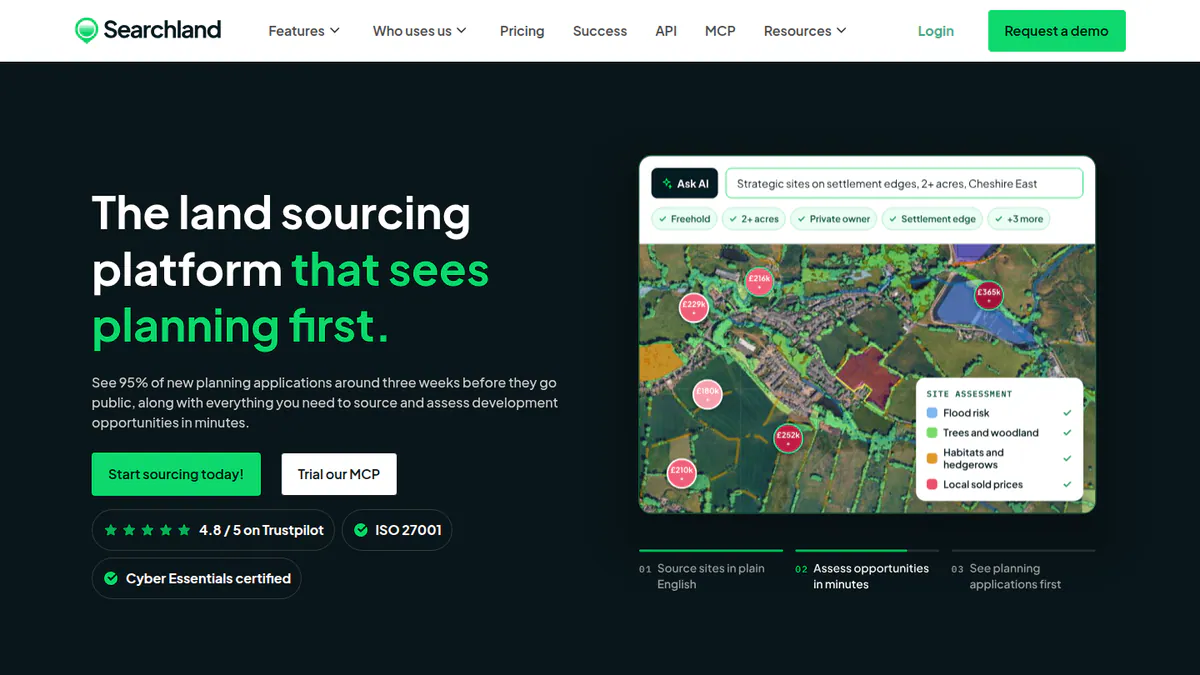
1. Searchland: best for UK solar and battery developers
Best for: Small and mid-sized land and green energy developers who look for sites in Great Britain. Score: 77.9/100.
What it is: Searchland is a London land-data tool. It covers England, Wales and Scotland only. Property, planning and green energy teams use it to find sites.
Why we picked it: It is the only tool here with GB grid headroom and title owner data on one map. It also publishes its prices and earns strong support reviews, though it does no deep grid modelling.
Key features:
- DNO grid data for all 14 GB areas. It shows substations, lines, voltages and red-amber-green headroom (spare grid capacity).
- The Embedded Capacity Register (the DNOs’ public list of linked and planned power plants). It ties in with planning data.
- Flood zone, protected habitat and heritage limits, plus 30+ years of planning bids.
- Nearby solar and BESS (battery storage) schemes, taken from planning records.
- Title and company owner data, with letters to landowners.
- A site filter by plot size and by distance to substations and power lines. It also has AI search, short notes on council papers and an MCP connector (a plug-in link) to the Claude AI assistant.
Pricing: Standard costs GBP 195 per user per month, or GBP 2,340 per user per year, ex VAT. The price per user falls with more seats (GBP 1,968 each for 4-5 users). Pro is on request. Even so, Searchland’s comparison page cites GBP 4,800 ex VAT for the top-tier licence. Checked October 2026 in Searchland’s G-Cloud 15 pricing document (January 2026).
Pros (from Trustpilot):
- You get personal, same-day help, not a ticket queue.
- It saves a lot of research time on each site.
- Broad data and AI tools sit in one place.
Cons (from Trustpilot):
- "Slightly expensive" for a small business (June 2026 review).
- Setting up the Claude connection took about 1.5 hours.
- The AI tools take time to learn.
Reviews: Trustpilot 4.8/5 (67 reviews), checked October 2026. Most reviewers work in land and property in general, not solar.
Want to see Searchland working? Book a demo with the SolarSoftwares team.
Book a demoYour request goes by email to the SolarSoftwares team. A time is set only after we reply. It does not change any score or ranking.
2. RatedPower: best for developers who want siting and engineered layout in one platform
Best for: Utility-scale developers, EPCs and IPPs who take a site from first checks to layout, yield and CAPEX. Score: 71.0/100.
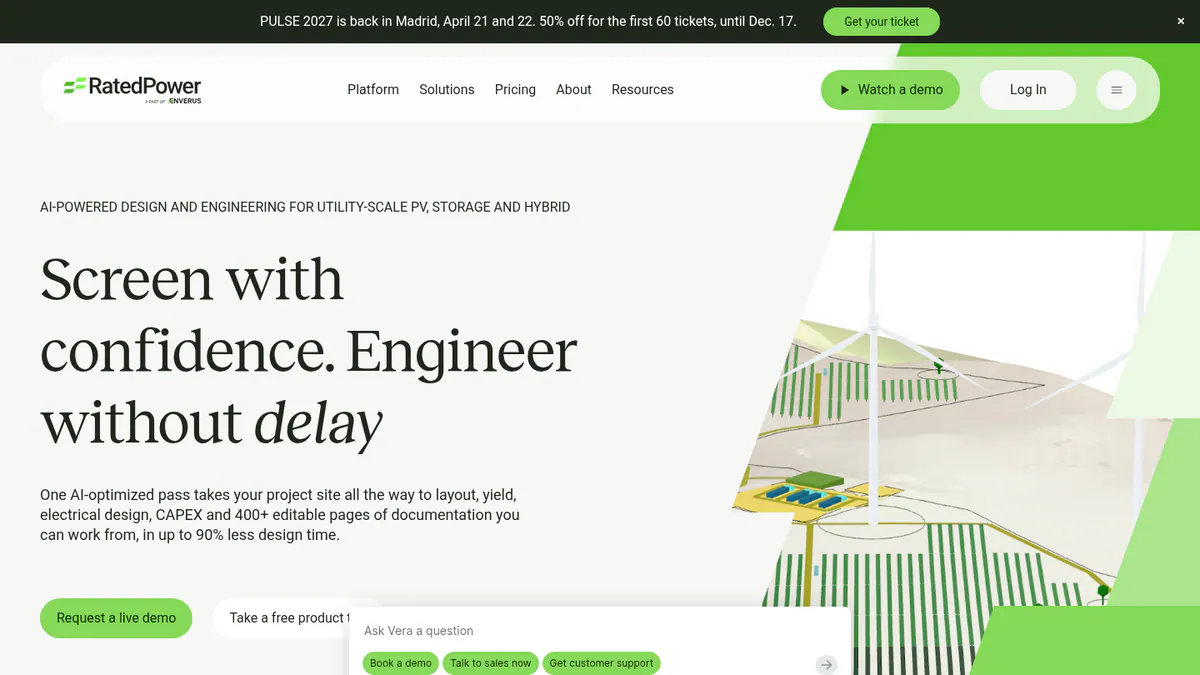
What it is: RatedPower is a cloud tool for design and engineering. It covers utility-scale PV, BESS and hybrid plants. Enverus owns it. Developers, EPCs and IPPs use it worldwide. But its site checks sit on the Enterprise tier only, and cover only some regions.
Why we picked it: It is the only tool here that takes a site from first screening to an engineered layout, yield and CAPEX. It also has the biggest review base on this page and ships updates often.
Key features:
- Site checks with land plot, substation and power line maps (Enterprise, some regions only). It can use Enverus PRISM data.
- Rule-based layout with setbacks, roads, slope and cut-and-fill (earthworks).
- Grid connection design on every tier.
- Energy yield matched to PVsyst, plus a 3D ray-traced mode.
- CAPEX (upfront build cost) and LCOE (levelised cost of energy), with 400+ docs you can edit.
- Power Analyst AI agent (add-on).
Pricing: Quote only (Basic, Advanced, Enterprise). Checked October 2026 on the RatedPower pricing page.
Pros (from G2 review themes):
- Ease of use gets the most praise (22 mentions).
- You save time on early-stage layouts (18 mentions).
- Users praise customer support (11 mentions).
Cons (from G2 review themes):
- Layout issues are the top complaint (14 mentions). These include handling land and site limits.
- Missing features (8 mentions), such as some BESS-PCS pairs.
- You cannot change the design much (6 mentions).
Reviews: G2 4.4/5 (305 reviews), checked October 2026.
Read our full RatedPower review or our RatedPower alternatives.
Want to see RatedPower working? Book a demo with the SolarSoftwares team.
Book a demoYour request goes by email to the SolarSoftwares team. A time is set only after we reply. It does not change any score or ranking.
3. PVcase Prospect: best for US grid-capacity screening
Best for: US developers who want power-flow results next to land plots. Score: 62.4/100.
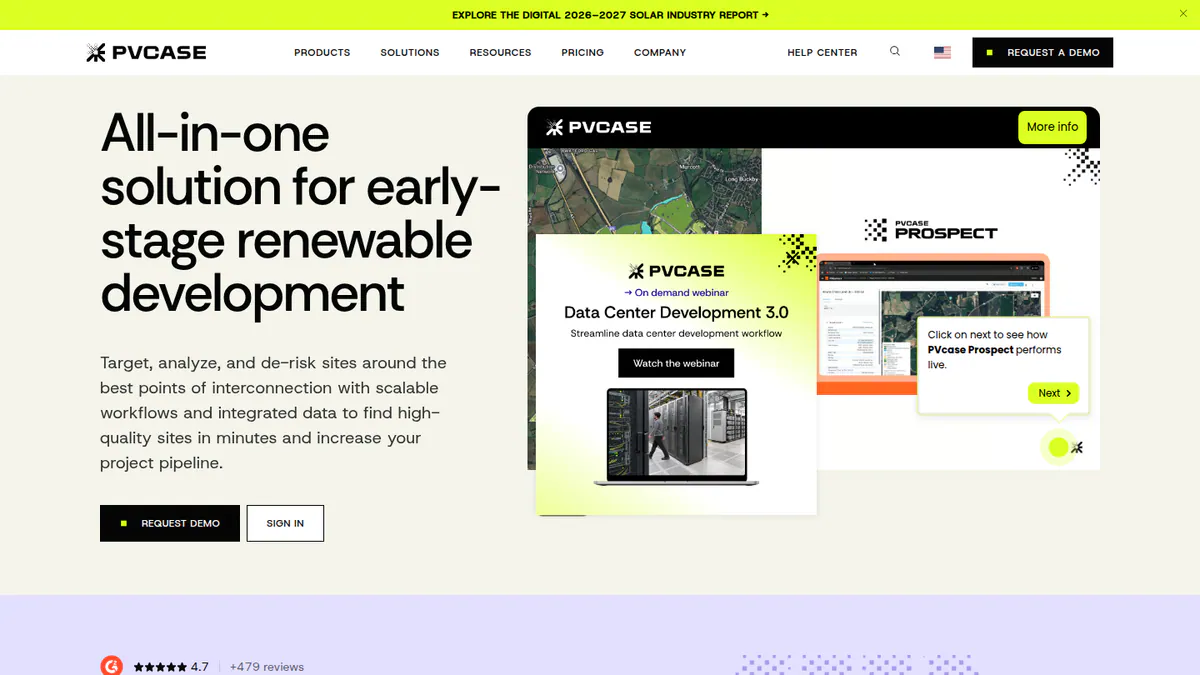
What it is: This is PVcase’s GIS (map-based) siting tool. It grew out of Anderson Optimization, which PVcase bought in 2023, and it feeds sites into PVcase Ground Mount. US developers of large and small grid-tied plants use it to screen land plots against grid capacity.
Why we picked it: It puts US power-flow capacity studies next to land plots in one tool. Its 41 G2 reviews give buyers more to go on than most siting tools.
Key features:
- Auto land plot search and buildable area.
- Hosting-capacity maps. Professional adds local grid maps and DG (distributed generation) layouts.
- Full-grid power-flow studies for injection and offtake capacity, with upgrade costs (Premium, US).
- Zoning checks and landowner phone lookup (US).
- Nodal LMP (locational marginal price) and basis risk (the gap between local and hub power prices), local mood and flood risk maps.
- Pipeline tracking and hand-off to Ground Mount.
Pricing: Quote only (Essentials, Professional, Premium). G2 lists the top tier as Enterprise. Checked October 2026 on the PVcase Prospect pricing page.
Pros (from our research):
- You can run power-flow injection studies without leaving the siting tool.
- Local grid layers help community-solar teams find small sites.
- The data keeps growing: new US layers came in February 2026.
Cons (from reviews and our research):
- G2’s review summary cites gaps in non-US data and screens that are clunky at times.
- The deepest grid features sit in the top tier.
- Capacity studies, power-market checks, local grid, permit checks, phone lookup and flood maps are US-only. Layouts work in all regions.
Reviews: G2 4.4/5 (41 reviews), checked October 2026. The 4.7 from 479 reviews on PVcase’s page is for the whole company.
Read our full PVcase Prospect review or our PVcase alternatives.
Want to see PVcase Prospect working? Book a demo with the SolarSoftwares team.
Book a demoYour request goes by email to the SolarSoftwares team. A time is set only after we reply. It does not change any score or ranking.
4. Solargis Prospect: best for solar resource checks at pre-feasibility
Best for: C&I (commercial and industrial) and utility developers who compare sites on sunlight (irradiance) and yield. Score: 61.3/100.
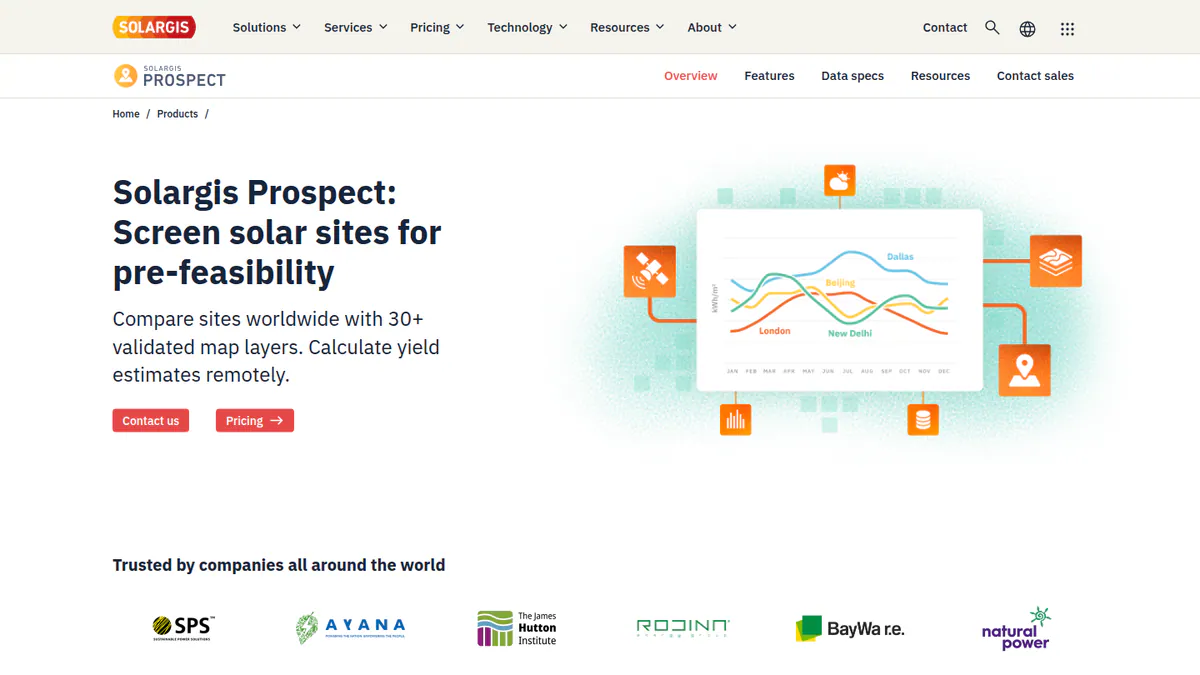
What it is: This app from Slovak data firm Solargis finds sites by sunlight. C&I and utility developers use it to compare sites on sunlight and yield, worldwide. It has no land, owner, grid or permit layers, so treat it as a data source next to a land and grid tool.
Why we picked it: It earns its place on sunlight and yield data for any country, at a price you can see. That makes it a useful first filter before you pay for land and grid data.
Key features:
- Global sun and weather data at 250 m detail.
- Monthly and hourly PVOUT (PV output), GHI and DNI (global horizontal and direct normal sunlight) and temperature profiles.
- Terrain, slope and horizon data.
- Compare sites side by side.
- ROI, LCOE and IRR calculator.
- PDF reports in 15+ languages.
Pricing: Basic EUR 2,400 per year (5 users, 500 projects). Professional EUR 4,800 per year (10 users, adds bifacial (two-sided) modules, trackers and floating PV). Enterprise on request. Checked October 2026 on the Solargis pricing page (Spanish locale).
Pros (from our research):
- You can budget before you call sales, since it is the only global tool here with a public price list.
- One tool covers sites in any country.
- Reports in 15+ languages suit teams that work across borders.
Cons (from our research):
- It has no land, owner, grid or permit data, so you still need a second tool.
- Basic covers fixed-tilt only. Trackers, bifacial and floating PV need Professional.
- There are no user reviews to judge it by.
Reviews: No user reviews found as of October 2026.
What we could not confirm: whether a free tier or trial is on offer in 2026.
Want to see Solargis Prospect working? Book a demo with the SolarSoftwares team.
Book a demoYour request goes by email to the SolarSoftwares team. A time is set only after we reply. It does not change any score or ranking.
5. Enverus PRISM: best for interconnection queue and nodal price intelligence
Best for: Large US developers, IPPs and investors who screen on queue spot and power prices. Score: 59.8/100.
What it is: Enverus is based in Austin, Texas. It runs PRISM, a power-market data tool for large firms. Its siting tools score US land plots for large developers, IPPs and investors. Enverus also owns RatedPower and hands sites to it for layout.
Why we picked it: Its docs list the largest US queue, land plot and power price data on this page, so it scores well on fit. It lost points for quote-only pricing and no user reviews.
Key features:
- 156M+ US parcels with a buildability model (slope, setbacks, exclusion layers).
- 88K+ interconnection-queue projects, updated daily.
- Injection capacity at POIs (points where plants join the grid).
- Nodal LMP across 60K+ nodes, with 20-year forecasts.
- A ranked landowner list.
- Hand-off to RatedPower for layout.
Pricing: Quote only. A new AI tool for siting power plants is in early access. Checked October 2026 on the Enverus siting page.
Pros (from our research):
- You get the largest queue and nodal datasets in the docs of any tool here.
- Daily queue updates mean you screen on fresh data.
- Sites go straight to RatedPower for layout, with no export step.
Cons (from our research):
- It has no public prices, so you need a sales call to budget.
- It states land plot and nodal data for the US only.
- There are no user reviews to judge it by.
Reviews: No user reviews found (G2 listing has none) as of October 2026.
What we could not confirm: its landowner contact and nature data, and whether the new AI siting tool is included.
Read our full Enverus PRISM review.
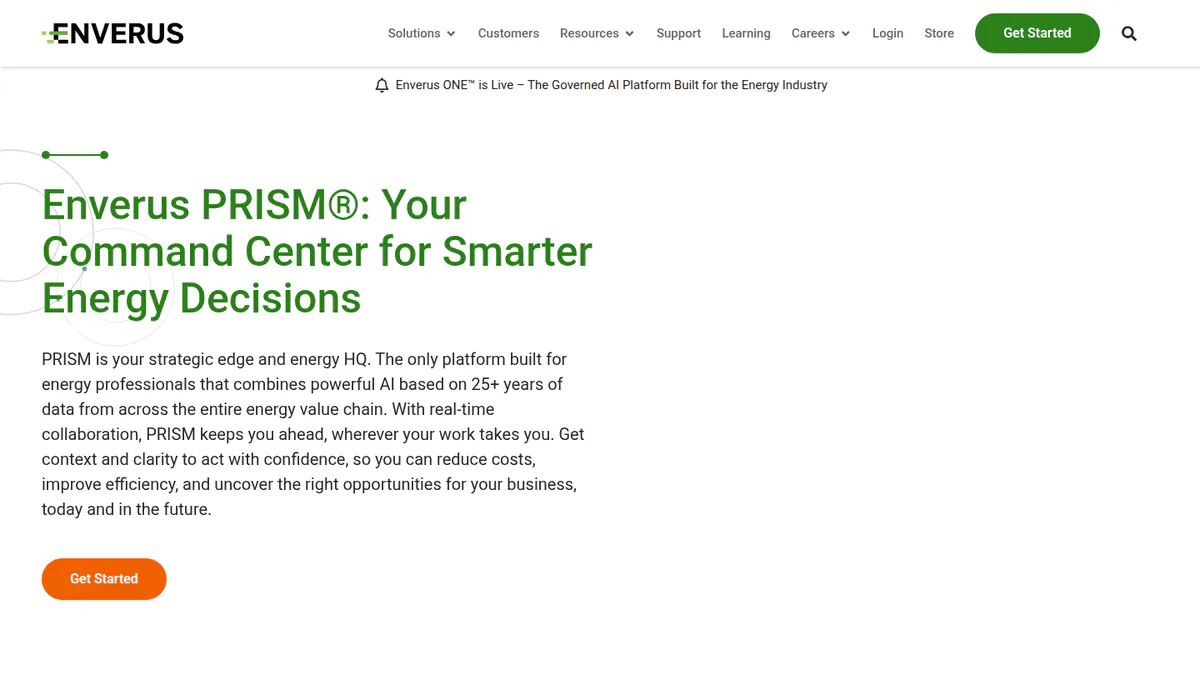
Want to see Enverus PRISM working? Book a demo with the SolarSoftwares team.
Book a demoYour request goes by email to the SolarSoftwares team. A time is set only after we reply. It does not change any score or ranking.
6. Paces: best for AI-ranked sites with permitting risk
Best for: Small and mid-sized US developers, including community-solar ones, who want ranked sites and draft site-check reports. Score: 57.8/100.
What it is: Paces is a New York start-up (Y Combinator S22). It raised a USD 11M Series A in July 2024. Its AI finds, ranks and checks US sites. Note: we could not open Paces’ website, so its features and pricing are unconfirmed. They come from its YC profile, ESG Dive and DataDrivenAEC (July 2026).
Why we picked it: It aims to cover the whole US screen in one place: land, grid capacity, permit risk and landowners. It scored lower because its facts come from third parties and it has no reviews.
Key features:
- Search and rank across 155M+ US land plots (as reported).
- Nature, zoning and permit risk (Permitting Predictor).
- Grid connection capacity and power-flow results.
- Landowner contacts.
- AI drafts of site-check reports and permit forms.
Pricing: Quote only, says DataDrivenAEC. A managed development service costs extra. Checked October 2026, but the company has not confirmed it.
Pros (from third-party reports, unconfirmed by the company):
- You see permit risk next to grid capacity on one screen.
- AI-drafted permit forms can save desk time.
- Community-solar developers (Chaberton, Demeter, Radiant Power) are named clients.
Cons (from our research):
- The company is shifting towards data centres, so solar may get less focus.
- Pricing is quote only, and the managed service costs extra.
- It works in the US only, and there are no user reviews.
Reviews: No user reviews found as of October 2026.
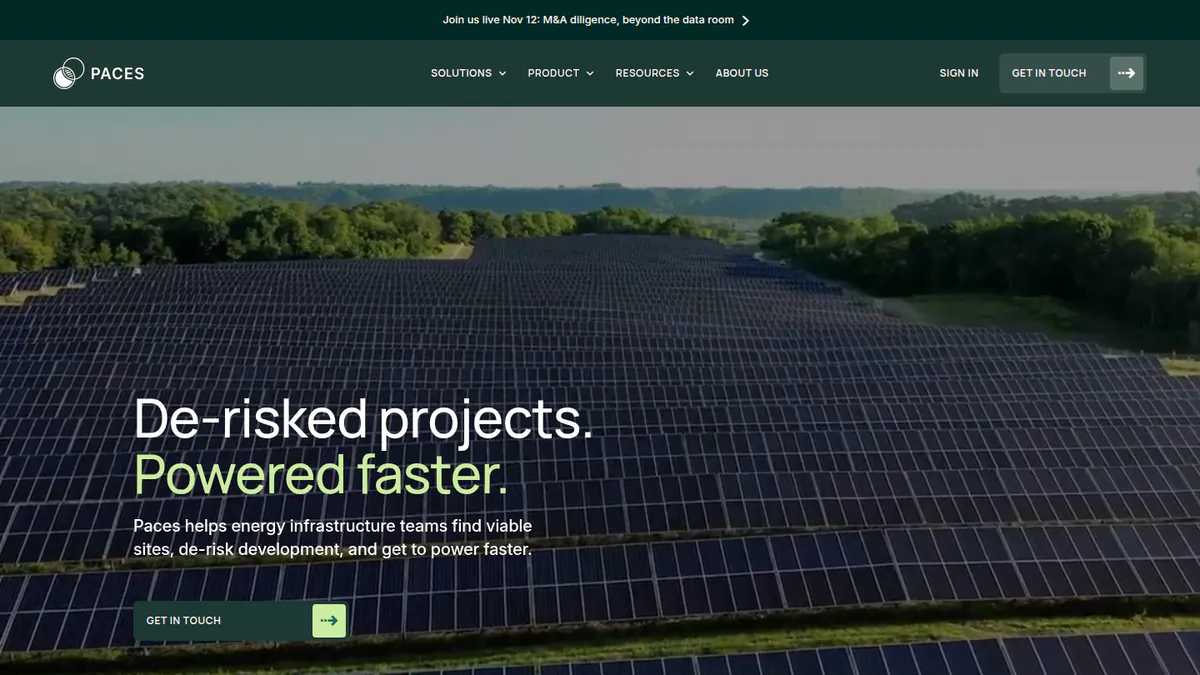
Want to see Paces working? Book a demo with the SolarSoftwares team.
Book a demoYour request goes by email to the SolarSoftwares team. A time is set only after we reply. It does not change any score or ranking.
7. Transect: best for environmental due diligence and local solar rules
Best for: US developers whose main filter is permit risk. Score: 57.2/100.
What it is: Transect is a US siting tool built around nature permits. Developers and green consultants use it when permit risk decides the site. Its local grid data also suits community solar.
Why we picked it: It has the deepest permit and local rules data of any tool here, and permit risk is often what kills a US site. Quote-only pricing and no user reviews held it back.
Key features:
- Auto groups of next-door land plots that meet acreage rules.
- Desk reports on federal and state species, waters, permits and soils.
- Local solar rules: setbacks, size limits, zoning and moratoriums.
- Bus-level injection estimates (base case and N-1, meaning with one grid element out), plus distribution line phase, voltage and capacity.
- Solar Pulse AI, which scores the risk of local pushback.
- A marketplace for Phase I ESAs (environmental site assessments) and ALTA surveys (US land title surveys).
Pricing: Quote only. You can get a free one-click mini-report on any plot or KML (Google Earth map file) upload. Checked October 2026 on the Transect solar siting page.
Pros (from our research):
- You can check setbacks, size limits and moratoriums in one local-rules database.
- A free mini-report lets you test it on a real plot before you buy.
- You can order Phase I ESAs and ALTA surveys in the same place.
Cons (from our research):
- Its docs show no landowner data, so outreach may need a second tool.
- Pricing is quote only.
- It works in the US only, and there are no user reviews.
Reviews: No user reviews found as of October 2026.
What we could not confirm: whether a free trial is on offer, as sources disagree.
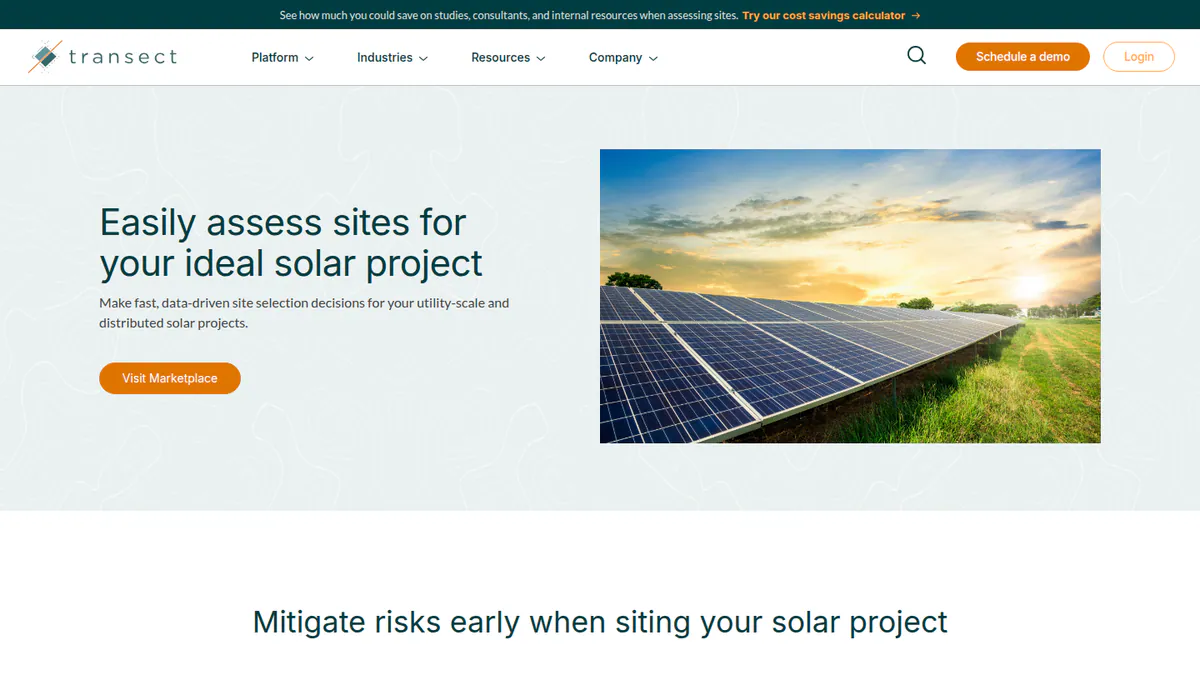
Want to see Transect working? Book a demo with the SolarSoftwares team.
Book a demoYour request goes by email to the SolarSoftwares team. A time is set only after we reply. It does not change any score or ranking.
How do the 7 site selection tools compare?
This table compares the 7 ranked tools side by side.
Product | Parcels and ownership | Grid capacity | Environmental and permitting | Layout | Coverage |
|---|---|---|---|---|---|
Yes, title owners | DNO headroom, ECR | Constraints, planning history | No | Great Britain | |
Parcels (Enterprise) | Substation and transmission maps | Not documented | Yes, engineered | Global, data in selected geographies | |
Yes, phone lookup (US) | Power-flow injection studies (US) | Yes, zoning (US) | Preliminary | US grid layers | |
No | No | No | Yield only | Global | |
Parcels, ranked landowners | Queue, injection, nodal prices | Exclusion layers | Via RatedPower | US | |
Yes (reported) | Power-flow results (reported) | Permitting risk (reported) | No | US | |
Parcel clusters | Bus-level estimates, distribution lines | Yes, strongest | No | US |
Also considered
- LandGate: Scored 57.2/100. It tied with Transect but sits below it in our scoring order. Wood Mackenzie bought it in June 2026. We do not know its prices or plans since the deal.
- Pivvot: Scored 57.2/100. It is the only route-planning tool we found for gen-ties (power lines that link a plant to the grid). But it has no grid-capacity data and does not say where it works.
- Nira Energy: Scored 46.5/100. It runs injection studies at every US substation. But it is a grid tool, not a full siting tool. The company has not confirmed any of its facts.
- Sunfig SIFT: Scored 40.6/100. It tests layout and IRR options on a site you already have. It does no land or grid checks. It has no dated updates since 2022, and we could not confirm who owns it now.
- Spottitt: Left out. The company now sells satellite monitoring to firms that run power lines and pipelines. It no longer has a solar site-selection product.
- Kevala: Grid analytics for utilities, not a developer siting tool.
- Global Solar Atlas: A free source of sunlight data. It is an input, not siting software.
- dvlp.energy, GridCARE, Latapult and Plume: G2 lists them in its energy site selection group. We did not review them for this edition.
How do you choose solar site selection software?
- If you develop in Great Britain, pick Searchland. Nothing else here holds DNO headroom and UK title data.
- If you build large US plants and screen on grid connection, compare PVcase Prospect and Enverus PRISM. If injection cost decides the deal, also look at LandGate and Nira Energy under Also considered.
- If you develop community solar, start with Transect or PVcase Prospect for local grid line data.
- If permits and local pushback kill most of your sites, look at Transect and Paces. Both model that risk head-on.
- If you want siting and engineered layout from one company, pick RatedPower on the Enterprise tier, or PVcase Prospect with Ground Mount.
- If you route long gen-ties, add Pivvot from Also considered.
- If you only need sunlight and yield data to compare countries or regions, Solargis Prospect has public prices.
Related guides: solar design software for EPCs, solar simulation software and solar financial modelling software.
Want more choices? Browse every tool we checked in our site selection and GIS category.
Solar site selection software FAQs
What is solar site selection software?
It screens land for solar projects. It stacks land plots, owners, grid capacity, nature limits and zoning rules on one map. As of October 2026, most tools hold US data only. Searchland is the main Great Britain option. You use it before layout and engineering software.
What factors matter when selecting a site for a solar farm?
Grid access and the cost to connect usually decide if a site works. Next come buildable acres, slope, and flood and habitat limits. Then local zoning and moratoriums, willing landowners and sunlight. For US sites, Transect and PVcase Prospect screen most of these in one place.
How does siting software assess grid interconnection capacity?
Some tools show published data, and others run power-flow studies. Searchland shows DNO headroom in Great Britain. PVcase Prospect (US, Premium tier), Enverus PRISM, LandGate and Nira Energy (also considered) show or estimate injection capacity (how much power the grid can accept). These are first checks, not a utility’s study.
Which site selection tools do renewable developers trust most?
There are few reviews to go on. As of October 2026, RatedPower has 305 G2 reviews (4.4/5) and PVcase Prospect has 41 (4.4/5). Searchland has 4.8/5 from 67 Trustpilot reviews, mostly from land users in general. Most other siting tools have no public reviews.
Can site selection software estimate solar plant capacity on a parcel?
Yes. PVcase Prospect makes first-draft layouts. RatedPower makes engineered layouts with yield and CAPEX. Enverus PRISM has a buildability model for US land plots. Of the also-considered tools, LandGate and Pivvot work out buildable or usable acres.
Sources
All checked 22 to 24 October 2026.
- Searchland: G-Cloud 15 pricing document, renewables blog, Trustpilot
- RatedPower: pricing, G2
- PVcase Prospect: pricing, US-only features, G2
- Solargis Prospect: pricing
- Enverus PRISM: generation siting, Renewable Energy World
- Paces: YC profile
- Transect: solar siting page
- LandGate: about, SolarQuarter, June 2026
- Pivvot: renewable energy page, G2
- Nira Energy: Latitude Media, May 2025, Infocast
- Sunfig SIFT: SIFT page, Solar Power World, July 2026
- Spottitt: InnoEnergy listing
Last updated 28 October 2026. Next scheduled review: 23 January 2027.