Key takeaways
- The US Department of Energy (DOE) benchmark page has 8 categories. The first 5 are hardware (module, inverter, energy storage, structural BOS, electrical BOS). The last 3 are soft costs.
- NLR’s (formerly NREL) benchmark reports list the inverter outside BOS. OpenSolar’s UK help page defines BOS as all components excluding the panels.
- This example’s 16-line job gives a BOS share of 21.4%, 31.4% or 76.0%. Only the definition changes. That is a 54.6-point spread.
- Monitoring sits in two places in NREL’s tables. Move this example’s monitoring line to the inverter. The narrow share drops from 21.4% to 18.9%.
- Of 3 tools’ pages read, only OpenSolar’s help names BOS (UK electrical components).
To check your own BOS share under each definition, use the calculator below. To tag BOS lines in quotes, see best solar estimating software.
Balance of system at a glance
BOS is a sorting label, not a part.
| Item | Detail |
|---|---|
| Formula | BOS share (%) = 100 × BOS value ÷ total job value. The BOS value depends on the definition used |
| Unit / typical range | USD, GBP or another currency, or a percentage of the job. No typical share is quoted here because none is taken from a primary source |
| Where it matters | BOM and takeoff grouping, supplier quotes, estimates, comparing proposals |
| Standard or rule | No single standard. DOE and NLR (formerly NREL) define it through the labels in their cost benchmarks |
| In software | Design tools mostly list parts by type. One tool in the table below names BOS in its help |
Why does balance of system matter for installers?
The same word means different things in a quote, an estimate and a benchmark. A quote that says BOS is not comparable until it says whether the inverter and labour are in it. See bill of materials and bill of quantities for how the parts lists are built.
What does balance of system include?
NLR’s (formerly NREL) tables list racking, conductors, switches and combiners as BOS. Wood Mackenzie lists structural items such as racking and clamps, and Aurora names wiring, switches and a meter. Sources differ on the inverter, monitoring, labour and soft costs.
Our rule for quotes: count hardware BOS (structural plus electrical) by default. If you add the inverter or labour, say so in writing.
| Part | Where the cited pages put it |
|---|---|
| Racking, rails, clamps, flashing | Structural BOS |
| Conductors, conduit, grounding | BOS materials, then electrical BOS |
| Disconnects, breakers, fuses | BOS materials, then electrical BOS |
| Transformers and switchgear | EPC-BOS materials in the utility-scale table |
| Monitoring and meters | Differs between sources and years |
| Rapid shutdown and optimisers | An additional BOS cost for rapid shutdown. Optimisers named in OpenSolar’s BOS |
| Inverter | Differs: a separate hardware item or inside BOS |
| Labour and soft costs | Outside BOS in the DOE and NREL labels |
Monitoring, inverter and labour are the contested rows. Their quotes come first.
- Monitoring and meters. Differs. NREL Q1 2015 (BOS materials) and 2017 (electrical BOS) include a monitoring system or production meter. NREL Q1 2018 Table 1 says inverter prices include monitoring equipment, yet its Table 2 lists monitoring under electrical BOS.
- Inverter. Differs. NREL Q1 2017 and 2018 list "module, inverter, structural and electrical BOS" as separate hardware items, as do Wood Mackenzie and Aurora. OpenSolar’s BOS help, written for UK electrical components, defines BOS as everything except panels. An undated page hosted by LBNL says a narrower use focuses on "inverters and hardware BOS". It cites SEIA 2016 and NREL 2017.
- Labour and soft costs. Outside BOS in the DOE and NREL labels. The LBNL-hosted page’s broad wording includes "services".
Other rows:
- Racking, rails, clamps, flashing. Structural BOS. NREL Q1 2018 residential table: "Includes flashing for roof penetrations and all the rails and clamps". Wood Mackenzie: SBOS covers "mounting systems, foundations, ballast, racking and clamps".
- Conductors, conduit, grounding. "BOS materials" in NREL Q1 2015. Electrical BOS in 2017 and 2018 (residential tables).
- Disconnects, breakers, fuses. "BOS materials" in NREL Q1 2015, electrical BOS in 2017 (switches, fuses, breakers). OpenSolar’s BOS page lists AC and DC isolators.
- Transformers and switchgear. NREL Q1 2015 utility-scale "EPC-BOS materials" row lists them with "all other ancillary equipment required to complete a system". See MV and LV design.
- Rapid shutdown and optimisers. NREL Q1 2017 Table 3 has a row "Additional balance-of-system (BOS) costs" for rapid shutdown. OpenSolar’s BOS list names DC optimizers. See rapid shutdown and MLPE.
The DOE page defines BOS by label only. Structural BOS is "The cost to the installer of structural balance of system components, as delivered". Electrical BOS has the same wording. NREL’s 2023 report says residential structural and electrical BOS costs are what installers pay to buy the components. In a benchmark, BOS is the cost of buying parts, and labour is counted elsewhere. The capex and opex page lists the DOE categories.
What is hardware BOS and what is soft BOS?
Hardware BOS is the racking and electrical equipment you can touch. Soft costs are everything else, such as labour, design, permitting and overhead. "Soft BOS" is informal. The cited pages do not define it.
DOE says "The first five categories are referred to as the hardware cost". The last three are soft. The soft three are fieldwork, office work and other. NLR’s (formerly NREL) 2017 and 2018 reports write: "Soft cost = total cost - hardware (module, inverter, structural and electrical BOS) cost". The 2017 report also uses the phrase "hardware BOS".
Labour is the open question. DOE counts fieldwork as soft. NREL’s 2018 report defines soft cost by subtraction, which puts labour there. Yet its breakdowns report labour apart from "other soft costs". Aurora’s education page counts installation labour inside hard costs. State your split beside any hardware or soft figure.
How does BOS appear in BOMs, takeoffs and proposals?
A BOM lists parts. A takeoff counts or measures them. A proposal shows a price. BOS is a tag you apply across all three. So the same line can sit in different groups.
- BOM: Solargraf’s blog lists category among the fields a racking BOM should include. OpenSolar’s hardware page names four categories: Module, Inverter, Battery and Other Component. BOS is not one of them. So a BOS tag is one you add. The BOM page builds a 13-line BOM that includes modules and the inverter.
- Takeoff: measured quantities such as cable runs feed BOS lines. See bill of quantities and cable routing and trenching.
- Proposal: a customer sees a total or a rate. If a proposal shows a BOS line, say what it contains. That is our advice, not a rule.
How do you sort a BOM into module, hardware BOS and soft BOS?
Tag every line with one group. Settle the edge items once. Then divide by the total.
- List the BOM lines plus the cost lines for labour, paperwork, fees and overhead.
- Tag each line: module, inverter, structural hardware, electrical hardware or soft.
- Decide where edge items go (monitoring, rapid shutdown, optimisers) and write it down.
- Add the groups your definition counts as BOS. Divide by the total. Print the definition beside the share.
Worked example: one example job, three BOS shares
The 16 lines below are an example 24-module roof job, shown in three parts. Values are example USD amounts, not prices. The category column is our mapping onto DOE-style labels.
Part 1: module, inverter and structural lines
| Line | Group | DOE-style category (our mapping) | Example value (USD) |
|---|---|---|---|
| PV modules (24) | Module | Module | 3,600 |
| String inverter | Inverter | Inverter | 1,500 |
| Rail and splices | Hardware BOS, structural | Structural BOS | 520 |
| Roof attachments and flashing | Hardware BOS, structural | Structural BOS | 640 |
| Mid and end clamps | Hardware BOS, structural | Structural BOS | 210 |
Part 2: electrical lines
| Line | Group | DOE-style category (our mapping) | Example value (USD) |
|---|---|---|---|
| PV wire | Hardware BOS, electrical | Electrical BOS | 240 |
| Grounding conductor and conduit | Hardware BOS, electrical | Electrical BOS | 260 |
| Breaker | Hardware BOS, electrical | Electrical BOS | 90 |
| AC and DC disconnects | Hardware BOS, electrical | Electrical BOS | 320 |
| Rapid shutdown device | Hardware BOS, electrical | Electrical BOS | 450 |
| Monitoring gateway and production meter | Hardware BOS, electrical (see note) | Electrical BOS | 380 |
Part 3: remaining electrical line, soft costs and total
| Line | Group | DOE-style category (our mapping) | Example value (USD) |
|---|---|---|---|
| Labels and fittings | Hardware BOS, electrical | Electrical BOS | 110 |
| Installation labour, on site | Soft | Fieldwork | 3,000 |
| Design and paperwork, off site | Soft | Office work | 700 |
| Permit, inspection and interconnection fees | Soft | Other | 600 |
| Overhead and margin | Soft | Other | 2,400 |
| Total | 15,020 |
Group totals are module 3,600, inverter 1,500, structural hardware 1,370, electrical hardware 1,850 and soft 6,700. Monitoring sits with electrical hardware here. NLR’s (formerly NREL) tables do the same (BOS materials in 2015, electrical BOS in 2017).
The same job gives three shares.
| Definition | Groups counted as BOS | BOS value (example USD) | BOS share |
|---|---|---|---|
| 1. Hardware BOS only | Structural + electrical | 3,220 | 21.4% |
| 2. Every non-module component | Structural + electrical + inverter | 4,720 | 31.4% |
| 3. Everything except the module | Components + soft costs | 11,420 | 76.0% |
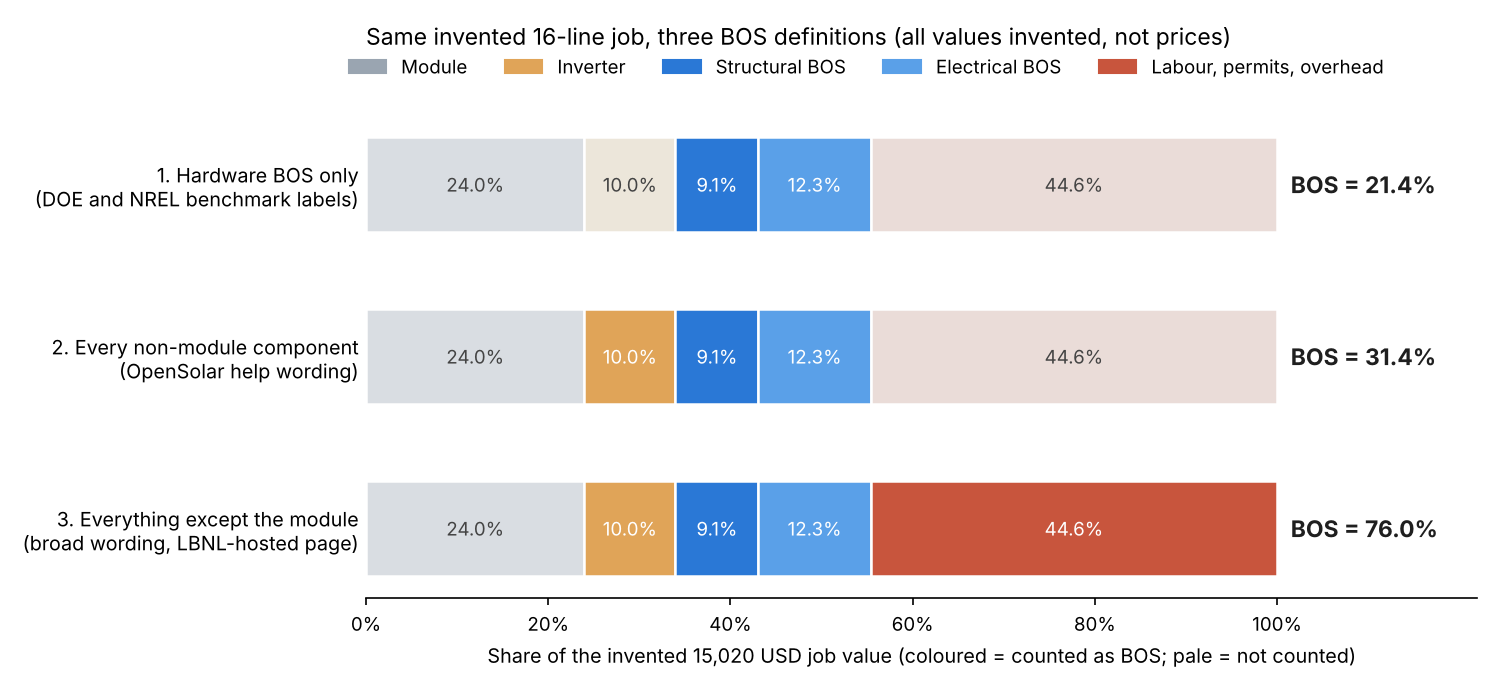
Figure 1. The same example 16-line job has a BOS share of 21.4%, 31.4% or 76.0%, depending only on which lines the definition counts.
Definition 1 follows the DOE and NREL labels. Definition 2 follows OpenSolar’s wording. It also follows the narrower use on the LBNL-hosted page ("inverters and hardware BOS", excluding direct labour and permitting). Definition 3 follows that page’s broad wording: "all components, equipment, structures, and services" necessary for a project, "beyond the PV modules themselves". On DOE’s split, hardware is 55.4% and soft is 44.6%. Move labour into hardware, as Aurora’s education page does, and hardware is 75.4%. Move the 380 USD monitoring line to the inverter and definition 1 drops to 18.9%. Definition 2 stays at 31.4%. Definitions 2 and 3 rest on OpenSolar’s help and an undated hosted page, not on DOE or NREL labels.
Balance of system share calculator
Type your own group totals. The first preset matches the tables above. It warns on blank, negative or out-of-range values. It holds no prices.
How solar software handles balance of system
Only OpenSolar’s help names BOS, and only for UK electrical components. Aurora’s education article names it as a cost category, which is not tool documentation. Ratings follow each company’s own page, checked October 2026. BOM export is rated on the BOM page.
| Software | Names BOS or groups parts by category? | Page read |
|---|---|---|
| OpenSolar | Yes | OpenSolar support, How to use BOS: Electrical Components (no date shown). How to add your hardware components, updated 15 April 2026 |
| Aurora Solar | Not stated | Aurora help, Adders and Discounts (no date shown). Aurora PV system costs article (no date shown) |
| Solargraf | Partly | Solargraf blog, published 11 September 2025 |
Not stated: the company page we cite does not say. Partly: only a company blog mentions it. What each page says:
- OpenSolar. A BOS page defines BOS as "all the components of a solar system excluding the solar panels". It lists wiring, AC and DC isolators, meters, DC optimizers, and cables and trunk lines. For string inverters it can add isolators and DC cabling on its own. UK only. It does not mention a BOM, pricing or proposals.
- Aurora Solar. The Adders and Discounts help page does not mention BOS. Aurora’s education article lists "Mounting and Balance of System" as one of four capital cost categories. That is not tool documentation.
- Solargraf. A company blog lists category among the fields a racking BOM should include. It does not mention BOS.
A missing mention on a page read does not show a tool lacks the feature. Ranked options are in best solar estimating software and best solar design and proposal software.
Common mistakes with balance of system
FAQs
Does balance of system include the inverter?
Not in the DOE and NREL labels, where the inverter is its own hardware item. OpenSolar’s help counts it, defining BOS as everything except the panels.
Is installation labour part of BOS?
Not in the DOE and NREL labels, where fieldwork is a soft cost. A broad wording that includes "services" would count it. Name the basis.
Is BOS the same as a BOM?
No. A BOM lists every part with a unit and quantity, modules included. BOS is a group you tag onto some of those lines, so one line can sit in different groups.
Where do monitoring and rapid shutdown devices go?
Wherever your written rule puts them, because sources differ. NLR’s (formerly NREL) tables are not consistent on monitoring. Its 2017 report counts rapid shutdown as an additional BOS cost.
Related terms
- Solar panel (module): the generating part that BOS surrounds.
- Inverter: the equipment sources count inside or outside BOS.
- Bill of materials: the parts list that BOS lines belong to.
- Procurement: buying the parts a BOS line covers.
- Inventory: stock of those parts.
- Job costing: tracking what a job costs against plan.
- Price per watt: a job price divided by system size.
Next step: to split BOS from soft costs on a quote, compare tools in the best solar estimating software list.
Sources
- US DOE. Solar Photovoltaic System Cost Benchmarks (2025Q1 data, page metadata modified 2 September 2026).
- NREL, now the National Laboratory of the Rockies. Benchmark reports are Q1 2015 (September 2015, archived copy), Q1 2017 (title page August 2017), Q1 2018 (November 2018), Q1 2023 (September 2023).
- Page hosted by LBNL. Descriptive Text of Value Chain Step (no date or publisher printed).
- Wood Mackenzie. Understanding U.S. Solar Pricing Methodology, 7 August 2025.
- Company pages (checked October 2026). OpenSolar How to use BOS: Electrical Components and How to add your hardware components (15 April 2026). Aurora Adders and Discounts and PV system costs. Solargraf racking BOM blog (11 September 2025).
- Quoted wording was re-checked at the DOE, OpenSolar BOS, Wood Mackenzie, LBNL-hosted, Aurora education and NREL Q1 2018 pages (checked 30 October 2026).
Last updated 30 October 2026. Next scheduled review: 30 January 2027.